Saint Nicephorus of Constantinople, 828
by VP
Posted on Friday March 13, 2026 at 03:00AM in Saints
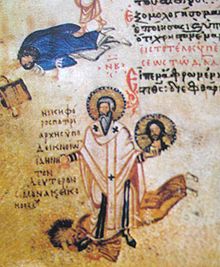
Nikephoros I of Constantinople trampling on John VII of Constantinople. Miniature from Chludov Psalter.
"Integrity of the Faith: There are not in the Christian faith any articles which it is permissible to accept or reject according to one's own good pleasure; all are equally holy and equally true. Faith teaches that it is good to hold in reverence the images of the saints; and this article of belief, apparently to little importance, has been upheld by martyrs.
Nicephorus,
elected patriarch of Constantinople in 806, despite his opposition,
furnished us with a striking example. The emperor Nicephorus, who had
been instrumental in bringing about this election, was not mistaken in
the estimate he had made of his former secretary. On the emperor Leo the
Armenian succeeding to Nicephorus, he renewed the persecution in the
matter of images, but found on the part of the patriarch an amount of
resistance as unbending as it was determined. Unable to conquer him, he
banished him to a monastery, where the saintly old man spent fourteen
years, accounting himself happy to suffer this long disgrace for the
sake of religion. He there died in 828, after having composed several
works in defense of the faith. The Greeks celebrate his festival on the
2nd of June, and the Latin Church on the 13th of March.
Moral Reflection:
How shall we venture to cavil at the Faith, when St. Paul himself
proclaimed that he had received the apostleship not for the control of,
but for obedience to the faith? (Rom. i. 5)" Pictorial Half Hours with the Saints by Abbe Auguste Lecanu
- "Second Council of Nicaea, the Seventh Ecumenical Council, in 787. Among the canons that were issued during this council:
“We define that the holy icons, whether in color, mosaic, or some other material, should be exhibited in the holy churches of God, on the sacred vessels and liturgical vestments, on the walls, furnishings, and in houses and along the roads, namely the icons of our Lord God and Savior Jesus Christ, that of our Lady the Theotokos, those of the venerable angels and those of all saintly people. The more frequently they are seen in representational art, the more are those who see them drawn to remember and long for those who serve as models, and to pay these images the tribute of salutation and respectful veneration (dulia). Certainly, this is not the full adoration [or real worship] (latria) in accordance with our faith, which is properly paid only to the divine nature… Further, people are drawn to honor these images with the offering of incense and lights, as was piously established by ancient custom. Indeed, the honor paid to the image is in effect transmitted to the prototype; he who venerates the image, venerates the person represented in that image.
“Therefore all those who dare to think or teach anything different, or who follow the accursed heretics in rejecting ecclesiastical traditions, or who devise innovations, or who spurn anything entrusted to the church (whether it be the Gospel or the figure of the cross or any example of representational art or any martyr’s holy relic), or who fabricate perverted and evil prejudices against cherishing any of the lawful traditions of the Catholic Church, or who secularize the sacred objects and saintly monasteries, we order that they be suspended if they are bishops or clerics, and excommunicated if they are monks or lay people.”
“What earlier generations held as
sacred, remains sacred and great for us too, and it cannot be all of a
sudden entirely forbidden or even considered harmful. It behooves all
of us to preserve the riches which have developed in the Church’s faith
and prayer, and to give them their proper place.” Pope Benedict XVI
Source: Ugly Churches and Modern Day Iconoclasm
A Litany of Saints Who Suffered for the Sake of Holy Images (for private use)
Lord, have mercy on us. Lord, have mercy on us.Christ, have mercy on us. Christ, have mercy on us.
Lord, have mercy on us. Lord, have mercy on us.
Christ, hear us. Christ, hear us.
Christ, graciously hear us. Christ, graciously hear us.
God the Father, invisible and uncircumscribed, have mercy on us.
God the Son, Image of the Father, made flesh for man, have mercy on us.
God the Holy Ghost, sent under the form of a dove and tongues of flame, have mercy on us.
Holy Trinity, one God, have mercy on us.
Holy Mary, pray for us.
Holy Mother of God, pray for us.
Holy Virgin of virgins, pray for us.
Ye forty-two holy monks of Ephesus, tortured under Constantine Copronymus, pray for us.
St. Lazarus, monk, tortured under Theophilus as a painter of sacred images, pray for us.
St. Tharasius, bishop, recipient of a letter from Pope Adrian I in defense of holy images, pray for us.
St. Euthymius of Sardis, bishop, exiled by Michael and martyred under Theophilus, pray for us.
St. Theophanes, monk, imprisoned, then exiled by Leo the Armenian for venerating images, pray for us.
St. Nicephorus, bishop, exiled to the island of Prokonesis for reverencing holy images, pray for us.
St. Paul of Constantinople, burnt to death under Constantine Copronymus, pray for us.
St. Nicetas of Apollonia, bishop, driven into exile, pray for us.
St. John Damascene, apologist of icons, whose cut-off hand was restored by the Mother of God, pray for us.
St. Macarius, who under the Emperor Leo ended his life in exile, pray for us.
St. Nicetas of Medikion, abbot, who suffered much under Leo the Armenian, pray for us.
St. Plato, monk, who strove dauntlessly against the heretical breakers of holy images, pray for us.
St. George of Antioch, bishop, who died in exile for the veneration of holy images, pray for us.
St. Anthusa, virgin, beaten with scourges for the veneration of holy images and exiled, pray for us.
St. Emilian, bishop, who suffered at the hands of the Emperor Leo and died in exile, pray for us.
SS. Julian, Marcian, and eight others, slain with the sword for venerating an image of the Saviour, pray for us.
St. George Limniota, whose hands were cut off and whose head was set on fire, pray for us.
SS. Hypatius and Andrew, who suffered flaying, burning, and the cutting of your throats, pray for us.
St. Theophilus, cruelly scourged and driven into exile by Leo the Isaurian, pray for us.
St. Andrew of Crete, monk, scourged by Constantine Copronymus who cut off thy foot, pray for us.
St. Theodore of Studium, zealous fighter for the Catholic veneration of holy images, pray for us.
St. Gregory Decapolites, who suffered much for the veneration of holy images, pray for us.
SS. Theodore & Theophanes, brothers, beaten and sent into exile twice for the honor due to icons, pray for us.
Lamb of God, who takest away the sins of the world, spare us, O Lord.
Lamb of God, who takest away the sins of the world, graciously hear us, O Lord.
Lamb of God, who takest away the sins of the world, have mercy on us.
V. There is no idol in Jacob, neither is there a simulacrum in Israel.
R. The Lord his God is with him, and the sound of the King’s victory is in him. (Num 23:21)
V. He is the image of the invisible God, the firstborn of every creature:
R. For in him were all things created in heaven and on earth, visible and invisible. (Col 1:15–16)
Let us pray. Almighty everlasting God, who dost not forbid us to carve or paint likenesses of Thy saints, in order that whenever we look at them with our bodily eyes we may call to mind their holy lives and resolve to follow in their footsteps: may it please Thee to bless us by images made in memory and honor of Thine only begotten Son, our Lord Jesus Christ, and to grant that all who in their presence pay devout homage to Thine only-begotten Son may by His merits and primacy obtain Thy grace in this life and everlasting glory in the life to come, through Christ our Lord. Amen.
Source: A Litany of Saints Who Suffered for the Sake of Holy Images
Day 24. Lent with the Cure d'Ars: The Evil Tongues
by VP
Posted on Friday March 13, 2026 at 03:00AM in Lenten Sermons
"There are some who, through envy, for that is what it amounts to, belittle and slander others, especially those in the same business or profession as their own, in order to draw business to themselves. They will say such evil things as "their merchandise is worthless" or "they cheat"; that they have nothing at home and that it would be impossible to give goods away at such a price; that there have been many complaints about these goods; that they will give no value or wear or whatever it is, or even that it is short weight, or not the right length, and so on.
A workman will say that another man is not a good worker, that he is always changing his job, that people are not satisfied with him, or that he does no work, that he only puts in his time, or perhaps that he does not know how to work. "What I was telling you there," they will then add, "it would be better to say nothing about it. He might lose by it, you know." "Is that so?" you answer." It would have been better if you yourself had said nothing. That would have been the thing to do."
A farmer will observe that his neighbor's property is doing better than his own. This makes him very angry so he will speak evil of him. There are others who slander their neighbors from motives of vengeance. If you do or say something to help someone, even through reasons of duty or of charity, they will then look for opportunities to decry you, to think up things which will harm you, in order to revenge themselves. If their neighbor is well spoken of, they will be very annoyed and will tell you: "He is just like everyone else. He has his own faults. He has done this, he has said that. You didn't know that? Ah, that is because you have never had anything to do with him."
A great many people slander others because of pride. They think that by depreciating others they will increase their own worth. They want to make the most of their own alleged good qualities. Everything they say and do will be good, and everything that others say and do will be wrong. But the great bulk of malicious talk is done by people who are simply irresponsible, who have an itch to chatter about others without feeling any need to discover whether what they are saying is true or false. They just have to talk. Yet, although these latter are less guilty than the others -- that is to say, than those who slander and backbite through hatred or envy or revenge -- yet they are not free from sin. Whatever the motive that prompts them, they should not sully the reputation of their neighbor. It is my belief that the sin of scandal-mongering includes all that is most evil and wicked.
Yes, my dear brethren, this sin includes the poison of all the vices -- the meanness of vanity, the venom of jealousy, the bitterness of anger, the malice of hatred, and the flightiness and irresponsibility so unworthy of a Christian.... Is it not, in fact, scandal-mongering which sows almost all discord and disunity, which breaks up friendships and hinders enemies from reconciling their quarrels, which disturbs the peace of homes, which turns brother against brother, husband against wife, daughter-in-law against mother-in-law and son-in-law against father-in-law? How many united households have been turned upside down by one evil tongue, so that their members could not bear to see or to speak to one another? And one malicious tongue, belonging to a neighbor, man or woman, can be the cause of all this misery....
Yes, my dear brethren, the evil tongue of one scandalmonger poisons all the virtues and engenders all the vices. It is from that malicious tongue that a stain is spread so many times through a whole family, a stain which passes from fathers to children, from one generation to the next, and which perhaps is never effaced.
The malicious tongue will follow the dead into the grave; it will disturb the remains of these unfortunates by making live again the faults which were buried with them in that resting place.
What a foul crime, my dear brethren! Would you not be filled with fiery indignation if you were to see some vindictive wretch rounding upon a corpse and tearing it into a thousand pieces? Such a sight would make you cry out in horror and compassion. And yet the crime of continuing to talk of the faults of the dead is much greater. A great many people habitually speak of someone who has died something after this fashion: "Ah, he did very well in his time! He was a seasoned drinker. He was as cute as a fox. He was no better than he should have been." But perhaps, my friend, you are mistaken, and although everything may have been exactly as you have said, perhaps he is already in Heaven, perhaps God has pardoned him. But, in the meantime, where is your charity?"
Source: The Sermons of the Curé of Ars, 1960 (Public Domain)
Prayer for Lent: O Lord who, for our sake, didst fast forty days and forty nights; give us grace to use such abstinence that, our flesh being subdued to the spirit, we may worthily lament and acknowledge our wretchedness, and may obtain perfect remission and forgiveness of Thee, the God of all mercy, who livest and reignest with the Father and Holy Ghost, one God, world without end. Amen
Source: Lent with the Cure d'Ars Compiled by the CAPG