Day 47. Easter with the Cure d'Ars: On Paradise
by VP
Posted on Sunday April 05, 2026 at 02:00AM in Lenten Sermons
"Blessed, O Lord, are those who dwell in Thy house: they shall praise Thee for ever and ever."
To dwell in the house of the good God, to enjoy the presence of the good God, to be happy with the happiness of the good God - oh, what happiness, my children! Who can understand all the joy and consolation with which the saints are inebriated in Paradise? St. Paul, who was taken up into the third heaven, tells us that there are things above which he cannot reveal to us, and which we cannot comprehend.... Indeed, my children, we can never form a true idea of Heaven till we shall be there. It is a hidden treasure, an abundance of secret sweetness, a plenitude of joy, which may be felt, but which our poor tongue cannot explain. What can we imagine greater? The good God Himself will be our recompense: Ego merces tua magna nimis - I am thy reward exceeding great. O God! the happiness Thou promisest us is such that the eyes of man cannot see it, his ears cannot hear it, nor his heart conceive it.
Yes, my children, the happiness of Heaven is incomprehensible; it is the last effort of the good God, who wishes to reward us. God, being admirable in all His works, will be so too when He recompenses the good Christians who have made all their happiness consist in the possession of Heaven. This possession contains all good, and excludes all evil; sin being far from Heaven, all the pains and miseries which are the consequences of sin are also banished from it. No more death! The good God will be in us the Principle of everlasting life. No more sickness, no more sadness, no more pains, no more grief. You who are afflicted, rejoice! Your fears and your weeping will not extend beyond the grave. . . . The good God will Himself wipe away your tears! Rejoice, O you whom the world persecutes! your sorrows will soon be over, and for a moment of tribulation, you will have in Heaven an immense weight of glory. Rejoice! for you possess all good things in one - the source of all good, the good God Himself.
Can anyone be unhappy when he is with the good God; when he is happy with the happiness of the good God, of the good God Himself; when he sees the good God as he sees himself? As St. Paul says, my children, we shall see God face to face, because then there will be no veil between Him and us. We shall possess Him without uneasiness, for we shall no longer fear to lose Him. We shall love Him with an uninterrupted and undivided love, because He alone will occupy our whole heart. We shall enjoy Him without weariness, because we shall discover in Him ever new perfections; and in proportion as we penetrate into that immense abyss of wisdom, of goodness, of mercy, of justice, of grandeur, and of holiness, we shall plunge ourselves in it with fresh eagerness. If an interior consolation, if a grace from the good God, gives us so much pleasure in this world that it diminishes our troubles, that it helps us to bear our crosses, that it gives to so many martyrs strength to suffer the most cruel torments - what will be the happiness of Heaven, where consolations and delights are given, not drop by drop, but by torrents!
Let us represent to ourselves, my children, an everlasting day always new, a day always serene, always calm; the most delicious, the most perfect society. What joy, what happiness, if we could possess on earth, only for a few minutes, the angels, the Blessed Virgin, Jesus Christi In Heaven we shall eternally see, not only the Blessed Virgin and Jesus Christ, we shall see the good God Himself! We shall see Him no longer through the darkness of faith, but in the light of day, in all His Majesty! What happiness thus to see the good God! The angels have contemplated Him since the beginning of the world, and they are not satiated; it would be the greatest misfortune to them to be deprived of Him for a single moment. The possession of Heaven, my children, can never weary us; we possess the good God, the Author of all perfections. See, the more we possess God, the more He pleases; the more we know Him, the more attractions and charms we find in the knowledge of Him. We shall always see Him and shall always desire to see Him; we shall always taste the pleasure there is in enjoying the good God, and we shall never be satiated with it. The blessed will be enveloped in the Divine Immensity, they will revel in delights and be all surrounded with them, and, as it were, inebriated. Such is the happiness which the good God destines for us.
We can all, my children, acquire this happiness. The good God wills the salvation of the whole world; He has merited Heaven for us by His death, and by the effusion of all His Blood. What a happiness to be able to say, "Jesus Christ died for me; He has opened Heaven for me; it is my inheritance. . . . Jesus has prepared a place for me; it only depends on me to go and occupy it. Vado vobis parare locum - I go to prepare a place for you. The good God has given us faith, and with this virtue we can attain to eternal life. For, though the good God wills the salvation of all men, He particularly wills that of the Christians who believe in Him: Qui credit, habeat vitam aeternam - He that believeth hath life everlasting. Let us, then, thank the good God, my children; let us rejoice - our names are written in Heaven, like those of the Apostles. Yes, they are written in the Book of Life: if we choose, they will be there forever, since we have the means of reaching Heaven.
The happiness of Heaven, my children, is easy to acquire; the good God has furnished us with so many means of doing it! See, there is not a single creature which does not furnish us with the means of attaining to the good God; if any of them become an obstacle, it is only by our abuse of them. The goods and the miseries of this life, even the chastisements made use of by the good God to punish our infidelities, serve to our salvation. The good God, as St. Paul says, makes all things turn to the good of His elect; even our very faults may be useful to us; even bad examples and temptations. Job was saved in the midst of an idolatrous people. All the saints have been tempted. If these things are, in the hands of God, an assistance in reaching Heaven, what will happen if we have recourse to the Sacraments, to that never-failing source of all good, to that fountain of grace supplied by the good God Himself! It was easy for the disciples of Jesus to be saved, having the Divine Savior constantly with them. Is it more difficult for us to secure our salvation, having Him constantly with us? They were happy in obtaining whatever they wished for, whatever they chose; are we less so?We possess Jesus Christ in the Eucharist; He is continually with us, He is ready to grant us whatever we ask, He is waiting for us; we have only to ask. O my children! the poor know how to express their wants to the rich; we have only our indifference, then, to accuse, if assistance and graces are wanting to us. If an ambitious or a covetous man had as ample means of enriching himself, would he hesitate a moment, would he let so favorable an opportunity escape? Alas! we do everything for this world, and nothing for the other? What labor, what trouble, what cares, what sorrows, in order to gather up a little fortune! See, my children, of what use are our perishable goods? Solomon, the greatest, the richest, the most fortunate of kings, said, in the height of the most brilliant fortune: "I have seen all things that are done under the sun; and behold, all is vanity and vexation of spirit. " And these are the goods to acquire which we labor so much, whilst we never think of the goods of Heaven!
How shameful for us not to labor to acquire it, and to neglect so many means of reaching it! If the fig tree was cast into the fire for not having profited by the care that had been taken to render it fertile; if the unprofitable servant was reproved for having hidden the talent that he had received, what fate awaits us, who have so often abused the aids which might have taken us to Heaven? If we have abused the graces that the good God has given us, let us make haste to repair the past by great fidelity, and let us endeavor to acquire merits worthy of eternal life!"
Source: The Blessed Curé of Ars in His Catechetical Instructions (1951)
Surrexit Christus spes mea
by VP
Posted on Sunday April 05, 2026 at 12:00AM in Tradition
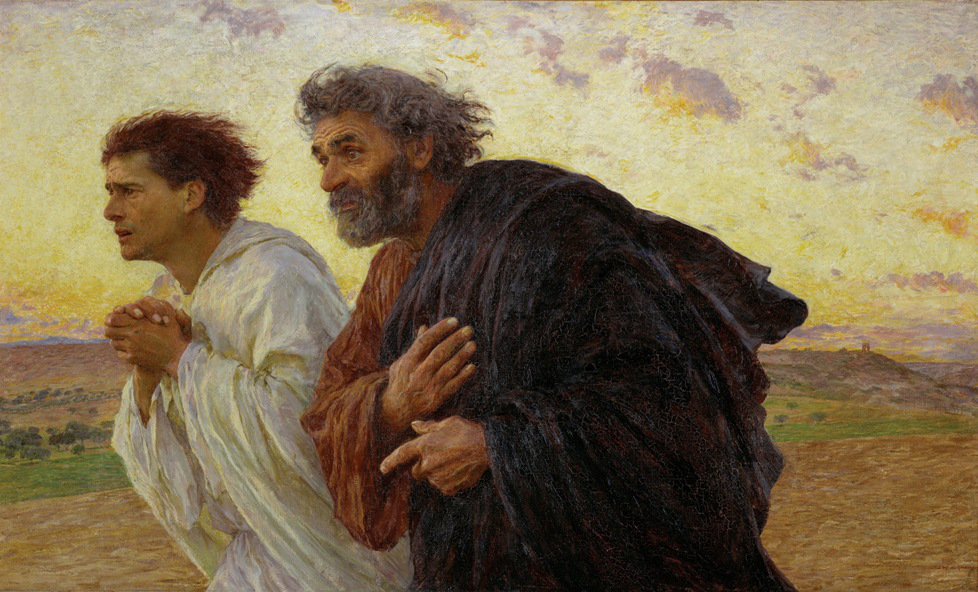
Peter and John Running to the Tomb Eugène Burnand (1850 – 1921)
Christians, to the Paschal victim
offer your thankful praises!
A lamb the sheep redeemeth:
Christ, who only is sinless,
reconcileth sinners to the Father.
Death and life have contended
in that combat stupendous:
the Prince of life, who died,
reigns immortal.
Speak, Mary, declaring
what you saw, wayfaring:
"The tomb of Christ, who is living,
the glory of Jesus' resurrection;
"Bright angels attesting,
the shroud and napkin resting.
"Yea, Christ my hope is arisen;
to Galilee he will go before you."
Christ indeed from death is risen,
our new life obtaining;
have mercy, victor King, ever reigning!
Amen! Alleluia!
St. Vincent Ferrer, O.P. Confessor, A.D. 1419.
by VP
Posted on Sunday April 05, 2026 at 12:00AM in Saints

"St. Vincent brought with him into the world a happy disposition for learning and piety, which were improved by a good education. In order to subdue his passions, he fasted from his childhood every Wednesday and Friday. The Passion of Christ was always the object of his tender devotion. The Blessed Virgin he ever honoured as his spiritual Mother. Looking on the poor as the members of Christ, he treated them with the greatest affection and charity. Having taken the habit of the Dominicans, he made surprising progress in perfection, taking St. Dominic for his model. The arms which he employed against the devil were prayer, penance, and perpetual watchfulness over every impulse of his passions. His heart was always fixed on God, and he made his studies, labour, and all other actions a continued prayer. He led a very mortified life, never eating flesh, nor wearing linen. His whole employment was in preaching the gospel, in converting Jews and Infidels to the Christian faith, and sinners to a holy life. He never passed a day wherein he gave not instructions to those who were assembled at prayers with him. Though by his sermons thousands were moved to give their possessions to the poor, the saint never accepted any thing himself; and was no less scrupulous in cultivating in his heart the virtue and spirit of obedience, than that of poverty; for which reason he declined accepting any dignity in the Church, or superiority in his Order. He was favoured with the gift of miracles, and cured innumerable sick wherever he came, also raised a dead man to life, in presence of a great multitude. He continued his preaching and labours to the last; and worn out with age and infirmity, died on the 5th of April, 1419, being sixty-two years old.
Reflection: "Whatever you do," said Saint Vincent, "think not of yourself, but of God." In this spirit, he preached, and God spoke by him; in this spirit, if we listen, we shall hear the voice of God. Source: Little Pictorial Lives of the Saints, 1925
O glorious Apostle and Wonderworker, Saint Vincent Ferrer, new Angel of the Apocalypse and our gracious Protector, deign to accept our humble prayer, and draw down upon us an abundance of divine favors. Through the love with which your heart is inflamed, obtain for us from the Father of Mercies the forgiveness of all our sins, steadfastness in faith, and perseverance in good works, so that, living as good and fervent Christians, we may render ourselves worthy of your powerful protection.
Extend this protection, too, over our bodies, and deliver us from every infirmity. Preserve our fields from the ravages of storm and hail, and ward off other misfortunes from us. Thus favored by you in the blessings of both spirit and body, we shall remain ever devoted to you, and one day we shall go to heaven to praise God with you, for ever and ever. Amen.
Translated from the French: Prière à Saint Vincent Ferrier. Manuel des indulgences, Paris 1897
Let us pray: O God, who by the wonderful preaching of blessed Vincent, thy confessor, hast brought a multitude of nations to acknowledge thy Holy Name, grant, we beseech thee, that we may merit to receive as our reward in heaven the judge whom he announced would come on earth, through Christ our Lord. Amen.
Easter Sunday: The Joy of Penance
by VP
Posted on Sunday April 05, 2026 at 12:00AM in Sunday Sermons

Touch me not by Jacques Tissot
"I WISH all of you, my brethren, the joys of this day. It is the day of our Lord's victory over death and hell. Many of you have received Him in Holy Communion either this morning or during the preceding week. To such He has found a way to communicate something of the vast ocean of love and joy which inundates His own soul. A good Communion, following a humble confession of sin, is indeed the nearest way to that tomb, riven and empty, and streaming with the light of heavenly joy, about which the Church gathers her children this morning. How well chosen is Eastertime for the annual Communion of all good Christians. "I have seen the tomb of Christ, who has risen from the dead," may we well say with Mary Magdalen. God grant that not one of you all may pass beyond Trinity Sunday without attending to what is so appropriately called the Easter duty.
It seems to me that this feast is a great day for sinners - meaning, of course, repentant sinners. For look at the facts? Who is the saint of the Resurrection by excellence? Certainly dear Mary Magdalen, the type of all the penitent. She stood beneath the Cross when Jesus died, comforting Him and His Mother in that dreadful hour of His doom and of that Mother's woe. And when the dead corpse was lowered down, Mary Magdalen pressed His limbs and feet and hands to her bosom while our sorrowful Mother clasped His heart to her own and kissed His pallid face a thousand times. Mary Magdalen helped to lay Him in His grave. She watched then; when driven away by the soldiers she bought spices and came again to embalm Him. And whose words are those repeated to-day all round the world as the dawn greets the watching glances of the faithful. "They have taken away my Lord! I know not where they have laid Him"; and again the amazed and ecstatic exclamation when she saw Him in the garden: "Rabboni! Master."
What a great store of love, says St. Gregory the Great, was in that woman's heart, who, when even His disciples were gone away, could not tear herself from the grave of the Lord!
See, then, my brethren, the reward of the love which is in true sorrow for sin; it is given a singular kind of pre-eminence; it is selected above that of innocence and placed on guard at the post of honor to receive the first public greeting from the Immortal King of Glory, triumphant over sin for ever. I say public greeting, for doubtless Jesus visited and greeted His Mother in private first of all; but this is not written down for our edification, and Mary Magdalen's privilege is. Sinners need encouragement, and certainly they get it today in the honor paid to their glorious patron, to the woman who had many sins forgiven her because she loved much.
I say again that sinners need encouragement. In truth, there is no shame so deadly as that which conscious guilt brings to the human soul. There is no degradation like vice - in fact, there is none other but vice. Hence many sinners are met with who do not turn to God and who hold back from confession and communion because they are ashamed and afraid. It is not so much love of sin as want of confidence that now hinders them. They have felt the force of passion as the slave feels the whip of the slave-driver; or they have repented before and fallen again, and this fills them with distrust in themselves; or their surroundings are a constant source of temptation; or they have been so long away that the very process of reconciliation to God, the very practice of the simplest acts of religion, have grown strange to them. These, and other reasons, varying from mere timidity to utter despair, show the need of a strong word of encouragement to sinners. This is the day for giving sinners courage to repent. Oh! let every man and woman partake of Christ's courage today. All who are sinners, let them loath and detest their sins, and let them feel that if our Lord is with them they can conquer any passion, resist any temptation, and persevere to the end.
It is a singular thing that not only the first recorded words of our Lord after His resurrection were addressed to His favorite child, the great penitent woman of the Gospel, but that the first interview He had with His disciples was begun by the institution of the Sacrament of Penance, the open door of that city of refuge our Lord's Sacred Heart. Now is the time, therefore, most appropriate for the return to God of all sinners among us. May our risen Savior give you that joy if you have it not, and if you have it, may He confirm it to you for ever! Amen." Five minutes sermons by the Paulist Fathers
Day 46. Lent with the Cure d'Ars: Do you want to be happy?
by VP
Posted on Saturday April 04, 2026 at 02:00AM in Lenten Sermons
"Why, my dear brethren, are our lives full of so many miseries? If we consider the life of man carefully, it is nothing other than a succession of evils: the illnesses, the disappointments, the persecutions, and indeed the losses of goods fall unceasingly upon us so that whatever side the worldly man turns to or examines, he finds only crosses and afflictions. Go and ask anyone, from the humblest to the greatest, and they will all tell you the same thing. Indeed, my dear brethren, man on earth, unless he turns to the side of God, cannot be other than unhappy. Do you know why my friends? No, you tell me. Well, here is the real reason. It is that God, having put us into this world as into a place of exile and of banishment, wishes to force us, by so many evils, not to attach our hearts to it but to aspire to greater, purer, and more lasting joys than those we can find in this life. To make us appreciate more keenly the necessity to turn our eyes to eternal blessings, God has filled our hearts with desires so vast and so magnificent that nothing in creation is capable of satisfying them. Thus it is that in the hope of finding some pleasure, we attach ourselves to created objects and that we have no sooner possessed and sampled that which we have so ardently desired than we turn to something else, hoping to find what we wanted. We are, then, through our own experience, constrained to admit that it is but useless for us to want to derive our happiness here below from transient things.
If we hope to have any consolation in this world, it will only be by despising the things which are passing and which have no lasting value and in striving towards the noble and happy end for which God has created us.
Do you want to be happy, my friends? Fix your eyes on Heaven; it is there that your hearts will find that which will satisfy them completely. All the evils which you experience are the real means of leading you there. That is what I am going to show you, in as clear and brilliant way as shines the noon-day sun.
First of all, I am going to tell you that Jesus Christ, by His sufferings and His death, has made all our actions meritorious, so that for the good Christian there is no motion of our hearts or of our bodies which will not be rewarded if we perform them for Him. Perhaps you are already thinking: "That is not so very clear." Very well! If that will not do you, let us put it more simply. Follow me for a moment and you will know the way in which to make all your actions meritorious for eternal life without changing anything in your way of behaving. All you have to do is to have in view the object of pleasing God in everything you do, and I will add that instead of making your actions more difficult by doing them for God, you will make them, on the contrary, much more pleasant and less arduous. In the morning, when you awake, think at once of God and quickly make the Sign of the Cross, saying to Him: "My God, I give you my heart, and since You are so good as to give me another day, give me the grace that everything I do will be for Your honor and for the salvation of my soul."
Source: The Sermons of the Cure d'Ars 1960 (Public Domain)
Prayer for Lent: O Lord who, for our sake, didst fast forty days and forty nights; give us grace to use such abstinence that, our flesh being subdued to the spirit, we may worthily lament and acknowledge our wretchedness, and may obtain perfect remission and forgiveness of Thee, the God of all mercy, who livest and reignest with the Father and Holy Ghost, one God, world without end. Amen
Source: Lent with the Cure d'Ars Compiled by the CAPGSt. Isidore, Bishop, Doctor of the Church, A.D. 606
by VP
Posted on Saturday April 04, 2026 at 12:00AM in Saints

"He was born in Spain, and having qualified himself by virtue and learning for the service of the Church, assisted his brother St. Leander, archbishop of Seville, in the conversion of the Visigoths, from the Arian heresy. After the death of his brother, he was, much against his will, chosen to succeed him His election was confirmed by St. Gregory the Great, who also appointed him his Apostolic Vicar over the whole of Spain.
In his episcopal career it is incredible how constant, humble, and patient he was; as well as solicitous for keeping up Christian and ecclesiastical discipline. Indeed he was eminent in all virtue; and distinguished also for great learning, and a general acquaintance with ancient writers, both sacred and profane. He was a great promoter and encourager of monastic institutions throughout Spain; and built several monasteries and colleges. He compiled many useful works, in which he takes in the whole circle of the sciences; and many portions of his writings were embodied in the canon law of the Church.
When St. Isidore was almost fourscore years old, though age and fatigues had undermined and broken his health, he never interrupted his usual exercises and labours. During the last six months of his life, he increased his charities with such profusion, that the poor of the whole country crowded his house from morning till night. Perceiving his end to draw near, he entreated two bishops to come to see him. With them he went to the church, where one of them covered him with sackcloth, and the other put ashes on his head. Clothed with the habit of penance, he stretched his hands towards heaven, prayed with great earnestness, and begged aloud the pardon of his sins. He then received from the hands of the bishops the Body and Blood of our Lord, recommended himself to the prayers of all that were present, remitted the bonds of all his debtors, exhorted the people to charity, and caused all the money which he had not as yet disposed of to be distributed among the poor. This done, he returned to his own house, and calmly departed this life four days after, on the 4th of April, in the year 636.
His memory was held in
such veneration, that the eighth Council of Toledo, fourteen years after
his death, styles him "The excellent Doctor, the late ornament of the
Catholic Church, the most learned man, given to enlighten the latter
ages, always to be named with reverence." Give thanks to Almighty God,
for His wonderful graces to this His servant, and beg a like mercy on
all the present pastors of the Church. Pray likewise for yourself and
the whole flock, that God would render us a holy and acceptable people,
well-pleasing in his sight." The Catholic Year by Rev. Fr. John Gother
Holy Saturday: "He descended into hell, the third day he rose again from the dead.”
by VP
Posted on Saturday April 04, 2026 at 12:00AM in Tradition

James Tissot - Holy Saturday
"The Savior of the world, having expired on the cross, and by His death paid the ransom due to the divine justice for the sins of men, descended into Limbo, to deliver thence those just souls who were waiting for their Redeemer, and were prepared to enter with Him into glory. Inexpressible was the joy of those holy souls at the presence of their Redeemer, who having conquered death and hell, came down in the happy character of a deliverer, and demanded them from their long confinement, to take part in his triumphs. It was the Messias whom they expected; and He being come, they think all the time of their banishment to have been as nothing, beginning now to enjoy Him, whom they had so long desired, and whom no time can ever more take from them. The same will be the happiness of every one that dies well. Whether the evils of life have been great or inconsiderable, long or short, they all disappear at the hour of a happy death, and are lost in eternity.
Our Blessed Redeemer was pleased to be taken down from the cross, and laid in a sepulchre, so to confirm to all generations the truth of His death for us, and of His resurrection from the dead. Pray that by a firm faith of what He has suffered for us, you may plentifully partake of His mercies, and daily increase in that hope and love, which are to bring you to the possession of Him. From His sacred body being laid in the sepulchre, you may learn the mystery which is taught you this day, that you also ought to be buried together with Him; that you are not only to labour that in the likeness of His death the old man may die in you, but that he may be buried also; so that he be altogether hidden from the world, and that nothing may appear in us but the new man, who is renewed in us by his death.
What happy fruit of Christ's passion would it be to us, could we obtain this mercy! We are convinced of the folly of sin, and the vanity of all that pleases for a moment; we are tired of our corruption; but who will deliver us from the body
of this death? None can do this but Jesus. Wherefore apply yourself to Him: sit at His sepulchre, and by His sacred passion beseech Him to have
compassion on you, to help you in the relief of your necessities, and give you the victory which you desire." The Catholic Year by Rev. Fr. John Gother
Day 45. Lent with the Cure d'Ars: Last Judgment
by VP
Posted on Friday April 03, 2026 at 02:00AM in Lenten Sermons
"Our catechism tells us, my children, that all men will undergo a particular judgment on the day of their death. No sooner shall we have breathed our last sigh than our soul, without leaving the place where it has expired, will be presented before the tribunal of God. Wherever we may die, God is there to exercise His justice. The good God, my children, has measured out our years, and of those years that He has resolved to leave us on this earth, He has marked out one which shall be our last; one day which we shall not see succeeded by other days; one hour after which there will be for us no more time. What distance is there between that moment and this - the space of an instant. Life, my children, is a smoke, a light vapour; it disappears more quickly than a bird that darts through the air, or a ship that sails on the sea, and leaves no trace of its course!
When shall we die? Alas! will it be in a year, in a month? Perhaps tomorrow, perhaps today! May not that happen to us which happens to so many others? It may be that at a moment when you are thinking of nothing but amusing yourself, you may be summoned to the judgment of God, like the impious Baltassar. What will then be the astonishment of that soul entering on its eternity? Surprised, bewildered, separated thenceforth from its relations and friends, and, as it were, surrounded with Divine light, it will find in its Creator no longer a merciful Father, but an inflexible Judge. Imagine to yourselves, my children, a soul at its departure from this life. It is going to appear before the tribunal of its Judge, alone with God; there is Heaven on one side, Hell on the other. What object presents itself before it? The picture of its whole life! All its thoughts, all its words, all its actions, are examined.
This examination will be terrible, my children, because nothing is hidden from God. His infinite wisdom knows our most inmost thoughts; it penetrates to the bottom of our hearts, and lays open their innermost folds. In vain sinners avoid the light of day that they may sin more freely; they spare themselves a little shame in the eyes of men, but it will be of no advantage to them at the day of judgment; God will make light the darkness under cover of which they thought to sin with impunity. The Holy Ghost, my children, says that we shall be examined on our words, our thoughts, our actions; we shall be examined even on the good we ought to have done, and have not done, on the sins of others of which we have been the cause. Alas! so many thoughts to which we abandon ourselves - to which the mind gives itself up; how many in one day! in a week! in a month! in a year! How many in the whole course of our life! Not one of this infinite number will escape the knowledge of our Judge.
The proud man must give an account of all his thoughts of presumption, of vanity, of ambition; the impure of all his evil thoughts, and of the criminal desires with which he has fed his imagination. Those young people who are incessantly occupied with their dress, who are seeking to please, to distinguish themselves, to attract attention and praise, and who dare not make themselves known in the tribunal of Penance, will they be able still to hide themselves at the day of the judgment of God? No, no! They will appear there such as they have been during their life, before Him who makes known all that is most secret in the heart of man.
We shall give an account, my children, of our oaths, of our imprecations, of our curses. God hears our slanders, our calumnies, our free conversations, our worldly and licentious songs; He hears also the discourse of the impious. This is not all, my children; God will also examine our actions. He will bring to light all our unfaithfulness in His service, our forgetfulness of His Commandments, our transgression of His law, the profanation of His churches, the attachment to the world, the ill-regulated love of pleasure and of the perishable goods of earth. All, my children, will be unveiled; those thefts, that injustice, that usury, that intemperance, that anger, those disputes, that tyranny, that revenge, those criminal liberties, those abominations that cannot be named without blushes...."
Source: The Sermons of the Cure d'Ars 1960 (Public Domain)
Prayer for Lent: O Lord who, for our sake, didst fast forty days and forty nights; give us grace to use such abstinence that, our flesh being subdued to the spirit, we may worthily lament and acknowledge our wretchedness, and may obtain perfect remission and forgiveness of Thee, the God of all mercy, who livest and reignest with the Father and Holy Ghost, one God, world without end. Amen
Source: Lent with the Cure d'Ars Compiled by the CAPGSt. Richard, Bishop of Chichester, A.D. 1253.
by VP
Posted on Friday April 03, 2026 at 12:00AM in Saints

"The saint's devotion to the Holy Eucharist is shown by his minute and careful legislation regarding all things connected with the service of the altar. Everything surrounding it, and especially the linen used for Mass, must be of spotless cleanliness, and no priest may say Mass in torn or dirty vestments. The chalices must be of gold or silver, and a crucifix must always be placed before the celebrant. When the Holy Viaticum is carried to the sick it must be taken with the utmost reverence, the priest in surplice and stole, accompanied by cross, lights, and holy water, and preceded by an acolyte with a bell to let the people know that their Lord is passing.
Only those who have
passed a sufficient examination are to be admitted to the ranks of the
clergy, and no one is to be ordained to sacred orders if he come with
any other design than to serve God alone; ordination, therefore, should
be refused to anyone for money, favor, or privilege, and all those in
the least tainted with heresy or suspected of leading unholy lives must
be rigorously excluded from the priesthood. (...) Finally,
the clergy are reminded of the duty of instructing their flocks in the
truths of the Faith, and they must teach them simple prayers according
to their ability to learn. Source: Richard of Wyche, labourer, Scholar, Bishop, and Saint. by Sister Mary Reginald OP 1913
"St. Richard was born in Worcestershire. From his childhood, he had a great aversion to dances, shows, and gay amusements; and applied diligently to virtue and learning. Quitting all worldly prospects, he studied first at Oxford, then at Paris, where, with two companions, he lived in great poverty, contenting himself with coarse bread, and drinking only water, which nevertheless he used to say was the most pleasant time of his whole life.
He afterwards went to Bologna, to study canon law; and having taught there a short time, he returned to Oxford, and was chosen chancellor of that university. He was afterwards appointed chancellor to St. Edmund, archbishop of Canterbury; in which charge he was faithful, just, affable, modest, and sincere. He kept close to his holy prelate in all his tribulations, and accompanied him in his exile. Being ordained priest, he returned to England; and not long after was chosen bishop of Chichester. The king, Henry III., opposed his nomination, but Pope Innocent IV. ratified his election, and consecrated him with his own hands at Rome.
The saint returned to England, but found all the revenues of his bishopric seized by the king's officers. He went therefore to his diocese poor and penniless, and suffered great hardships for two years, when his revenues were restored to him, though much impaired. Seated now in his episcopal chair, St. Richard shone forth more illustrious then ever in all virtues. He was fervent in prayer, night and day, liberal in alms-deeds, and rigorous in the chastisement of his body. In visiting his diocese, he always made diligent inquiry after the sick and poor; and not only relieved them, but visited them in person, to comfort them with pious exhortations. God was pleased by miracles to testify his approbation of these great charities; especially when one loaf blessed by the saint, was so wonderfully multiplied, as to satisfy three thousand poor. He suffered at one time a great loss by fire; but with a pleasant countenance he only said: "Perhaps God has punished us, because we were not liberal enough in our alms; and therefore see that we give more bountifully for the time to come."
Whilst he was employed in preaching a crusade for the recovery of the Holy Land, he fell sick; and prepared for his last end, by receiving the Sacraments, and making a general confession of his whole life. He died at Dover on the 3rd of April, 1253, in the fifty-sixth year of his age. Pray for the pastors of the Church, and in particular of this nation, that they may be every way fitted for their charge. Pray for the people also, that peace and charity may reign among them, that they may be united in one faith, and live according to the Gospel." The Catholic Year by Rev. Fr. John GotherPrayer to Saint Richard of Chichester
Most merciful Redeemer,
who gavest to thy Bishop Richard a love of learning,
a zeal for souls, and a devotion to the poor:
grant that, encouraged by his example,
and aided by his prayers,
we may know thee more clearly,
love thee more dearly,
and follow thee more nearly,
day by day;
who livest and reignest with the Father
in the unity of the Holy Spirit, ever one God,
world without end. Amen.
Gratias tibi ego, Domine Jesu Christe, de omnibus beneficiis, quae mihi praestitisti; pro poenis & opprobiis, quae pro me pertulisti; propter quae plactus ille lamentablis vere tibim competebat. Non est dolor sicut dolor meus.
God Surrenders to Man
by VP
Posted on Friday April 03, 2026 at 12:00AM in Poetry
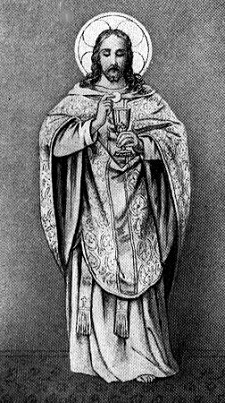
"There is a passage in the Following of Christ, II., 11, in which a Kempis insists that nothing we can offer to God is acceptable unless we offer ourselves. "If a man give his whole substance, it is nothing. If he do great penance, it is but little. If he attain to all knowledge, he is far off still. If he have great virtue and very fervent devotion, there is still much wanting to him, the one thing which is supremely necessary to him." What is the one thing necessary? "that having given all things else to God he give himself."
Now, man, recognizing the demand of God that we surrender ourselves to Him, boldly retaliates with a demand that God surrender Himself to us. Man says to God, " Thou mayest multiply Thy favors; Thou mayest overwhelm me with gifts, but though Thy gifts, temporal and spiritual, be piled in mountains before me, my heart remains unsatisfied, my soul is discontent. I want not Thy gifts, I want Thee. Pardon, my God, if I speak boldly, I speak as Thou hast made me. Thou hast made me man, but Thou hast given me the cravings of a god. Thou mayest empty Thy treasure-house before my feet. Still I demand more, that Thou give me Thyself. Thou hast made me for Thyself. My heart remains empty until it be filled with Thee."
The answer is the Incarnation and the Blessed Sacrament."
Source: A Thought a Day for Lent, Rev. James M Gilles, C.P.; Paulist Press, 1923.
