The Fruits of the Mass
by VP
Posted on Wednesday April 01, 2026 at 11:02PM in Articles
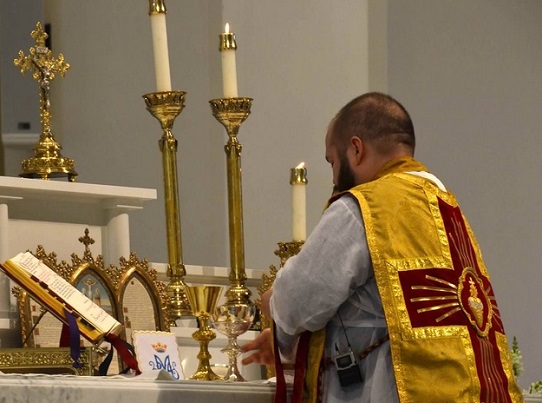
By Msgr. George W. Shea , S.T.D.
"The Mass has a fourfold purpose, and therefore a fourfold efficacy. It is offered, first and foremost, to adore God, whence it is called the "Sacrifice of Praise ". Secondly, it is offered to thank God for His great glory and for the benefits He has showered upon us, whence the Mass is called the "Eucharistic Sacrifice," that is the “Sacrifice of Thanksgiving ". Thirdly, it is offered to implore new benefits, notably grace, whence it is called an "lmpetratory Sacrifice ". Finally, it is a "Propitiatory Sacrifice", because it is offered to move the divine mercy to the pardon of sins.
Of these various effects of the Mass, the two which derive to men (the impetratory and the propitiatory) are usually termed the "fruits" of the Mass. Whereas the effects of the Mass insofar as it is a Sacrifice of Praise and of Thanksgiving are infinite, the “fruits" of the Mass are limited. The measure in which they are bestowed depends especially on the dispositions of those to whom they are given.
To whom are they given? To some degree or other the fruits of the Mass are bestowed upon the celebrant, upon those who serve or assist at the Holy Sacrifice, upon the person or persons for whom it is offered, upon all living, especially the members of the Church, and also upon the souls in Purgatory. The latter, however, are capable only of the propitiatory fruits of the Mass.
That the celebrant shares in the fruits of the Mass is readily understandable. No one more than he participates in the sacrifice. His active cooperation is necessary. He acts as the instrument of Christ, the High Priest, in virtue of the power received at Ordination. So he has a right to what is called the “most special fruit" of the Mass.
Sharing with him in this "most special fruit", but to a lesser degree, are the faithful who serve or assist at the Holy Sacrifice. The greater their devotion, the more plentiful are the graces God gives them through the Mass.
The person or persons for whom the priest celebrates the Mass in particular obtain what is termed the "special fruit" of the Mass. The priest may offer the Holy Sacrifice for any living person (although only privately for the excommunicated), and for the souls in Purgatory (although only privately for those to whom the Church has denied ecclesiastical burial). Since we have no way of knowing to what extent this special fruit is obtained by a soul in Purgatory for whom a particular Mass is offered, it is a pious practice to have the Holy Sacrifice celebrated repeatedly for the faithful departed.
Then, finally, there is the “general fruit" of the Mass. This comes to all the living, especially the members of the Church, and also to all the souls in Purgatory. At the Offertory of the Mass the celebrant prays that "the Sacrifice will be beneficial not only for himself and for all here present", but also for all faithful Christians, whether living or dead", not only for our own salvation," but also for that of the whole world ".
This is a most consoling thought because of our membership in the Church we share in a general way (but more intimately than those who are outside the Church) in the effects of every single Mass being offered up anywhere on earth Even when we are absorbed in our dally routine there accrue to us the beneficent effects of every Mass!
Source: The Catholic Advocate Vol 8 N17, 10 April 1959
The Mass and the Priest's Personal Sanctification
by VP
Posted on Saturday March 07, 2026 at 11:00PM in Articles
The Lord said also to Moses : Speak to the priests and say to them: They shall be holy to their God, for they offer the bread of their God, and therefore they shall be holy.—Lev. 21:6.
Was it Saint Philip Neri who thought a single Mass sufficient to make an ordinary being a saint? Certainly it was the same kindly but shrewd ascetic who declared that, if he had twelve good priests, he would convert the world. What, then, are the elements that enter into the fashioning of the ideally good priest? Personal holiness, of course, which consists in the union of the priest with the Master, his exemplar and personal friend and his High-Priest. And this intimate union can be suggested in no more fitting way than by the word "communion "-union with unio cum Christo. “I am the vine; you the branches." The nearer the tendril is to the main portion of the plant, the more sap it will receive, the greater and more luxuriant will be its growth. In proportion as the priest is near to Christ, the holier he will be. “I am the vine and my Father is the husbandman. Every branch in Me that beareth not fruit, He will take away: and everyone that beareth fruit, he will purge it, that it may bring forth more fruit. Abide in Me, and I in you. As the branch cannot bear fruit of itself, unless it abide in the vine, so neither can you, unless you abide in Me. He that abideth in Me, and I in him, the same beareth much fruit: for without Me you can do nothing".
What deed is it that unites us priests in so intimate a union with Christ whereby He abides with and in us, and we with and in Him? It is that deed which recalls the daring words of St. John Chrysostom, "nos sibi coagmentat," ? and which made St. Augustine say in the person of the Blessed Christ: “Nec tu me mutabis in te, sicut cibum carnis tuae, sed tu mutaberis in me." The union at Mass of the Christ and His priest is unique. At this Agape, the " vinculum amoris " -the Eucharistic bond of love—is forged in the "Burning Furnace of Charity.” In the immense depths of the Eucharistic "centre of all hearts," the " fountain of life and holiness,"
and the “abyss of all virtues” the priest's heart becomes submerged.
This union of the human soul and the Divine Personality may be viewed from different angles. There is the union of affection, the close bond of friend with friend. The Divine Friend assures His priests: "You are my friends . . . I have called you friends ... I have chosen you.” There is also the union or identity of purpose. In this unity, Christ shares with His priests the great desire to save souls. “Behold I come,". He says, and to His chosen ministers: “I have appointed you that you should go !” Again, there is the union or likeness between the model and its copy. The Divine Model admonishes those who would be like unto Him: "Be you therefore perfect, as also your heavenly Father is perfect." Moreover, there is also the union of the disciple and his Master. The servant delights to dwell near his lord. He anticipates the latter's wishes and avoids what is displeasing to him. “It is enough," says Christ," for the disciple, that he be as his Master, and the servant as his lord.” And finally, there exists that sacred relationship of the lover and his beloved which is aptly expressed by the singer of the Canticle of Canticles: “I to my beloved, and my beloved to me who feedeth among the lilies.” (C. 6: 2.)
Each of these various forms of union must solicit our admiration and stimulate our zeal. Nevertheless, in the hurry and bustle of this sadly distracting workaday world of ours, the heart of the ideally good priest can hardly fail to hunger after some simple formula, some clearly expressed symbol, some unique and outstanding fact, that may possibly assemble and coordinate these different kinds of union. Is there anywhere such a formula, such a symbol, such an outstanding fact? Fortunately there is. The one thing that assembles all these figurative, moral and spiritual ideas of union into one simply understood and clearly expressed symbol and fact of union, is, undoubtedly, the Sacrament of the Altar. There results from this coagmentation (to quote the thought of St. John Chrysostom again) a double gain. Not only does the priest become united with Christ, but he also becomes a symbol and fact of union between the real body of Christ and that mystical body which we call the Church. For it is the Mass that makes the priest the efficient fountain from which gush forth the waters of the Saviour unto all the thirsting children of men.
This is the ascetical theory of the priest's relation to Christ's real body on the one hand and to His mystical body on the other. And this ascetical theory, as theory we may call it, is a fact of Catholic doctrine. Is it any wonder that the Angel of the Schools, meditating the theory and practicing the fact, should have seen in this ineffable relationship those wondrous fruits to which he calls attention? The effects of the Holy Eucharist, says St. Thomas, are to give us a pledge of our future glory with God, to preserve the soul from sin, to purify it and free it from the punishment due to sin, to imbue us with a hatred for things earthly, to elevate the mind to God, to illumine the intellect, to give fervor to the affections, to refine the faculties of soul and body, to produce interior peace and holy joy. All these are the Eucharistic treasure trove of what Father Faber calls the “ Citadel of Divine Love”.
If such are truly the effects of supping at this Divine Table, we need not marvel at the words of St. Philip Neri : “Give me twelve good priests and I will convert the world”. There must assuredly be something wanting to us. Is it possible that to us may be applied the words of the Prophet Aggeus: “ You have eaten and are not filled, you have drunk and you are not inebriated ", since apparently we do not measure up to the standard of St. Philip's “good priests”? May it not be that we need to be reminded of St. Paul's admonition to St. Timothy: Renew thy first fervor.
If the preacher strongly conscious that his sermon may be the last, encourages himself to renewed efforts and speaks as a dying man to dying men, should not the priest with still greater reason stimulate his first fervor by a similar thought. This Holy Mass which he is about to celebrate may indeed be his last, for we know not the day nor the hour when the Son of Man cometh. The priest—that other Christ—truly offers a sacrifice of death for a dead world. If that world is to live again, it must be by the revivifying power of the Sacrifice of Calvary. And in this great recreative drama the priest must regard himself not so much as the minister of Christ, but as the Christ Himself of Calvary." Nearly every priest, even among those of venerable age, can probably recall with little effort the almost apocalyptical splendors that glorified his first Holy Mass. He would have been happy and satisfied if that first Mass had also been his last. This is no mere figure of speech. This is not fiction or fantasy. It has happened, ho ever, that the good God has prolonged his life and has granted him the priceless boon of many, many Masses during his priestly life. If, then, before each Mass or at his morning meditation he should recall the days that shortly preceded his ordination, surely his youth would be "renewed like the eagle's." “I thought," sang the Psalmist,“ upon the days of old: and I had in mind the eternal years. And I meditated in the night with my own heart: and I was exercised and I swept my spirit. . . And I said, Now have I begun: this is the change of the right hand of the most High. ... I will be mindful of Thy wonders from the beginning. And I will meditate on all Thy works." Thus the priest is moved to meditate: If this Mass which I am about to offer were my last Mass, as it may be, I should offer it as a dying man for dying men.” With what a glow of enthusiasm would he ascend the steps of the altar to offer the Clean Oblation for the living, the dying, and the dead. He is not only offering the Holy Sacrifice for himself, a dying man, but he also offers it for that dying world for which Christ died.
Of course we have to face the fact, which in some respects is a terrible one, that we are after all children of nature. As such we are subject inevitably to that otherwise kindly process of nature by which she gradually and insensibly converts into a kind of automatism those activities which at first we had to learn to perform with anxious care. Whatever we do repeatedly, nature more and more tries to make automatic. A habit we call it. And the proverb warns us that habit is a second nature. But call it what we will automatism, habit or routine-slowly but surely and alas, all unconsciously, we fall under the sway of our natural inclinations."
Meanwhile, children of nature though we be, we are by our very profession striving to lead, not a natural, but a supernatural life. Grace is battling with nature. To which side should our sympathies lean? Certainly of all men the priest must once for all range himself on the side of grace. Now it is a fortunate circumstance that the very powers of intellect, will, and passion, which nature subtly strives to gain to her side, can be marshalled against her. For after all the intellect can be aroused by meditation before Holy Mass, the will can be quickened to its fullest zeal by the contemplation of Christ's initial Sacrifice on Calvary, and the emotions can be warmed into a glowing fervor at the thought of that heavenly Bread which is to sustain the life of the priest's own soul and, through his ministration, the souls committed to his care.
Reverting to the effects of Holy Communion as indicated by St. Thomas, we of course know that these are partly due to the opus operatum but also very largely to the opus operantis." We cannot add to the former, but by the kind of meditation I have indicated, we can immeasurably increase the latter, and so at least approximate to the ideally good priest of whom St. Philip speaks.
While the Holy Mass combines for the priest the two aspects of sacrifice and communion, the completion of the whole divine drama consists in the assembling of the faithful to eat the Body of Christ. In this way, the Holy Sacrifice is a means and help to that heavenly feasting—the priest preparing for it by the sacrifice and then eating of the Bread and drinking of the Chalice at Communion time. Such was the thought of the sublime poet of the Blessed Sacrament when in his “Sacris Solemniis ” he sang: "Sic sacrificium istud instituit”.
Continuing this view we shall find that our meditation stimulates the intelligence, quickens the will, and enflames the emotions in a worthy preparation for the Holy Sacrifice and for this supreme drama itself as a further preparation for the climax to be attained in Holy Communion. Thus meditation, sacrifice and communion are but links in the chain of personal sanctification.
In all that has been so far said the writer has but endeavored to give expression to the thought crystallized in the ancient proverb: “Quidquid agas, prudenter agas et respice finem.” The end, which is the last thing to be attained, is the first thing to be conceived. The end, of course, must be our sanctification; "for this,” says St. Paul, “is the will of God: your sanctification." Respice finem! It will represent to our minds the one great purpose of our creation. It will also enable us "prudenter agere ", for the end is not only the first thought conceived in the mind, it is also the rudder which is to steer us to the destined port—it is the “ guide, philosopher, and friend” always at our side, whispering into our ear words of counsel, of warning, and of kindliest encouragement. Our ancient proverb is a pagan one, and we are reminded alas ! how much the children of this world are wiser in their generation than the children of light.
V. F. KIENBERGER, O.P. Washington, D. C.
The American Ecclesiastical Review, Volume 63
edited by Herman Joseph Heuser 1920, public domain
The Sufferings of Mary as Co-Redemptrix
by VP
Posted on Thursday February 19, 2026 at 11:00PM in Articles

"O Mother of pity and of mercy who, while thy sweetest Son was bringing about the Redemption of the human race on the altar of the Cross, didst stand next to Him, as a Co-redemptrix, suffering with Him...; preserve in us, we beseech thee, and increase day by day, the precious fruit of His Redemption and thy Compassion."
Pope Piux XI, April 28 1935
Source: Mary, Co-redemptrix by Rev. Juniper B. Carol, O.F.M. S.T.D.
The Sufferings of Mary as Co-Redemptrix
How Did Mary Make Satisfaction For us?
The purpose of satisfaction is to repair the offense offered to God and to make Him once more favorable to the sinner. The offense offered by mortal sin has about it a certain infinity, since offense is measured by the dignity of the person offended. Mortal sin, by turning the sinner away from God, his final end, denies in practice to God His infinite rights as the Supreme Good and destroys His reign in souls.
It follows from this that only the Incarnate Word could offer to the Father perfect and adequate satisfaction for the offense of mortal sin. For satisfaction to be perfect, it must proceed from a love and oblation which are as pleasing to God as, or more pleasing than, all sins united are displeasing to Him. But every act of charity elicited by Jesus had these qualities for His Divine Person gave them infinite satisfactory and meritorious value. A meritorious work becomes satisfactory (or one of reparation and expiation) when there is something painful about it. Hence, in offering His life in the midst of the greatest physical and moral sufferings, Jesus offered satisfaction of an infinite and superabundant value to His Father. He alone could make satisfaction in strict justice since the value of satisfaction like that of merit comes from the person, and the Person of Jesus, being divine, was of infinite dignity.
It was, however, possible to associate a satisfaction of becomingness (de congruo) to Jesus' satisfaction, just as a merit of becomingness was associated to His merit. In explaining this point, we shall show all the more clearly the depth and extent of Mary's sufferings.
Mary offered for us a satisfaction of becomingness (de convenientia) which was the greatest in value after that of her Son.
When a meritorious work is in some way painful it has value as satisfaction as well. Thus theologians commonly teach, following upon what has been explained in the previous section, that Mary satisfied for all sins de congruo in everything in which Jesus satisfied de condigno. Mary offered God a satisfaction which it was becoming that He should accept: Jesus satisfied for us in strict justice.
As Mother of the Redeemer, Mary was closely united to Jesus by perfect conformity of will, by humility, by poverty, by suffering— and most particularly by her compassion on Calvary. That is what is meant when it is said that she offered satisfaction along with Him. Her satisfaction derives its value from her dignity as Mother of God, from her great charity, from the fact that there was no fault in herself which needed to be expiated, and from the intensity of her sufferings.
The Fathers treat of this when they speak of Mary " standing " at the foot of the Cross, as St. John says (John xix, 25). They recall the words of Simeon, "Thy own soul a sword shall pierce " and they show that Mary suffered in proportion to her love for her crucified Son; in proportion also to the cruelty of His executioners, and the atrocity of the torments inflicted on Him Who was Innocence itself. The liturgy also has taught many generations of the faithful that Mary merited the title of Queen of Martyrs by her most painful martyrdom of heart. That is the lesson of the Feasts of the Compassion of the Blessed Virgin and of the Seven Dolors, as well as of the Stabat Mater.
Leo XIII summed up this doctrine in the statement that Mary was associated with Jesus in the painful work of the redemption of mankind. Pius X calls her " the repairer of the fallen world " and continues to show how she was united to the priesthood of her Son: " Not only because she consented to become the mother of the only Son of God so as to make sacrifice for the salvation of men possible, but also in the fact that she accepted the mission of protecting and nourishing the Lamb of sacrifice, and when the time came led Him to the altar of immolation— in this also must we find Mary's glory. Mary's community of life and sufferings with her Son was never broken off. To her as to Him may be applied the words of the prophet: My life is passed in dolor and my days in groaning. To conclude this list of Papal pronouncements we may refer to the words of Benedict XV: "In uniting herself to the Passion and Death of her Son she suffered almost unto death; as far as it depended on her, she immolated her Son, so that it can be said that with Him she redeemed the human race ".
The Depth and Fruitfulness of Mary's Sufferings as Co-Redemptrix
Mary's sufferings have the character of satisfaction from the fact that like Jesus and in union with Him, she suffered because of sin or of the offense it offers to God. This suffering of hers was measured by her love of God Whom sin offended, by her love of Jesus crucified for our sins, and by her love of us whom sin had brought to spiritual ruin. In other words, it was measured by her fullness of grace, which had never ceased to increase from the time of the Immaculate Conception. Already Mary had merited more by the easiest acts than the martyrs in their torments because of her greater love. What must have been the value of her sufferings at the foot of the Cross, granted the understanding she then had of the mystery of the Redemption !
In the spiritual light which then flooded her soul, Mary saw that all souls are called to sing the glory of God. Every soul is called, to be as it were a ray of the divinity, a spiritual ray of knowledge and love, for our minds are made to know God and our wills to love Him. But though the heavens tell God's glory unfailingly, thousands of souls turn from their Creator. Instead of that divine radiation, instead of God's exterior glory and His Kingdom, there are found in countless souls the three wounds called by St. John: the concupiscence of the flesh, the concupiscence of the eyes, and the pride of life: living as if there were no desirable love except carnal love, no glory except that of fame and honor, and no Lord and Master, no end, except man himself.
Mary saw all that evil, all those wounds in souls, just as we see the evils and wounds of bodies. Her fullness of grace had given her an immense capacity to suffer from the greatest of evils: sin. She suffered as much as she loved God and souls: God offended by sin and souls whom it rendered worthy of eternal damnation. Most of all did Mary see the crime of deicide prepared in hearts and brought to execution : she saw the terrible paroxysm of hatred of Him Who is the Light and the Author of salvation.
To understand her sufferings, we must think too of her love, both natural and supernatural, of her only Son Whom she not only loved but, in the literal sense of the term, adored since He was her God. She had conceived Him miraculously. She loved Him with the love of a virgin — the purest, richest and most tender charity that has ever been a mother's. Nor was her grief diminished by ignorance of anything that might make it more acute. She knew the reason for the crucifixion. She knew the hatred of the Jews, His chosen people — her people. She knew that it was all for sinners.
From the moment when Simeon foretold the Passion — already so clearly prophesied by Isaias — and her compassion, she offered and did not cease to offer Him Who would be Priest and Victim, and herself in union with Him. This painful oblation was renewed over years. Of old, an angel had descended to prevent Abraham's immolation of his son Isaac. But no angel came to prevent the immolation of Jesus.
In his sermon on the Compassion of Our Lady, we read the following magnificent words of Bossuet: " It is the will of the Eternal Father that Mary should not only be immolated with the Innocent Victim and nailed to the Cross by the nails that pierce Him, but should as well be associated with the mystery which is accomplished by His death . . . Three things occur in the sacrifice of Our Savior and constitute its perfection. There are the sufferings by which His humanity was crushed. There is His resignation to the will of His Father by which He humbly offered Himself. There is the fruitfulness by which He brings us to the life of grace by dying Himself. He suffers as a victim who must be bruised and destroyed. He submits as a priest who sacrifices freely; voluntarie sacrificabo tibi (Ps liii, 8). Finally He brings us to life by His sufferings as the Father of a new people . . . "Mary stands near the Cross. With what eyes she contemplates her Son all covered with blood, all covered with wounds, in form now hardly a man! The sight is enough to cause her death. If she draws near to that altar, it is to be immolated there: and there, in fact, does she feel Simeon's sword pierce her heart . . . " But did her dolors overcome her, did her grief cast her to the ground? Stabat juxta crucem: she stood by the Cross. The sword pierced her heart but did not take away her strength of soul: her constancy equals her affliction, and her face is the face of one no less resigned than afflicted. "What remains then but that Jesus Who sees her feel His sufferings and imitate His resignation should have given her a share in His fruitfulness. It is with that thought that He gave her John to be her son: Woman, behold thy son. Woman, who suffer with me, be fruitful with me, be the mother of my children whom I give you unreservedly in the person of this disciple; I give them life by my sufferings, and sharing in the bitterness that is mine your affliction will make you fruitful."
In the sermon, of which the paragraphs I have quoted are the opening, Bossuet develops the three main points outlined and shows that Mary's love for Jesus was enough to make her a martyr: " One Cross was enough for the well-beloved Son and the mother." She is nailed to the Cross by her love for Him. Without a special grace she would have died of her agony.
Mary gave birth to Jesus without pain: but she brings the faithful forth in the most cruel suffering. "At what price she has bought them! They have cost her her only Son. She can be mother of Christians only by giving her Son to death. O agonizing fruitfulness! It was the will of the Eternal Father that the adoptive sons should be born by the death of the True Son. What man would adopt at this price and give his son for the sake of strangers? But that is what the Eternal Father did. We have Jesus' word for it: God so loved the world as to give His only begotten Son (John iii, 16).
" (Mary) is the Eve of the New Testament and the mother of all the faithful; but that is to be at the price of her First-born. United to the Eternal Father she must offer His Son and hers to death. It is for that purpose that providence has brought her to the foot of the Cross. She is there to immolate her Son that men may have life . . . She becomes mother of Christians at the cost of an immeasurable grief ..." We should never forget what we have cost Mary. The thought will lead to true contrition for our sins. The regeneration of our souls has cost Jesus and Mary more than we can ever think.
We may conclude this section by noting that Mary the Co-Redemptrix has given us birth at the foot of the Cross by the greatest act of faith, hope and love that was possible to her on such an occasion. One may even say that her act of faith was the greatest ever elicited, since Jesus had not the virtue of faith but the beatific vision. In that dark hour when the faith of the apostles themselves seemed to waver, when Jesus seemed vanquished and his work annihilated, Mary did not cease for an instant to believe that her Son was the Savior of mankind and that in three days, He would rise again as He had foretold.
When He uttered His last words " It is consummated" Mary understood in the fullness of her faith that the work of salvation had been accomplished by His most painful immolation. The evening before Jesus had instituted the Eucharistic sacrifice and the christian priesthood; she sees now something of the influence the sacrifice of the Cross will exercise. She knows that Jesus is the true Lamb of God Who takes away the sin of the world, that He is the conqueror of sin and the demon, and that in three days He will conquer death, sin's consequence. She sees the hand of God where even the most believing see only darkness and desolation. Hers was the greatest act of faith ever elicited by a creature, a faith higher than that of the angels when they were as yet in their period of trial.
Calvary saw too her supreme act of hope at a moment when everything seemed lost. She grasped the force of the words spoken to the good thief: "This day thou Shalt be with me in paradise"; heaven, she realized, was about to be open for the elect.
It was finally her supreme act of charity : so to love God as to offer His only Son in the most painful agony: to love God above everything at the moment when He tried her in the highest and deepest of her loves, even in the object of her adoration — and that because of our sins.
It is true that the theological virtues grew in Mary up to the time of her death, for these acts of faith, hope and charity were not broken off but continued in her as a kind of state. They even expanded in the succeeding calm, like a river which becomes more powerful and majestic as it nears the ocean. The point which theology wishes to stress is not that of Mary's subsequent growth in the virtues but the equality between her sacrifice and her merits at the foot of the Cross itself: both her sacrifice and her merits were of inestimable value and their fruitfulness, while not approaching that of Christ's sacrifice and merits, surpasses anything the human tongue can utter. Theologians express this by saying that Mary made satisfaction for us de congruo, in proportion to her immense charity, while Jesus made satisfaction de condigno.
Even the saints who have been most closely associated with the sufferings of the Savior did not enter as Mary did into the most secret depths of the Passion. St. Catherine de Ricci had every Friday during twelve years an ecstasy of pain which lasted twenty-eight hours and during which she lived over again all the sufferings of the way of the Cross. But even such sufferings fell far short of those of Mary. Mary's heart suffered in sympathy with all the agony of the Sacred Heart to such a point that she would have died of the experience had she not been especially strengthened.
Thereby she became the consoler of the afflicted, for she had suffered more than all, and patroness of a happy death. We have no idea how fruitful these sufferings of hers have been during twenty centuries.
Mary's Participation as Co-Redemptrix in the Priesthood of Christ.
Though Mary may be termed Co-Redemptrix in the sense we have explained, there can be no question of calling her a priest in the strict sense of the word since she has not received the priestly character and cannot offer Holy Mass nor give sacramental absolutism. But, as we have seen already, her divine maternity is a greater dignity than the priesthood of the ordained priest in the sense that it is more to give Our Savior His human nature than to make His body present in the Blessed Eucharist. Mary has given us the Priest of the sacrifice of the Cross, the Principal Priest of the sacrifice of the Mass and the Victim offered on the altar.
It is more also, and more perfect, to offer her only Son and her God on the Cross as Mary did, by offering herself with Him in community of suffering, than to make the body of Our Lord present and to offer It on the altar as the priest does at Holy Mass.
We must affirm, too, as has recently a careful theologian who has devoted years to the study of these questions that "it is a certain theological conclusion that Mary co-operated in some way in the principal act of Jesus' priesthood, by giving, as the divine plan required, her consent to the sacrifice of the Cross as it was accomplished by the Savior. In another context he writes: "If we consider only certain immediate effects of the priest's action such as the Eucharistic consecration or the remission of sins in the sacrament of penance, it is true that the priest can do certain things which Mary, not having the priestly power, cannot. But to look at the matter so is not to compare dignities but merely particular effects which are produced by a power which Mary lacks and which do not necessarily indicate a higher dignity".
But even if Mary cannot, for the reasons given, be spoken of as priest in the strict sense of the term, it remains true, as M. Olier has said, that she has received the fullness of the spirit of the priesthood, which is the spirit of Christ the Redeemer. That is the reason why she is called Co-Redemptrix, a title which, like that of Mother of God, implies a higher dignity than that of the christian priesthood.
Mary's participation in the immolation and oblation of Jesus, Priest and Victim, cannot be better summed up than in the words of the Stabat Mater of the Franciscan Jacopone de Todi (1228-1306).
The Stabat Mater manifests in a singularly striking manner that supernatural contemplation of the mystery of Christ crucified is part of the normal way of holiness. In precise and ardent words it speaks of the wounding of the Savior's Heart and shows the intimate and persuasive manner in which Mary leads us to Him. Not only does Mary lead us to the divine intimacy, in a sense she produces it in us- that is what the repetition of the imperative " Fac " in the following strophes brings out:
Eia Mater, fons amoris,
Me sentire vim doloris
Fac, ut tecum lugeam.
O Thou Mother! Fount of Love!
Touch my spirit from above,
Make my heart with thine accord!
Fac ut ardeat cor meum
In amando Christum Deum,
Ut sibi complaceam.
Make me feel as thou hast felt;
Make my soul to glow and melt
With the love of Christ my Lord.
Fac ut portem Christi mortem,
Passionis fac corsortem
Et plagas recolere.
Let me, to my latest breath,
In my body bear the death
Of that dying Son of thine.
Fac me plagis vulnerari
Fac me cruce inebriari,
Et cruore Filii.
Wounded with His every wound,
Steep my soul till it hath swoon'd
In His very blood away.
— Fr. Caswall
This is the prayer of a soul which, under a special 'inspiration, wishes to know in a spiritual way the wound of love and to be associated in these painful mysteries of adoring reparation as were John and the holy women on Calvary — and Peter, too, when he shed his bitter tears. Those tears of adoration and sorrow are what the Stabat asks for in the following strophes:
Fac me tecum pie flere,
Crucifixo condolere,
Donee ego vixero.
Let me mingle tears with thee,
Mourning Him who mourn'd for me,
All the days that I may live.
Juxta crucem tecum stare,
Et me tibi sociare
In planctu desidero.
By the cross with thee to stay.
There with thee to weep and pray,
Is all I ask of thee to give.
— Fr. Caswall
Mary exercised therefore a universal mediation on earth by meriting de congruo all that Jesus merited de condigno and also by making similar satisfaction in union with Him.
Source: The Mother of the Savior and our interior Life by Garrigou Lagrange, O.P
Foster Vocation
by VP
Posted on Saturday January 31, 2026 at 11:00PM in Articles

"The priest should attract others to the priesthood by his own personality. He should strive to live a life so truly Christ-like that his character will be manifest as being beautifully and delightfully Catholic. The young love to see realized in themselves an ideal. Hence there is no doubt that the number of those entering the priesthood would be doubled, even trebled, if we who are now living the priestly life would endeavor scrupulously and continually to live before God and man as "other Christs." Then the young would be filled with respect, reverence, and love for the priest and his sacred office; and, drawn by personal attraction, they would feel a yearning desire to become like unto us."
Source: The Sunday-School Director's Guide to Success by Rev. Patrick James Sloan 1909
Home Altars and Private Chapels
by VP
Posted on Wednesday January 28, 2026 at 11:00PM in Articles
"How ironic it would be if the “Christian house church” — that
concept so dear to the antiquarianizing liturgical revolutionaries who
took it as a pretext for their streamlined modern prayer-service —
turned out to be the place where the Tridentine Mass in all its medieval
and Baroque density, albeit in temporarily humble circumstances,
survived the coming persecution of Catholics." New Liturgical Movement.
- Building Home Altar (New Liturgical Movement)
- Private Chapels brought to Light by Social Distancing (Liturgical Art Journal)
- Portable Altars in Malta (Liturgical Art Journal)
- The Domestic Church: The Catholic Home (The Fish Eater)
- A family realizes a longtime dream of a Home Chapel (Archdiocese of Saint Paul and Minneapolis)
Catholic Persecution and Private Chapels in America
"It was to gain religious liberty that the pioneer Catholics of the old world left their comfortable homes in Europe to brave the unknown hardships of the new Province upon the shores of Maryland; which freedom of conscience they granted to all comers as far as was in their power. But they themselves met with intolerance when English rulers later came into power and sought to enforce the then bigoted laws of Great Britain.
Colonel Bernard U. Campbell in his “Life and Times of Archbishop Carroll” tells us that as late as 1758 an attempt was made to pass a bill to prevent the growth of Popery, by which priests were to be rendered incapable of holding any lands and forbidden to make any proselytes under penalty for high treason; and which further provided that no person educated at foreign Popish seminaries should be qualified to hold land or inherit any estate within the new province.
This bill, which did not pass, seems to have been aimed particularly at John Carroll, who later became the first Catholic Bishop of the New World; Charles Carroll, signer of the Declaration of Independence; and Robert Brent, afterwards, first Mayor of Washington, who were all heirs to large estates in Maryland and at that time were boys being educated abroad at Catholic institutions.
Colonel Campbell further states that though this bill did not pass, the early Catholics were compelled to pay a land tax exactly double that exacted from others; that Catholic places of worship were forbidden and Catholic education not permitted; that Catholics were declared unfit to hold public office and that the Council even granted orders to take children away from the “pernicious contact of their Catholic parents.”
Nor did these days of intolerance pass until the Revolutionary period had broadened the minds of men and united all Americans in a more truly Christian spirit.
“In 1774 when the Reverend John Carroll returned to America, a priest, it is not believed,” says Colonel Campbell, “that there was a public. Catholic Church in all of Maryland.” “St. Peter's in Baltimore had been begun but never finished, being closed by the authorities.” And it was not until 1776 that the ban against public Catholic worship was removed.
It is not to be inferred from this, however, that Catholicity was crushed out, nor Catholic worship abolished. The well-to-do Catholics of that period had private chapels in their own homes upon their large estates and here the family and its many retainers, would gather for service whenever a faithful pastor came that way in the ministry of his duties. Of these early private chapels, in the vicinity of the present city of Washington are known to have been three: Queen's Chapel, a part of the large estate of Richard Queen, Esq., situated amid the wooded hills of Langdon; the Capitol Hill Chapel of Cern Abbey on the Duddington estate; and one in the manor house of Notley Young near the present corner of Tenth and G Streets S. W., where Father Devitt, Professor of History at Georgetown College says public Mass was first said in Washington, after it was permitted.
Father John Carroll finding this condition of catholicity in 1774 began his ministry from his own home near Rock Creek in the vicinity of Forest Glen. Here his zealous mother had maintained a small private chapel for her own family use and this was the nucleus of the present St. John's Church. After 1776, however, when the law against public Catholic worship was abolished, Father Carroll built an humble frame Church near his home, which was without doubt the first public Church in the vicinity of the District of Columbia. Father Carroll was ordained the first Catholic Bishop of the New World and was later made Archbishop. In 1789, Georgetown College was built with a small chapel attached, which in 1792 was superseded for public worship by Trinity Church, served by the same Jesuit Fathers."
Source: Records, Volume 23,Columbia Historical Society (Washington, D.C.)
Priestly Legacy
by VP
Posted on Saturday January 10, 2026 at 11:00PM in Articles
Archbishop Lynch of Toronto used to say: " The average priest secures the salvation of five thousand souls." The more thoroughly and minutely this statement is examined, the more manifest becomes its truthfulness. Hence the priest who secures but one successor to his sacred office has a perennial source of hope and consolation during his declining years, such as is particularly inspiring at the moment of death. But, why should any priest rest content with having secured one? The more the better. It is related of an aged and venerable priest of Orleans, France, that when about to die he gave expression to this beautiful thought: "I am eighty-three and shall soon die. I have not done all the good I would, but one thing consoles me - I leave after me thirty-three priests whom I have formed to the ecclesiastical state; they will do better than I have done."
Some years later, one of these thirty-three, on the occasion of his silver jubilee to the priesthood, had gathered around him twenty-five other priests, whose vocations to the religious state he in turn had fostered. To him his pastor had said on the day of ordination: "Always have pupils in your presbytery; you will be their angel, and they will be yours." (Quest on Vocations.) Would that God might inspire more to emulate the zeal of such priests as these.
Comparatively few dioceses can be found which are not in actual need of more religious workers who have consecrated their lives to the service of Christ. Pastors are petitioning the various religious communities for Sisters and Brothers to teach in the parish schools. Bishops, especially those of the West and South, as also of our newly acquired possessions in the Orient, are appealing for priests to take charge of missionary work. "Send us priests, wise zealous, holy priests," comes as a cry almost universal. Vast multitudes in every land are groping amid the darkness of error and in the shadows of death, seeking for some one to lead them forth into the light of truth and unto the life of Christ. This need is both instant and imperative, and unless there are found some followers of Christ, ardently devoted to His Church and nobly obedient to His call, who will voluntarily offer themselves for this service and consecrate their lives to this endeavor, these benighted ones, so unfortunate in their error, so well disposed for the right, so precious in the sight of God, will continue, in all probability, to search in vain for the way of salvation; and at least many of them, will be lost.
"The harvest indeed is great but the laborers are few." The work to be done is the work of Christ. He is present all days, directing an assisting and blessing. He calls for help. He chooses some favored ones from among His followers and commands them to go forth into the highways and byways and search our laborers and bring them into His vineyard. Some are found who leave this command practically unheeded, not from malice, but rather because they do not thoroughly realize how intense is the desire of Christ for additional laborers in His work and how dire is the need of the Church at the present time for their consecrated service. Thrice blessed, therefore, and well assured of eternal happiness is the priest who can truthfully say at the hour of death: "I shall soon die; I have not done all the good I would, but one thing consoles me - I leave after me others whom I have formed to the priestly life; they will do better than I have done. "
Source: The Sunday-School Director's Guide to Success by Rev. Patrick James Sloan 1909
External Worship
by VP
Posted on Wednesday December 31, 2025 at 11:00PM in Articles
"Man being such," Says the Council of Trent, "that, without the help of sensible signs, he can only with difficulty rise to the consideration of divine things, the Church, like a tender mother, has establish certain rites, has ordered that certain parts of the Mass should be said in a low and other in a loud voice. She has also instituted ceremonies: such are mysterious blessings, lights, incense, vestments, and many other things, in accordance with discipline and apostolic tradition. " The end of all this is to add to the majesty of the Adorable Sacrifice, and to lead the minds of the Faithful, by means of these visible signs of piety and religion, to the contemplation of the great mysteries hidden in Christianity.
On this point, the impious agree perfectly in their words and deeds with us. Religion reduced to pure spirituality, says one of them, is very soon banished to the regions of the moon. Another adds that dogmas disappeared with the external signs bearing witness to them. When, at the close of the last century, the disciples of these men, who could argue so well, were pleased to destroy religion among us, with what did they begin? With external worship. They first turned ceremonies into ridicule. They then pulled downs temples, crosses, and altars.
But in vain does man wage war against nature. These pitiless enemies of external worship had scarcely taken the reins of government into their own hands, when they felt all the necessity for public and solemn rites. In order to convert people to their ideas of morality, they hastened to practice what they had condemned, by calling to their aid external worship. They only changed its immortal object, and referred it altogether to human virtues, which are but pompous nonentities when separated from their Author.
They scoffed in their writings and in their lyceums at the worship of the Saints, and substituted for it the worship of heroes, after the manner of the pagans, who rendered the honors of apotheosis only to persons remarkable for extraordinary feats, most generally the ravagers of nations. They jeered at the piety of Catholics towards the precious remains of the just man, and they rendered honors almost divine to their own great men. In fine, is there a single part of Catholic worship that they did not employ to win favor and credit for their lessons with the multitude? Hymns, canticles, altars, the tables of the law, the ark of the constitution, candelabra, sacred fire, holidays, statues of liberty and equality, tutelary genii, and other emblems of the revolution: did they not offer us a collection of religious ceremonies as extensive as that of any other worship?"
Source: Catechism of perseverance, Msgr. Gaume
Immaculate Conception, Patron of the Raleigh Diocese
by VP
Posted on Sunday December 07, 2025 at 11:00PM in Articles
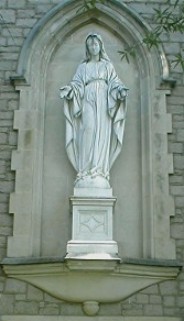
Our Lady of North Carolina, Memorial to Bishop Hafey First Bishop of the Diocese Sacred Heart Downtown Raleigh
Bishop Vincent Waters, December 8th 1945 (The Bulletin):
"On coming to the Diocese a little over five months ago, I discovered that the Diocese of Raleigh had no diocesan patron. After talking the matter over with the Right Reverend and Very Reverend Consultors, as well as with a number of the Diocesan clergy, I petitioned His Holiness Pope Pius XII to declare, by Apostolic Brief, Our Blessed Mother, under the title of her Immaculate Conception, as the patron of this diocese. I have just received a cablegram from Monsignor Alfonso Carinci, Secretary of the Sacred Congregation of Rites, advising that His Holiness has granted our request.
Although the eighth of December is a day for general rejoicing in America, since our country is dedicated to our heavenly Mother under this title there is an especial reason this year, and every year thereafter, for rejoicing on the eighth of December in the Diocese of Raleigh, for we have God’s own Mother under the title of her Immaculate Conception as our heavenly patron. In each church of the Diocese this day should be a day of general Communion of the faithful, especially of the children, and following the last Mass, or in the evening, Benediction of the Blessed Sacrament should be given, during which the enclosed Act of Consecration should be recited. I ask all to pray fervently to Our Heavenly Mother for the gift of faith for those outside the Church." --
The Immaculate Conception of the Blessed Virgin Mary.
This day is a festival of joy and thanksgiving to all those who have a due sense of the great blessing of their redemption. For whoever considers that long night of sin, which had covered the earth for four thousand years, must needs honour with joy that first moment of her sanctification, who was chosen from all eternity to be mother of Him, who was to be the light of the world, and to take off that malediction, which sin had brought upon it. All who consider this, must rejoice, when Mary, like the morning star begins to rise, and foretels the near approach of day. And this joy must be accompanied with most solemn thanksgiving, for those extraordinary favours by which she was distinguished from all that are born of women. These privileges, the effect of the divine bounty, demand our thanks; for though she was the subject of this grace, yet the mercy was to be extended to all.
But having paid this tribute of praise and thanksgiving, and seriously considered the eminent sanctity of the B. V. Mary, we are then to turn our eyes upon ourselves, and see whether we can discover there, a like subject of joy. For if so wonderful were the dispositions of the B. Virgin, to prepare her to be the Mother of Christ, some degrees of them there ought to be in us too; since, though in a different manner, it is a dignity, to which every Christian is called, for in every Christian, Christ is to be formed. Galat. iv. 19.
If we can find any suitable dispositions in us for this work of grace, we may with reason rejoice; but if none such appear, this solemnity of joy will be to us a day of confusion. Look then on the B. Virgin Mary, and see what these dispositions are. A most profound humility, a spirit raised up to God by love, and perfect conformity to His holy Will. By these her soul was fitted, and she was chosen amongst all women to have Christ formed in her, so to become the Mother of our Redeemer. Now, what can you say of yourselves? How near do you come to these necessary dispositions for having Christ formed in you?
What have you of humility? Are you fully persuaded of your origin being from nothing? That the being, which God has given you, is so frail, and you so little master of it, that you would in any moment return to the same nothing, if God's powerful hand did not support you. That your necessities are universal: that you are not able to do, say, or think any thing that is good: that by sin you are many degrees worse than nothing; and for your rebellion against God, deserve to be deprived of all grace and blessings, and to be abandoned to all misery. That as it is, your corruption and weakness are so general that you scarce perform one good action which has not a mixture of evil in it; so that whatever favourable thoughts you may frame of yourselves, you are truly, in the sight of God, wretched and miserable, and poor, and blind, and naked.
There are many steps in humility. Begin at the lowest; this will help to raise you, and give you hopes of coming to the top. As you advance here, so will the love of God, by proportioned degrees, increase in your soul; and so will you be still more and more conformed to the Divine Will. These are the dispositions for your rejoicing on this festival of joy. Thus you see how the dignity which you honour in the B. Virgin, may, in some manner, belong to you. Make some advances towards it; beseech God to be your help, and pray the B. Virgin to join her prayers with yours, that you may obtain of the divine bounty some degrees of that virtue which so much recommended her to God. For it will be but a barren festival to you, if you end the day with the same pride with which you began it." The Catholic Year; Or Daily Lessons on the Feasts of the Church by Rev Fr. John GOTHER
Our Lady of North Carolina:
Corpus Christi
by VP
Posted on Thursday June 19, 2025 at 12:00AM in Articles
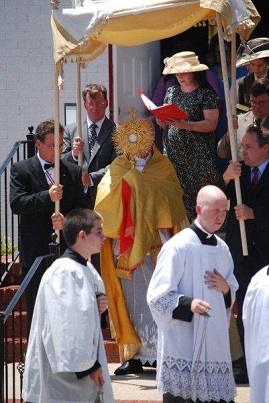
The Feast of Corpus Christi by Rev. John W. Sullivan
"The most splendid part of the office of Corpus Christi, that which most distinguishes it from other festivals, is the solemn procession. Unlike the procession for the Forty Hours, it has no penitential element; unlike that of Holy Hours, it has no shadow of the Cross. Today the Church gives full freedom to the transports of love which fill her heart for her divine Spouse, who resides with her in the Sacrament of love. Enthroned in the glittering Ostensorium, borne in the veiled hands of His servant beneath the silken canopy, accompanied by lighted tapers, hymned with canticles of joy and exaltation, adored and worshiped by the faithful, Jesus is borne along triumphantly with all the pomp and magnificence possible, borne among His loved ones to bless them and to receive the homage of their hearts. Does not His presence speak to the heart and ask its gratitude? Do not the flowers scattered along the way tell us of the beauty and brightness and abundance of His gifts and prompt us to a spirit of sacrifice? Do not the clouds of incense rising to the sky invite us to a return of love? Do not the holy hymns that resound through the church tell us of the great mystery we celebrate, of the stupendous gift we have received, of the stupendous truth, that God is with us? and shall our heart be cold, our lips dumb, our soul unmoved? Is it not our virtues that He would see carpeting His way? Is it not our prayers that He would have ascending like clouds of incense and myrrh and filling the heavens? He is not replaced in the tabernacle after the procession, but high and exalted upon His throne, that for eight days the faithful may keep devout and adoring watch.", A Pulpit Commentary on Catholic Teaching 1910
Prayer to the Sacred Heart for Priests:
Remember, O most loving Heart of Jesus,
that they for whom I pray are those for whom You prayed so earnestly the
night before Your death. These are they to whom You look to continue
with You in Your sorrows when others forsake You, who share Your griefs
and have inherited your persecutions, according to Your word: That the
servant is not greater than his Lord.
Remember, O Heart of
Jesus, that they are the objects of the worldʼs hatred and Satanʼs
deadliest snares. Keep them then, O Jesus, in the safe citadel of Your
Sacred Heart and there let them be sanctified in truth. May they
be one with you and one among themselves, and grant that multitudes may
be brought through their word to believe in You and love You. Amen.
Saint Thomas A. Becket, Archbishop of Canterbury, martyr (Proclamation on 850th Anniversary of the Martyrdom of Saint Thomas Becket)
by VP
Posted on Friday December 29, 2023 at 11:00PM in Articles

"If we are to continue to be the land of the free, no government official, no governor, no bureaucrat, no judge, and no legislator must be allowed to decree what is orthodox in matters of religion or to require religious believers to violate their consciences.(...) A society without religion cannot prosper. A nation without faith cannot endure — because justice, goodness, and peace cannot prevail without the grace of God." (White House, President Donald J. Trump, Dec. 29, 2020 Proclamation on 850th Anniversary of the Martyrdom of Saint Thomas Becket)
The Martyrdom of St. Thomas Becket, Archbishop of Canterbury
"All the strength of the Pontiffs and
Pastors of the Church consists in their imitation of Jesus. It is not
enough that they have in them the character of His Priesthood. They must
also be ready, like Him, to lay down their lives for their sheep. The
Shepherd who thinks more of his own life than of the salvation of his
flock, is a hireling. He is not a shepherd: he loves himself, and not
his sheep. His flock has a claim upon his shedding his blood for them
and if he will not, he is no longer an image of the Good Shepherd,
Jesus. See how calmly Saint Thomas lays down his life! He bows down his
head to receive the blows of his executioners, as though he were simply
acquitting himself of a duty, or paying a debt. After the example of
Jesus, he gives his blood for the deliverance of his people, and no
sooner has the sword done its work than the Church over which God had
him, is set free: his blood has brought peace (Colossians i. 20). He
withstood the wolf that threatened destruction to his flock. He
vanquished him. The wolf himself was turned into a lamb, for the king
visited the tomb of his victim and sought in prostrate supplication the
Martyr’s blessing. (...)
Speak for us to the Infant Jesus — to Him that is to bear the Cross on His shoulders, as the insignia of His government (Isaias ix. 6) — and tell Him that we are resolved, by the assistance of His grace, never to be ashamed of His cause or its defenders: that, full of filial simple love for the Holy Church which He has given us to be our Mother, we will ever put her interests above all others for she alone has the words of eternal life, she alone has the power and the authority to lead men to that better world, which is our last end, and passes not away, as do the things of this world: for everything in this world is but vanity, illusion and, more frequently than not, obstacles to the only real happiness of mankind.
But, in order that this Holy Church of God may fulfill her mission and avoid the snares which are being laid for her along the whole road of her earthly pilgrimage has need, above all things else, of Pastors like you, O Holy Martyr of Chris ! Pray, therefore, the Lord of the vineyard, that He send her labourers who will not only plant and water what they plant, but will also defend her from those enemies that are at all times seeking to enter in and lay waste, and whose character is marked by the Sacred Scripture, where she calls them, the wild boar (Psalm lxxix. 14) and the fox (Canticles ii. 15). May the voice of your blood cry out more suppliantly than ever to God, for, in these days of anarchy, the Church of Christ is treated in many lands as the creature and slave of the State." (Dom Prosper Guéranger: In Lumine de Fidei).
