Day 12. Lent with the Cure d'Ars: Catechism on the Cardinal Virtues
by VP
Posted on Sunday March 01, 2026 at 03:00AM in Lenten Sermons
"Prudence shows us what is most pleasing to God, and most useful to the salvation of our soul. We must always choose the most perfect. Two good works present themselves to be done, one in favor of a person we love, the other in favor of a person who has done us some harm; well, we must give the preference to the latter. There is no merit in doing good, when a natural feeling leads us to do it. A lady wishing to have a widow to live with her to take care of, asked St. Athanasius to find her one among his poor. Afterwards meeting the Bishop, she reproached him that he had treated her ill, because this person was too good, and gave her nothing to do by which she could gain heaven; and she begged him to give her another. The saint chose the worst he could find; of a cross, grumbling temper, never satisfied with what was done for her. This is the way we must act, for there is no great merit in doing good to one who values it, who thanks us and is grateful.
There are some persons who think they are never treated well enough; they seem as if they had a right to everything. They are never pleased with what is done for them; they repay everybody with ingratitude... Well! those are the people to whom we should do good by preference. We must be prudent in all our actions, and seek not our own taste, but what is most pleasing to the good God. Suppose you have a franc that you intend to give for a Mass; you see a poor family in distress, in want of bread: it is better to give your money to these wretched people, because the Holy Sacrifice will still be offered; the priest will not fail to say Holy Mass; while these poor people may die of hunger... You would wish to pray to the good God, to pass your whole day in the church; but you think it would be very useful to work for some poor people that you know, who are in great need; that is much more pleasing to God than your day passed before the holy tabernacle.
Temperance is another cardinal virtue; we can be temperate in the use of our imagination, by not letting it gallop as fast as it would wish; we can be temperate with our eyes, temperate with our mouth - some people constantly have something sweet and pleasant in their mouth; we can be temperate with our ears, not allowing them to listen to useless songs and conversation; temperate in smelling - some people perfume themselves to such a degree as to make those about them sick; temperate with the hands - some people are always washing them when it is hot, and handling things that are soft to the touch... In short, we can practice temperance with our whole body, this poor machine, by not letting it run away like a horse without bit of bridle, but checking it and keeping it down. Some people lie buried there, in their beds;... they are glad not to sleep, that they may the better feel how comfortable they are. The saints were not like that. I do not know how we are ever to get where they are...Well! if we are saved, we shall stay infinitely long in purgatory, while they will fly straight to heaven to see the good God.
That great saint, St. Charles Borromeo, had in his apartment a fine cardinal's bed, which everybody saw; but, besides that, there was one which nobody could see, made of bundles of wood; and that was the one he made use of. He never warmed himself; when people came to see him, they remarked that he placed himself so as not to feel the fire. That is what the saints were like. They lived for heaven, and not for earth: They were all heavenly; and as for us, we are all earthly.
Oh, how I like those little mortifications that are seen by nobody, such as rising a quarter of an hour sooner, rising for a little while in the night to pray! but some people think of nothing but sleeping.
There was once a solitary who had built himself a royal palace in the trunk of an oak-tree; he had placed thorns inside of it, and he had fastened three stones over his head, so that when he raised himself of turned over he might feel the stones or the thorns. And we, we think of nothing but finding good beds, that we may sleep at our ease.
We may refrain from warming ourselves; if we are sitting uncomfortably, we need not try to place ourselves better; if we are walking in our garden, we may deprive ourselves of some fruit that we should like; in preparing the food, we need not eat the little bits that offer themselves; we may deprive ourselves of seeing something pretty, which attracts our eyes, especially in the streets of great towns. There is a gentleman who sometimes comes here. He wears two pairs of spectacles, that he may see nothing... But some heads are always in motion, some eyes are always looking about...When we are going along the streets, let us fix our eyes on our Lord Carrying His cross before us; on the Blessed Virgin, who is looking at us; on our guardian angel, who is by our side. How beautiful is the interior life! It unites us with the good God. ...Therefore, when the devil sees a souls that is seeking to attain to it, he tries to turn him aside from it by filling his imagination with a thousand fancies. A good Christian does not listen to that; he goes always forward in perfection, like a fish plunging into the depths of the sea. As for us, alas! We drag ourselves along like a leech in the mud.
There were two saints in the desert, who had sewed thorns into all their clothes; and we seek for nothing but comfort! Yet we wish to go to heaven, but with all our luxuries, without having any annoyance; that is not the way the saints acted. They sought every way of mortifying themselves, and in the midst of all their privations they tasted infinite sweetness. How happy are those who love the good God! They do not lose a single opportunity of doing good; misers employ all the means in their power to increase their treasure; they do the same for the riches of heaven - they are always heaping up... We shall be surprised at the Day of Judgment to see souls so rich!"
Source: The Spirit of the Curé of Ars by Abbé Monnin, p. 106 1865
Prayer for Lent: O Lord who, for our sake, didst fast forty days and forty nights; give us grace to use such abstinence that, our flesh being subdued to the spirit, we may worthily lament and acknowledge our wretchedness, and may obtain perfect remission and forgiveness of Thee, the God of all mercy, who livest and reignest with the Father and Holy Ghost, one God, world without end. Amen
Source: Lent with the Cure d'Ars Compiled by the CAPGSecond Sunday in Lent: Duties of Lent
by VP
Posted on Sunday March 01, 2026 at 03:00AM in Sunday Sermons

anonymous: A Hermit Saint Doing Penance
"God has called us... unto sanctification in Christ Jesus our Lord."—I THESS. iv. 7.
1. Our sanctification the work of Lent.
2. The means: Fasting, self-restraint.
3. Alms-giving: Christ's poor alive and dead.
4. Prayer: the direct and most important means.
"OUR heavenly Father has granted us to start another Lent, during which
"let us amend and do better for those things in which we have sinned
through ignorance; lest suddenly prevented by the day of death, we seek
time for penance, and be not able to find it." And the means by which we
can amend and do better are plainly set before us during Lent. Each of
us knows them; and each of us, if he followed his selfish inclinations,
would fain find excuse not to use them. Fasting, alms-deeds, and prayer
are not duties that human nature welcomes. But these are the means unto
sanctification to which we are called.
There are so many reasons and excuses found for the non-observance of
fasting, that very few are found to take any heed of the obligation. But
the necessity of doing penance is still urgent upon us. And if we
cannot endure the hardships that our forefathers bore humbly and
penitently—are we less sinful, less prone to evil, have we less to make
atonement for than they had? And is there no means of doing penance
other than depriving ourselves of food? Is all that we drink as
necessary to sustain us as meat and bread ? Would it not be real fasting
to do without some of our pleasures and pastimes, cards, theaters, and
the rest? Let us try the Rosary and attendance at the Stations of the
Cross for a change. We may be unwilling, granted; but otherwise how
shall we answer to God that we used the means to our sanctification?
Self also is ready with excuses when there is mention of alms-deeds.
"Charity begins at home," and other well-known pleas immediately find
utterance. But we are called unto sanctification, and not slavishly to
obey the dictates of selfishness. The Holy Scriptures tell us: "Give
alms out of thy substance, and turn not away thy face from any poor
person; for so it shall come to pass that the face of the Lord shall not
be turned from thee. For alms deliver from all sin and from death, and
will not suffer the soul to go into darkness. Alms shall be a great
confidence before the most high God, to all them that give it " (Tobias
iv. 7, 12). And did not our Blessed Lord Himself note and commend the
widow's mite, for He sees and blesses the good intention of the kindly
heart. Remember His words: "Give, and it shall be given to you, good
measure and pressed down and shaken together and running over shall they
give into your bosom. For with the same measure that you shall mete
withal, it shall be measured unto you again " (Luke vi. 38).
It may seem most unlikely to us that we shall ever need the alms of
others; and it may be so in this life, but the day will come that we
shall be needy and poor. When our soul, friendless and alone, shall be
imprisoned in purgatory till the last farthing be paid, that is the hour
when with bitter regret we shall bewail our selfishness in neglecting
the poor and needy, and "Take especially the souls of the faithful
departed. pity on me, at least you my friends!" Yes; but how seldom did
we heed that cry from others amidst the pleasures and occupations of our
life on earth! Prayers, a holy Communion, a Mass offered for the
departed—what a blessing they will prove to us hereafter ! Give, and it
shall be given to you."
The Lenten duties that we have considered-viz., fasting and almsdeeds -
have reference to ourselves and our neighbors; the third great
duty-prayer refers directly to God. "Bless the Lord, O my soul, and
never forget all He hath done for thee; Who forgiveth all thy
iniquities, Who redeemeth thy life from destruction, Who crowneth thee
with mercy and compassion" (Ps. cii. 2, 4). To use this greatest means
of our sanctification, as it should be done, not so many more prayers
are needed-though in Lent there should be an increase-as an intensifying
of our devotion during prayer. We must throw our hearts into our
prayers. We must remember Whom we are addressing.
Lowly adoration of our heavenly Father, our Creator, with an ardent
offering of ourselves to do His blessed Will, and thus inherit the
Kingdom of heaven, should commence our prayer. And that our prayers may
be acceptable, our sins should be always before us," that He may fill
our hearts with true sorrow, for " a humble and contrite heart" God will
not despise. Then, lest we should fall away again, let us pray for help
and strength. God loves thus to be implored, and He is our hope and
strength in all our necessities.
There is another part of prayer in which we are often
wanting: thanksgiving. Our Father loves to be thanked. Thanksgiving is
the work of the angels, their eternal and blessed occupation. And we
poor sinners are permitted to join our voices with theirs to praise and
glorify and thank the good God. St. John the Evangelist, when blessed
with a vision of heaven, heard the angels cry out, "Glory and honor and
benediction! Thou art worthy, O Lord our God, to receive glory and honor
and power, because Thou hast created all things, and for Thy Will they
were and have been created" (Apoc. iv.). Should our prayers aspire to
this? Yes, in very deed, we can thank and glorify God in union with the
prayers of Mary Immaculate and the very prayers of the Sacred Heart of
our Lord Himself. For we are "called unto sanctification in Christ Jesus
our Lord.”
These are the means by which we can sanctify Lent: prayer, fasting, and
alms-deeds. We have need to make good use of this holy time. It is a
duty, and an imperative duty. And how consoling it will be to us, when
we come to die -perhaps before the next Lent- that we have made good use
of this holy time." Source: Short Sermons on the Epistles & Gospels of the Sundays of the Year By Fr. Francis Paulinus Hickey 1922 (Second Sunday in Lent)
Saint David, Wales and Saint Albinus, Brittany (Bishops)
by VP
Posted on Sunday March 01, 2026 at 03:00AM in Saints

"From his tender years, he gave great proofs of the fear and love of God, which increased in him as he grew up, together with a love of purity, and a diligent application to sacred literature: and such was the progress he made in virtue and learning, that he was judged worthy of being advanced to the priesthood. He exercised his talents in preaching the word of life, and propagating the kingdom of Christ among the Britons. He gained innumerable souls to God, by word and example. He also collected a great number of disciples, desirous to aspire to Christian perfection in a monastic life; in favour of whom he founded twelve religious houses, under a most excellent rule and institute.
Whilst he was thus conducting many holy souls to Christian perfection, he was invited by St. Dubritius to a national synod of British bishops, assembled at Brevi, in Cardiganshire, against the Pelagian heresy. At the conclusion of the synod, St. Dubritius resigned his archbishopric to St. David, who removed the metropolitan see to Menevia, now called St. David's.
Such was the life and conversation of this holy archbishop, that he was looked upon as the glory of Britain, and the father of his country. He has ever since been honored as the principal patron of Wales, on account of his eminent sanctity, and the great miracles, for which he was renowned, both in his life and after his death. He was a mirror and pattern to all; instructing all, both by word and example; an excellent preacher in words, but more excellent in works. He was an instruction to all, a model to the religious, life to the poor, support to orphans, defence to widows, father to the fatherless, a rule to monks, and a model to teachers; becoming all to all, to gain all to God.
St. David having founded several monasteries, and been the spiritual father of many saints, died about the year 544, at a very advanced age. Pray for all bishops in Christ's Church. Pray for your country; that God would in his mercy remove from it all errors and schisms, and establish it in the unity of its primitive faith. And let the ancient Britons have this day a part in your prayers.
It being the first day of the month, consecrate it by a sincere oblation of yourself to God, and his service. Beg his blessing on yourself, and all who belong to you; and beseech him to accompany you in the discharge of all your duties, and preserve you from temptation and sin." The Catholic Year by Fr. John Gother
"Saint David, son of Sant, Prince of Cardigan and of Non, was born in that country in the fifth century, and from his earliest years gave himself wholly to the service of God. He began his religious life under Saint Paulinus, a disciple of St. Germanus, Bishop of Auxerre, who had been sent to Britain by Pope Saint Celestine to stop the ravages of the heresy of Pelagius, at that time abbot, as it is said, of Bangor. On the reappearance of that heresy, in the beginning of the sixth century, the bishops assembled at Brevi, and, unable to address the people that came to hear the word of truth, sent for St. David from his cell to preach to them. The Saint came, and it is related that, as he preached, the ground beneath his feet rose and became a hill, so that he was heard by an innumerable crowd. The heresy fell under the sword of the Spirit, and the Saint was elected Bishop of Caerleon on the resignation of St. Dubricius ; but he removed the see to Menevia, a lone and desert spot, where he might, with his monks, serve God away from the noise of the world. He founded twelve monasteries, and governed his Church according to the canons sanctioned in Rome. At last, when about eighty years of age, he laid himself down, knowing that his hour was come. As his agony closed, Our Lord stood before him in a vision, and the Saint cried out, “ Take me up with Thee,” and so gave up his soul on Tuesday, March 1, 561."
Saint Albinus, Bishop. Saint Albinus was of an ancient and noble family in Languidic Vannes, Brittany, and from his childhood was fervent in every exercise of piety. He ardently sighed after the happiness which a devout soul finds in being perfectly disengaged from all earthly things. Having embraced the monastic state at Tintillant, near Angers, he shone a perfect model of virtue, living as if in all things he had been without any will of his own; and his soul seemed so perfectly governed by the spirit of Christ as to live only for Him. At the age of thirty-five years he was chosen abbot, in 504, and twenty-five years afterwards Bishop of Angers. He everywhere restored discipline, being inflamed with a holy zeal for the honor of God. His dignity seemed to make no alteration either in his mortification or in the constant recollection of his soul. Honored by all the world, even by kings, he was never affected with vanity. Powerful in works and miracles, he looked upon himself as the most unworthy and most unprofitable among the servants of God, and had no other ambition than to appear such in the eyes of others as he was in those of his own humility. In the third Council of Orleans, in 538, he procured the thirtieth canon of the Council of Epaone to be revived, by which those are declared excommunicated who presume to contract incestuous marriages in the first or second degree of consanguinity or affinity. He died on the 1st of March, in 549.
Reflection.— With whatever virtues a man may be endowed, he will discover, if he considers himself attentively, a sufficient depth of misery to afford cause for deep humility; but Jesus Christ says, “ He that humbleth himself shall be exalted. Source: Little Pictorial Lives of the Saints, 1894
Month of March: Saint Joseph
by VP
Posted on Sunday March 01, 2026 at 02:00AM in Monthly Devotion
March: Month of Saint Joseph
Virtue: Mortification
The first step to be taken by one who wishes to follow Christ, is, according to our Lord's own words, that of renouncing himself, that is, his own senses, his own passions, his own will, his own judgment, and all the movements of nature, making to God a sacrifice of all these things, and of all their acts, which are surely sacrifices very acceptable to the Lord. And we must never grow weary of this; for if anyone, having, so to speak, one foot already in heaven, should abandon this exercise, when the time should come for him to put the other there, he would run much risk of being lost.— St. Vincent de Paul.
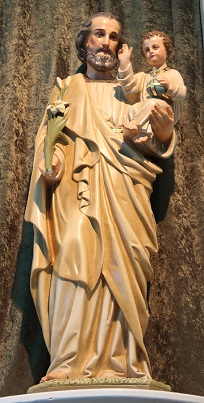
St. Joseph, (Mother of Mercy Catholic Church, Washington, NC)
Prayer to St. Joseph for Persecuted Priests
Dearest St. Joseph, be the protector and
defender of those priests undergoing persecution for being faithful to
their Lord and Sovereign Priest, Jesus Christ. See in them the image of
thy beloved child, and cherish them with that tender solicitude which
God places in Thy paternal heart. Obtain for them the good
graces of thy Queen and Spouse, for such graces of predilection will
surely lighten their burdens and render their crosses sweet. Amen.
● To St. Joseph for a Particular Priest
● Prayer to Saint Joseph for the Church
● Illustrious Patriarch
● Prayer to St. Joseph Patron and Protector of the Universal Church
● Prayer to Saint Joseph, Spouse of the Virgin Mary and Patron of the Holy Church

