Jan 18. Feast of St. Peter. Return of the "other Sheep" (For the conversion of all those in error)
by VP
Posted on Saturday January 17, 2026 at 11:00PM in Church Unity

"That all be one, O Lord, bring - bring them home -
The "other sheep" to thy one fold on earth,
To him who sits in Peter's Chair at Rome,
Thy Vicar, since the age which saw thy birth;
That with one Shepherd under one command
May march thy conquering hosts in every land.
"Ut omnes unum sint," O lord, we pray
That all be drawn within thy one, true fold,
Back to thy Church - from which the wand'rers stray
And the true Faith she keeps like saints of Old.
O bring them back, Good Shepherd of the sheep;
And rouse the heathen nations from their sleep. Amen"
Source: Catholic Hymns for the People, James Martin Raker 1919
Prayer intention: The return of all the "other sheep" to the one fold of St. Peter, the one Shepherd (For the conversion of all those in error)
(Form of prayer decreed by Pope Benedict XV: to be recited Daily during the Octave. + One decade (at least) of the Rosary for this particular intention, Holy Communion if possible.)
Ant. That they all may be one, as Thou, Father, in me and I in Thee, that they also may be one in us; that the world may believe that Thou has sent me.
℣. I say to thee, that thou art Peter,
℟. And upon this rock I will build my Church.
- Let us pray: Lord Jesus Christ, Who didst say to Thine Apostles: peace I leave with you, my peace I give unto you, look not upon my sins, but upon the faith of Thy Church; and vouchsafe unto Her that peace and unity which is agreeable to Thy will: Who livest and reignest God forever and ever. Amen.
- Lord Jesus, most gracious savior of the world, we humbly beg of Thee by Thy most Sacred heart, that all the sheep now wandering astray may be converted to Thee, the Shepherd and Bishop of their souls: Who livest and reignest through all eternity. Amen (Pius X, 26 Oct., 1905)
Source: The Church Unity Octave, 1939 American Ecclesiastical Review, Volume 100
Reflection:
"On this opening day of the Chair of Unity Octave, the Church celebrates the feast of St. Peter to whom was first confided the primacy and supremacy as the Vicar of Christ. This feast was reestablished by Pope Paul IV in 1558 to emphasize the authority and the primacy of the Papacy, after the Protestants tried to show that St. Peter never lived or died in Rome. This feast providentially stressed the role of St. Peter as Christ's Vicar on earth and it symbolizes the unity of the Church and the authority which St. Peter and his successors received from God.
Humanly speaking, prayer for the unity of all men in the true Church seems fantastic; it seems an unattainable goal. For there are more than two billion people on the earth; more than half of these are not Christian in any form, while seven hundred million who call themselves Christians are not members of the true Church. Moreover, the great plan of converting the world has been going on for nearly two thousand years and it is still so far from realization. How can unity come? How will Christ's prayer be answered? It is not foolish even to dream of such a gigantic venture? But this is not a human goal at stake; it does not depend on the flimsy means of human thought and action; it is founded on sacrifice and prayer and grace.
The Blessed Mother of God can conquer souls for her Son. She dispenses the grace by which men come to know and love Him and the grace by which the faithful become zealous apostles fired with the desire of winning souls. As the late Bishop Francis X. Ford, heroic missioner in China, said: "Our Blessed Mother wants us to share anxiety for the conversion of the world...she wants us to carry about with us in our daily work this deep anxiety for the conversion of souls, and a corresponding generosity in offering reparation for the sins of the world...Our hearts must be like the Heart of Mary: anxious, yearning for the conversion of all people."
Though the problem is staggering and the task seem impossible, the gentle but powerful influence of Mary will overcome the forces of evil and of disunity. Mary is not only the humble Maid of Nazareth but the woman clothed with the sun, formidable as an army ready for battle - she will vanquish the powers of hell and win souls to Christ. As Pope Pius XI declared: "May Mary, the most holy Queen of the Apostles, graciously second our common undertakings; Mary, who since as she holds in her mother's heart all men who were committed to her on Calvary, cherishes and loves, not only those who happily enjoy the fruits of the Redemption, but those likewise who still do not know that they have been redeemed by Jesus Christ.
If all the faithful took an active interest in the Octave what a powerful wave of grace would sweep over the world! Or as Bishop Ford wrote: "If the Catholics throughout the world...were to redouble their prayers for the conversion of those outside the fold, the united prayers that would storm heaven would without doubt mark the year as a Pentecostal renewal. Our participation in this octave will at least enlarge our viewpoint, broaden our charity, and make us see in every man a brother whom Christ is yearning to welcome to His sacraments. "
Source: Rev. Father Titus Cranny, S.A. Our Lady and The Unity Octave, page 9. The American Ecclesiastical Review, Volume 130, Herman Joseph Heuser Catholic University of America Press, 1954
Our Lady's Intercession
by VP
Posted on Saturday January 17, 2026 at 11:00PM in Sunday Sermons

Wedding at Cana, Jacques Tissot
"And the Mother of Jesus was there."-JOHN ii. 2.
1. The incident of the marriage feast.
2. How like a Mother was Mary there.
3. The same loving Mother is she to us.
4. Her intercession for us cannot be refused by her divine Son.
"A plain, simple, but very consoling lesson is taught us in this Gospel, for it reveals to us the thoughtful, tender kindness of one who is not only the Mother of Jesus, but our own blessed Mother too. Recall the incident. Our Blessed Lord has just called the Apostles. The day after our Lord had been baptized, John the Baptist, as the Gospel tells us (John 1. 36), saw Him walking, and said, "Behold, the Lamb of God." And two of his disciples, who heard this, followed Jesus. St. Andrew was one of them, and he brought Peter to the Lord. And the following day he brought Philip, and he brought Nathaniel. And the third day there was a marriage at Cana of Galilee, "and the Mother of Jesus was there. And Jesus also was invited, and His disciples, to the marriage.”
Our Lady was a simple guest there, but, whilst others were enjoying themselves, she, with that tender mother's heart of hers, was thinking of the comfort and happiness of others. She noticed that the wine was running short, and unbidden, uncalled for, just simply to prevent the confusion and shame of the bride and bridegroom, she quietly tells Jesus that they have no wine. In spite of His remonstrance that His hour had not yet come, in spite of a seeming refusal, her simple request obtains the favour of His first public miracle. Unnoticed by the others, she quietly tells the waiters, "Whatsoever He shall say to you, do ye." "Jesus saith to them, "Fill the waterpots with water". And they filled them to the brim. And Jesus saith to them, "Draw out now and carry to the chief steward of the feast". And they carried it. And when the chief steward had tasted the water made wine, and knew not whence it was, but the waiters knew, who had drawn the water; the chief steward called the bridegroom, and saith to him, "Every man at first setteth forth good wine, and when men have well drunk, that which is worse. But thou hast kept the good wine until now. This beginning of miracles did Jesus in Cana of Galilee, and manifested His glory, and His disciples believed in Him."
This was His Mother Mary's doing! It is this same loving Mother that we pray to so often! If, without a prayer, and just for kindness' sake, she obtained the working of this first great miracle, what will she not do for us? There was no need for her to have done it. She was not bound to do it. She was not asked to do it.
How, then, can she refuse us or "despise our petitions in our necessities," when she did this, unbidden, just to prevent shame and confusion to others? Our necessities are so great. It is a matter of life and death to us eternal life, eternal death - that we should not give way to temptation, remain in sin, die in sin; can our Blessed Lady refuse to deliver us from such dangers? Even without our turning to her she is anxious for us; how much more, then, if we pray to her! If we cry to her for help, to avoid sin, to repent, to give our hearts to God, to endeavour to persevere day after day, can our Mother turn a deaf ear to our supplications? Oh! Mary, Mother of the Saviour, remember thy kindness at Cana, and be to us the same loving Mother now. Your request was granted, although His hour had not yet come. Ever since He has been listening to you, and never yet refused you, for He wills that all grace should come to us through you, O blessed Mother.
What daily, hourly prayers should we offer to our Lady; what confidence and trust we should place in her love and her power! Obtain for us, blessed Mother of God, the grace always to turn to thee-like little children to their mother-in all anxieties, fears, and dangers.
"And the Mother of Jesus was there." Let us impress those words on our soul, and endeavour to make them true in our own regard at all times, day after day.
In life, oh! may Mary Mother be there. At Baptism, when we became children of God, our souls had Mary there then. And she remained with us during our childhood, till, perhaps at last, some sad day, we drove our Mother away by mortal sin. But when we had repented, and received Holy Communion, again the Mother of Jesus was with us. How patiently she remains with us, guarding us, helping us, as we battle with temptation, beginning again after failures, rising after little falls, doing our daily duties with a good intention. This is the way to holy perseverance, which we must endeavour to obtain with Mary our Mother's constant help.
And at death-the time of all for a mother to care for her child - oh! may the Mother of Jesus be there.
Then all the prayers of our lifetime will intercede for us; the good habits formed in life will come to our aid; in our hearts, when voice may fail, we shall call upon her to stay with us. How safe shall we be in the arms of our Mother, how blessed the end!
And when we stand before the Judge, please God, may "the Mother of Jesus be there." For the last time she will plead for us, and may it be her happy privilege then," after this our exile is ended, to show us the blessed fruit of her womb, Jesus." Oh! that glorious, never-ending day of eternity in heaven, and Mary the Mother of Jesus will be there." Short Sermons on the Epistles & Gospels of the Sundays of the Year By Rev. Francis Paulinus Hickey, O.S.B. 1922 2nd Sunday after Epiphany
Feast of the Chair of Saint Peter
by VP
Posted on Saturday January 17, 2026 at 11:00PM in Prayers
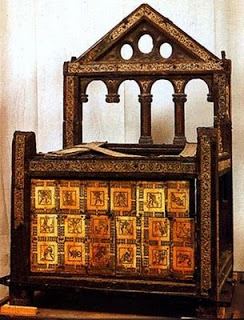
The Chair of St. Peter
"St. Peter, having founded the Church at Antioch, and established the Gospel in Gallacia, Capadocia, and other parts, came afterwards to Rome, where he erected his episcopal chair. Give praise to the infinite goodness of God, who thus directed his apostle to the capital city of the world, which being once converted to the faith of Christ, might with so much ease establish it in all nations and provinces subject to its power. Hence it was that we received the gospel; and therefore it is a day wherein we are concerned as well as Rome, and which requires your thanksgiving for this conduct of the divine goodness, ordaining the means of our salvation.
The capital of the empire of the world, and the centre of impiety, called for the zeal of the prince of the apostles. God had established the Roman empire, and extended its dominion beyond that of any former monarchy, for the more easy propagation of His Gospel. Its metropolis was of the greatest importance for this enterprise. St. Peter took that province upon himself; and repairing to Rome, there preached the faith, and established his episcopal chair, whose successors the bishops of Rome have been accounted in all ages.
It was by this means, that the city of Rome, in which was crowded all the superstition and idolatry of the whole world, for which it was called Babylon, was cleansed of its errors, sanctified by the faith of Christ, and made the centre of the Christian communion. Pray for that See now, that God may be ever its protector, and the Gospel its rule. Pray for all those nations, which are drowned in idolatry and error, that He would show them the like mercy, in bringing them to the light of His saving truths. Pray for yourself and your friends; and let not the depth of iniquity, or present obstinacy, put you into despair. You see here the effect of the divine power and mercy, which can easily draw light out of darkness, and of Babylon make a holy Jerusalem." The Catholic Year by Rev. Fr. John Gother
The Man of God
by VP
Posted on Saturday January 17, 2026 at 11:00PM in Books

The priest being the man of God, charged with the interests of His glory, is destined to do on earth what the angel does in heaven. As the blessed spirits, lost in veneration before the throne of the universal King, unceasingly sing His praises, and emulate one another in repeating their sublime Sanctus, so, says Father Olier, the Lord, desiring to be worshiped in a similar manner upon earth, and seeing that the majority of men would not keep themselves to this perpetual adoration, has instituted the priesthood to offer it in their stead.
The good priest is ever imbued with the profoundest love for God and the most ardent desire of procuring His glory. But it is especially towards the Holy Eucharist that his pious affection shows itself most ardent and zealous. It is in this wonderful mystery, as we have previously observed, that our divine Lord has humbled Himself most profoundly for our sake. Gratitude, therefore, demands that our love and veneration towards Him should be correspondingly greater than in other mysteries; and in this the Church and God Himself have given us the example.
(...)
"Priests," said Alain de Solminiac, "being officers of the crown, are under particular obligations not only to honor their divine King, but also to make Him honored as He deserves."
When the minister of Jesus Christ is under the guiding influence of lively faith, he manifests in his whole exterior such modesty, gravity, and every-abiding sense of God's holy presence that his very appearance becomes an homage to God and a salutary instruction to all who see him. People are influenced more by example than by precept. The sight of a holy priest prostrate before the tabernacle, motionless, and as it were, annihilated in the presence of the Lord, has, not un-frequently, been the means designed by a merciful Providence to re-animate lukewarm Christians, to convert sinners, and even to convince unbelievers by awakening in their souls a spirit of reflection, study, and prayer.
Source: The Sacrifice of the Mass Worthily Celebrated by Rev. Pierre Chaignon S.J., 1897
Joseph's Obedience
by VP
Posted on Saturday January 17, 2026 at 11:00PM in Meditations for Christmas
"1. No such questioning as we have supposed in our last meditation ever occurred to St.Joseph's mind. His duty, his pleasure, was to hear and to obey. Not a moment did he lose. He roused his virgin-spouse and told her what they had to do, and ere morning dawned, they had left Bethlehem far behind.
2. Yet there was no hurry or bustle or undue haste in the preparation they made ; no rushing to and fro, no impatience, not a movement but such as was calm and deliberate, modest and dignified. It is one of the marks of sanctity to have thus under control every look and every action. How can I stand this test When time presses, or my indignation is aroused, or my patience tried, am I gentle and peaceful and calm?
3. Observe, moreover, how there is not a single word of complaint or of grumbling, no expression of annoyance or word of mutual commiseration. Each seeks to lighten the work of the other. How cheerful both Mary and Joseph are! Almost joyous. It is a trial; yes, but more for the sake of the Divine Child than for their own. Even the thought of what Jesus may have to suffer never destroys their peace. O happy Joseph! O blessed Mary! make me more like you."
Meditations for Christmas . By Rev. Richard F. Clarke S.J. The Catholic Truth Society, London 1891
