Queenship of Mary
by VP
Posted on Saturday May 31, 2025 at 12:00AM in Tradition
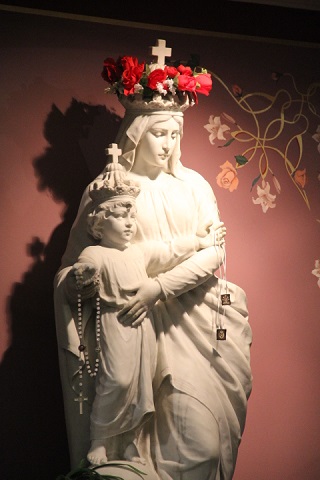
Our Lady, St. John the Baptist Catholic Church, Front Royal, VA
"Queen
of heaven, thy immense love for God maketh thee likewise love His
Church. We pray thee, come to its help amidst the ills under which it is
now suffering, rent asunder as she is by her own children. Thy prayers,
being a mother’s, can obtain all from that God Who loveth Thee so well.
Pray
then, pray for the Church; ask for enlightenment for so many
unbelievers who are persecuting it, and obtain for faithful souls the
necessary strength to resist being caught in the snares of the
unbelievers who would drag them down into their own ruin.
Encyclical of Pope Pius XII on Proclaiming the Queenship
of Mary to the Venerable Brethren, the Patriarchs, Primates,
Archbishops, Bishops, and Other Local Ordinaries in Peace and Communion
with the Holy See.
"47. Since we are convinced, after
long and serious reflection, that great good will accrue to the Church
if this solidly established truth shines forth more clearly to all, like
a luminous lamp raised aloft, by Our Apostolic authority We decree and
establish the feast of Mary's Queenship,
which is to be celebrated every year in the whole world on the 31st of
May. We likewise ordain that on the same day the consecration of the
human race to the Immaculate Heart of the Blessed Virgin Mary be
renewed, cherishing the hope that through such consecration a new era
may begin, joyous in Christian peace and in the triumph of religion.
48.
Let all, therefore, try to approach with greater trust the throne of
grace and mercy of our Queen and Mother, and beg for strength in
adversity, light in darkness, consolation in sorrow; above all let them
strive to free themselves from the slavery of sin and offer an unceasing
homage, filled with filial loyalty, to their Queenly Mother. Let her
churches be thronged by the faithful, her feast-days honored; may the
beads of the Rosary be in the hands of all; may Christians gather, in
small numbers and large, to sing her praises in churches, in homes, in
hospitals, in prisons. May Mary's name be held in highest reverence, a
name sweeter than honey and more precious than jewels; may none utter
blasphemous words, the sign of a defiled soul, against that name graced
with such dignity and revered for its motherly goodness; let no one be
so bold as to speak a syllable which lacks the respect due to her name."
(...)
52.
Earnestly desiring that the Queen and Mother of Christendom may hear
these Our prayers, and by her peace make happy a world shaken by hate,
and may, after this exile show unto us all Jesus, Who will be our
eternal peace and joy, to you, Venerable Brothers, and to your flocks,
as a promise of God's divine help and a pledge of Our love, from Our
heart We impart the Apostolic Benediction."
Source: Ad Caeli Reginam
The Ascension: Festival of Encouragement
by VP
Posted on Thursday May 29, 2025 at 12:00AM in Tradition

"The Lord Jesus was taken up into heaven." MARK XVI. 19.
1. Reconstruction of the event.
2. He had been the Way, the Truth, and the Life.
3. He ascended to claim the Kingdom for Himself and all who believe in Him.
4. Remembrance of this day, the hope and strength of His disciples.
"THE Ascension is the grand finale of the drama of Christ's life on earth. Short as are the accounts of it in the gospels and Acts of the Apostles, we can reconstruct devoutly the events of this blessed day. St. Luke tells us that "He led them out as far as Bethania." What tender condescension of our Blessed Lord! For the last time He wended His way along the lower slopes of Mount Olivet, accompanied by the disciples and His holy Mother. He loved His friends to the end; and we are told in the gospel that Jesus loved Martha and Mary. So He passed by their home in Bethania with a last, loving look; and at the grave of Lazarus and the house of Simon the leper where He had supped, and mounted the gentle rise to Olivet. There He had spent many a night in prayer; from there He had looked down upon Jerusalem and begun His humble triumph on Palm Sunday, and lower down He had commenced His sacred Passion six weeks before. Now that all things had been accomplished by the Son of Man, how befitting to rise hence and to enter into His glory. Picture the touching scene of His last farewell. Each of those favoured ones received a look of ineffable love; words of encouragement, to be treasured all life long; they were permitted to kiss His sacred feet, and the hand of blessing was laid upon their heads bowed down in adoration. It is beyond us to realize the farewell of the Mother and the Son! The Mother's heart would yearn never to be parted, but, according to His Will, that Mother gave up her divine Son to become the Mother of the infant Church. Her presence was needed to encourage the Apostles: to be a model to them, and to be a living proof that the Saviour, though departed to enter into His glory, had been a real Man born of the Virgin Mary; Who had lived for us; died for us on the Cross; and had risen again, immortal and glorified, to prove that He was not only Man, but God!
"And the Lord Jesus was taken up to heaven.” He had declared Himself thus: "I am the way, the truth, and the life" (John xiv. 6). The way of salvation He had shown to men by His obedience to His heavenly Father; by doing good to all; by being meek and humble of heart; by forgiving His enemies; by dying on the Cross for our salvation.
The truth He had taught them. He had renewed the commandments of old and explained and amplified them. He had taught them that the blessedness of life was to be found in poverty, in suffering, in peace, in cleanliness of heart, in suffering persecution for justice' sake.
The life! For from whence could man draw the power to obey the truth, to follow the way, but from that loving God made man, Who made us partakers of His own strength, endurance, and immortality; Who crowns our endeavours in this short life on earth with a never-ending life of glory?
And thus, when our Lord ascended into heaven, the Apostles did not lose Him, He only went before themtheir Leader, the Victor-to claim that heaven which He had won for us. On ascending, He had lifted up His hands and bestowed such a blessing upon them that their faith rose superior to His departure, and their hearts rejoiced. They had not lost Him! He had associated them with Himself in His triumph, as the Church sings this day, "Ascendo ad Patrem Meum" (I ascend to My Father and to your Father; to My God and to your God).
What a divine encouragement this vision of their beloved Master ascending to His Kingdom was to the Apostles! They had now to return, wait for the coming of the Holy Spirit, and then commence their labours. Yes, their labours, their persecutions, their martyrdom before their glory. As their Master, so they themselves. And He had said to them before His departure, "Thus it behoved Christ to suffer, and to rise again from the dead" (Luke xxiv. 46).
How the remembrance of the Ascension has been the source of the heroism of the saints! Not only to the Apostles, a vivid, lifelong remembrance; but to the martyrs amidst their tortures; to the hermits and fathers of the desert amidst trials and temptations; to the inmates of cloisters, during the slow martyrdom of obedience and unchanging monotony of life. It was heavenly sunshine to them, that lifted up their souls, and made them hopefully and bravely cling to their King and Master, Christ. Aye, and amongst the poor, unknown faithful, amidst their daily trials and labour and sorrows, the memory that Christ, their Lord, has won the Kingdom for them, has prepared a home for them, is waiting with the welcome on His lips, till they have fought the good fight and been faithful. Oh, how many have persevered through this blessed remembrance !
Rogation Wednesday: On Other Exercises of the Love of God
by VP
Posted on Wednesday May 28, 2025 at 12:00AM in Tradition
"Consider first, that Divine Love is also exercised in the penitential way by souls that, like Magdalene, (of whom our Lord pronounced that many sins were forgiven her because she loved much), go daily to the feet of Christ, in spirit, to wash them with their tears, flowing from a heart full of a sense of the infinite goodness of God, and of a deep regret for having offended that infinite goodness by their sins. This exercise of penitential love, as we see in the case of Magdalene, is most acceptable to our Lord, and most effectual for obtaining the discharge of all our sins; and, if diligently pursued, is capable of advancing even those that have been the greatest sinners to a high degree of virtue and sanctity. And whosoever has forfeited his baptismal innocence by mortal sin, if he would follow the rules of Christian prudence in choosing the safest way in a case where his all is at stake, should endeavor to pursue this exercise of penitential love, and never end it but with his life. Thus did all those great penitents of old who became afterwards such glorious saints. And this kind of exercise of love will become in a manner natural to all such as have a right sense of what God is and what sin is, and of the dreadful evil they have been guilty of in offending, though it were but once in their life, so great and so good a God.
Consider 2ndly, that there are also other ways of mourning in which we may exercise a love of God, most agreeable to Him, and beneficial to ourselves. As when we sit down at the foot of the cross, and there contemplating the extreme anguish and distress, the stripes and wounds, the racking pains and torments of our dear Redeemer, with all that complication of sufferings in all kinds which he endured in His passion for the love of us, we excite in our souls suitable affections of an ardent love in the way of compassion for our crucified Lover, and feed this fire with tears, flowing at the sight of His blood; which, as it shows forth in the most sensible manner His tender affection for us, so it most strongly calls for a return of our love, accompanied with a bitter grief to see our beloved treated with so much cruelty and contempt. Upon the same principle of the concern that every true lover has, to see the outrages offered to his beloved, we may also exercise a love most agreeable to our Lord, in mourning for the innumerable sins that are daily committed against Him throughout the whole world; to see His infinite goodness slighted, His sacred laws and ordinances trodden under foot, His mercies continually abused, and His most adorable majesty treated with the utmost contempt, by poor blind mortals, made by Him, and for Him redeemed by the blood of His Son, and loaded with innumerable favors, to engage them to love Him and serve Him. Oh! how can any true lover of God endure to see these outrages offered to His infinite majesty without having His heart perfectly broken with grief to see His Love thus abused?
Consider 3rdly, that, besides these exercises of the love of benevolence in the penitential and compassionate way, there is another most perfect exercise of love, and which comes the nearest to the love of the blessed in heaven; and that is, in the way of joy and congratulation - as when we rejoice in God and in His boundless perfections; when we are delighted to think that He is what He is, infinitely good, infinitely holy, infinitely happy, infinitely perfect; that He is the sovereign Lord of all, and that nothing can be added to Him, because He is every way infinite. O, what a comfort, what a pleasure, what a joy it is to a true lover of God to think that whatsoever may come to himself, or to any other thing in the world, his Love at least, whom he loves without comparison more than himself and all things else, will always be infinitely glorious, infinitely rich, and infinitely happy! O how like is this love to that of the blessed, even to that love that makes them blessed, which is an eternal joy in God and in all the beauties and perfections they contemplate in Him - this is their eternal delight.
Conclude to dedicate thyself for time and eternity to this most perfect love of God. Make it thy employment here, and it will be thy eternal reward hereafter. In the mean time, labor also to promote as much as thou canst, upon every occasion, the praise and glory of thy maker, the interests of His kingdom, the fulfilling of all His wills, as well in thyself as in all others; be concerned at every thing that displeases Him, put thy heart continually in His hands, give thyself and all things else to Him a hundred times in the day. Such acts as these, frequently repeated in the day, will secure to thee the rich treasure of divine love; by such exercises thou wilt effectually choose the better part, which will never be taken from thee."
Source: Challoner's MeditationsthenOn this day of Rogation, we beg of Thee, O Lord, in Thy mercy, to hear and answer our fervent petitions:
Do Thou, O Lord, defend Thy Holy Church and all Its members against the
snares of the enemy, the powers of evil, and all temporal misfortunes;
Deliver us, O Lord.
From all false doctrine and loss of faith; Deliver us, O Lord.
From famine, disease, and plague; Deliver us, O Lord.
From all captivity by our enemies; Deliver us, O Lord.
From the snares of the legions of Hell; Deliver us, O Lord.
From the spirit of the world and the flesh; Deliver us, O Lord.
From the spirit of pride and disobedience; Deliver us, O Lord.
That Godʼs Holy Church may dwell in peace and unity; O Lord, we beseech Thee, hear us.
That Thy True Catholic Church may spread throughout all nations; O Lord, we beseech Thee, hear us.
That Thou wouldst preserve, bless, and defend the Bishop Thou hast chosen to govern Thy flock; O Lord, we beseech Thee, hear us.
That Thou wouldst grant to the members of Thy Church the grace to live
in humility and obedience; O Lord, we beseech Thee, hear us.
That all the members of Thy Holy Church be preserved from all spiritual and physical harm; O Lord, we beseech Thee, hear us.
That Thou wouldst sustain all the members of Thy One, True, Church in
holiness, physical well-being, and material necessity; O Lord, we
beseech Thee, hear us.
That Thou wouldst convert all peoples to Thy One, True, Holy, Catholic Church; O Lord, we beseech Thee, hear us.
That Thou wouldst preserve Thy Church and our parishes from all
division, dissension, and disunity; O Lord, we beseech Thee, hear us.
That Thou wouldst preserve Thy Church from all those who have fallen into heresy and schism; O Lord, we beseech Thee, hear us.
That Thou wouldst inspire in the hearts of the faithful a greater spirit of charity; O Lord, we beseech Thee, hear us.
That Thou wouldst grant the blessings of wisdom and holiness to our
Clerics in preparing for the Priesthood; O Lord, we beseech Thee, hear
us.
That Thou wouldst preserve our Priests and Religious in the spirit of
charity, piety, holiness, and fervent zeal for souls; O Lord, we beseech
Thee, hear us.
Thou wouldst bless all of our missionary and apostolic labors and grant
abundant conversion of souls; O Lord, we beseech Thee, hear us.
That Thou wouldst grant abundant laborers to work in the harvest of
souls, and grant to all of our Religious perseverance in their holy
Vocation; O Lord, we beseech Thee, hear us.
That Thou wouldst imbue our youth with the spirit of piety and love of their Holy Faith; O Lord, we beseech Thee, hear us.
That Thou wouldst grant to Thy Church a favorable outcome in all our
court cases, legal actions, and attacks of the press and all of our
enemies; O Lord, we beseech Thee, hear us.
That Thou wouldst bless our Diocese, our Priory, our Friary, our
Seminary, our Convent, our schools, and all our apostolic undertakings; O
Lord, we beseech Thee, hear us.
Let us pray:
Almighty and Everlasting God, we commend unto Thee Thy Holy Catholic
Church: that Thou wouldst grant unto Her peace, unity, and Thy
protection, while shielding Her against the attacks of Her enemies and
subjecting to Her the powers of evil. We thank Thee, O Lord, for the
many blessings Thou hast bestowed upon us, and we beseech Thee to assist
us to live peaceful and tranquil lives; through the same Jesus Christ
our Lord. Amen.
Rogation Tuesday: On Acts of Divine Love
by VP
Posted on Tuesday May 27, 2025 at 12:00AM in Tradition
"Consider first, that the love of God is like a fire: its nature is to be always in motion, and always tending upwards towards its heavenly element; it quickly expires and dies if it lies idle. Wherefore if we would keep it alive, we must nourish it, and blow it up by frequent acts of love; and those not mere verbal acts, by telling God that we love Him, whilst our heart perhaps is far from Him, but by the real exercise of loving God both in our heart and in our works. We exercise the love of God in our heart, by affection; we exercise the love of God in our works, by effects. We love God with a love of chaste concupiscence, when in heart and work we tend to Him as our sovereign good, and aspire after the eternal enjoyment of Him. We love Him with a love of benevolence, that is of sincere and perfect friendship and charity, when both in heart and work we give our whole selves, with all our thoughts, words, and deeds, and all things else to Him, as being infinitely good in Himself. It is just we should exercise ourselves in acts of the love of God in both these ways, as in both these ways He is infinitely amiable but more especially that we should tend to love Him with the love of benevolence, by giving ourselves and all things to Him.
Consider 2ndly, that benevolence is a love by which we wish all manner of good to the person beloved; a love by which we earnestly seek and procure whatever may be for his honor, interest, or pleasure; by which we delight in all his advantages, and are concerned at all his losses, etc. Wherefore, if we would make proper acts of the love of benevolence towards God, we must desire, seek, and procure, as much as lies in us, the greater honor and glory of His name, and the propagation of His kingdom, both in our own hearts and throughout the whole world, and pray that all men may know Him, love Him, and serve Him; we must rejoice at every thing that is agreeable to his Holy Will, and be concerned at every thing that offends Him. This is the proper exercise of the love of benevolence; these are far better acts of divine charity than merely telling God that we love Him. My soul, what are thy dispositions? Dost thou sincerely desire and heartily pray that all the world may know, love, and serve thy God; that all his creatures in heaven and earth may give perpetual glory to Him; that the reign of sin may be abolished; and that the kingdom of God may take possession of all hearts; that none may resist or rebel against His orders; but that all may embrace and bow down, and adore His Divine Will? If so, there is no doubt but thou lovest God. Such as these are perfect acts of the love of God.
Consider 3rdly, that the exercise of the love of God, which, above all others, is recommended in Holy Scriptures, is the loving of his Divine Law and the keeping of His commandments. "This is the charity (that is the love) of God that we keep his commandments," 1 John v. 3. "He that keepeth his word, in him, in very deed, the charity of God is perfected,’ chap. ii. 5. The beloved disciple continually recommends acts of this kind of Divine Love, and the Psalms are full of aspirations or breathings of a soul that is in love with the Holy Law and commandments of God. This devotion to the commandments of God is loving God indeed with a true and effectual love, because it is giving up for His sake what is most dear to us, viz., our own will and liberty, and making a present of it to Him; it is giving Him what He chiefly calls for at our hands; whatsoever else we give Him can never content Him. He always prefers the sacrifice of obedience before all other sacrifices, because here we sacrifice to Him our own clear will, and immolate it, as it were, to His honor and glory. This kind of love is the safest from illusions, for whosoever loves the commandments of God and His Divine Will, and makes all that is in him submit thereunto, most certainly loves God, and is in the right way that will bring him safe to God. No other devotion without this can secure any man.
Conclude to exercise thyself daily in all these ways of loving God, and ever remember that loving God and keeping His commandments go always hand-in-hand, because we cannot love God without loving His Will, notified to us by His commandments."
Source: Challoner's MeditationsthenOn this day of Rogation, we beg of Thee, O Lord, in Thy mercy, to hear and answer our fervent petitions:
Do Thou, O Lord, defend Thy Holy Church and all Its members against the
snares of the enemy, the powers of evil, and all temporal misfortunes;
Deliver us, O Lord.
From all false doctrine and loss of faith; Deliver us, O Lord.
From famine, disease, and plague; Deliver us, O Lord.
From all captivity by our enemies; Deliver us, O Lord.
From the snares of the legions of Hell; Deliver us, O Lord.
From the spirit of the world and the flesh; Deliver us, O Lord.
From the spirit of pride and disobedience; Deliver us, O Lord.
That Godʼs Holy Church may dwell in peace and unity; O Lord, we beseech Thee, hear us.
That Thy True Catholic Church may spread throughout all nations; O Lord, we beseech Thee, hear us.
That Thou wouldst preserve, bless, and defend the Bishop Thou hast chosen to govern Thy flock; O Lord, we beseech Thee, hear us.
That Thou wouldst grant to the members of Thy Church the grace to live
in humility and obedience; O Lord, we beseech Thee, hear us.
That all the members of Thy Holy Church be preserved from all spiritual and physical harm; O Lord, we beseech Thee, hear us.
That Thou wouldst sustain all the members of Thy One, True, Church in
holiness, physical well-being, and material necessity; O Lord, we
beseech Thee, hear us.
That Thou wouldst convert all peoples to Thy One, True, Holy, Catholic Church; O Lord, we beseech Thee, hear us.
That Thou wouldst preserve Thy Church and our parishes from all
division, dissension, and disunity; O Lord, we beseech Thee, hear us.
That Thou wouldst preserve Thy Church from all those who have fallen into heresy and schism; O Lord, we beseech Thee, hear us.
That Thou wouldst inspire in the hearts of the faithful a greater spirit of charity; O Lord, we beseech Thee, hear us.
That Thou wouldst grant the blessings of wisdom and holiness to our
Clerics in preparing for the Priesthood; O Lord, we beseech Thee, hear
us.
That Thou wouldst preserve our Priests and Religious in the spirit of
charity, piety, holiness, and fervent zeal for souls; O Lord, we beseech
Thee, hear us.
Thou wouldst bless all of our missionary and apostolic labors and grant
abundant conversion of souls; O Lord, we beseech Thee, hear us.
That Thou wouldst grant abundant laborers to work in the harvest of
souls, and grant to all of our Religious perseverance in their holy
Vocation; O Lord, we beseech Thee, hear us.
That Thou wouldst imbue our youth with the spirit of piety and love of their Holy Faith; O Lord, we beseech Thee, hear us.
That Thou wouldst grant to Thy Church a favorable outcome in all our
court cases, legal actions, and attacks of the press and all of our
enemies; O Lord, we beseech Thee, hear us.
That Thou wouldst bless our Diocese, our Priory, our Friary, our
Seminary, our Convent, our schools, and all our apostolic undertakings; O
Lord, we beseech Thee, hear us.
Let us pray:
Almighty and Everlasting God, we commend unto Thee Thy Holy Catholic
Church: that Thou wouldst grant unto Her peace, unity, and Thy
protection, while shielding Her against the attacks of Her enemies and
subjecting to Her the powers of evil. We thank Thee, O Lord, for the
many blessings Thou hast bestowed upon us, and we beseech Thee to assist
us to live peaceful and tranquil lives; through the same Jesus Christ
our Lord. Amen.
Rogation Monday
by VP
Posted on Monday May 26, 2025 at 12:00AM in Tradition
"This, and the two following days, are named Rogation days, on which the faithful are called upon to humble themselves in penance and prayer; so to obtain God's blessing on the fruits of the earth, and for our preservation from all pestilential distempers, as likewise to prepare for the great solemnity of our Lord's Ascension. To comply with the design of the Church, we ought on these days to recite the litany of the saints, and offer up our prayers to Almighty God, to obtain his blessings; and in the true spirit of humiliation and penance, endeavour to prepare for the approaching solemnity of the Ascension.
We are ever in want of the divine blessings, which are all to come to us from the hand of God; and it being his will not to dispense them to us, but on the condition of our manifesting our most earnest desires to him by prayer, we are therefore, as we have a concern for our own interest, to be ever solicitous in praying to him. Now to pray as we ought, our first endeavours must be, by a sincere repentance and hearty contrition, to remove from our souls whatever is there of sin, and whatever we may apprehend to be an obstacle to the divine goodness, and just motive of denying what we ask for it is the prayer of the just man that prevails much; and sinners God hears not. Hence we may guess at some reason of our praying in vain; because we use a form of words, which being accompanied with only weak desires of a sinful heart, can never prevail on heaven to pour forth its blessings upon us. Secondly, we must beg of God to teach us how to pray. For we have many seeming necessities and false wants, which ought not to be the subject of our prayers. We are ignorant of what is good for ourselves; and therefore our prayer ought ever to be accompanied with submission to whatever God knows to be best for us. Thirdly, we ought to pray with perseverance; that, as the blessings of God are infinitely valuable, so we may express the value which we have for them by our fervent desires, and not being tired in our prayers. He that prays, ought to begin with a resolution of never being tired; and he will soon discover the good effect of his prayers." The Catholic Year by Fr. John Gother
On this day of Rogation, we beg of Thee, O Lord, in Thy mercy, to hear and answer our fervent petitions:
Do Thou, O Lord, defend Thy Holy Church and all Its members against the
snares of the enemy, the powers of evil, and all temporal misfortunes;
Deliver us, O Lord.
From all false doctrine and loss of faith; Deliver us, O Lord.
From famine, disease, and plague; Deliver us, O Lord.
From all captivity by our enemies; Deliver us, O Lord.
From the snares of the legions of Hell; Deliver us, O Lord.
From the spirit of the world and the flesh; Deliver us, O Lord.
From the spirit of pride and disobedience; Deliver us, O Lord.
That Godʼs Holy Church may dwell in peace and unity; O Lord, we beseech Thee, hear us.
That Thy True Catholic Church may spread throughout all nations; O Lord, we beseech Thee, hear us.
That Thou wouldst preserve, bless, and defend the Bishop Thou hast chosen to govern Thy flock; O Lord, we beseech Thee, hear us.
That Thou wouldst grant to the members of Thy Church the grace to live
in humility and obedience; O Lord, we beseech Thee, hear us.
That all the members of Thy Holy Church be preserved from all spiritual and physical harm; O Lord, we beseech Thee, hear us.
That Thou wouldst sustain all the members of Thy One, True, Church in
holiness, physical well-being, and material necessity; O Lord, we
beseech Thee, hear us.
That Thou wouldst convert all peoples to Thy One, True, Holy, Catholic Church; O Lord, we beseech Thee, hear us.
That Thou wouldst preserve Thy Church and our parishes from all
division, dissension, and disunity; O Lord, we beseech Thee, hear us.
That Thou wouldst preserve Thy Church from all those who have fallen into heresy and schism; O Lord, we beseech Thee, hear us.
That Thou wouldst inspire in the hearts of the faithful a greater spirit of charity; O Lord, we beseech Thee, hear us.
That Thou wouldst grant the blessings of wisdom and holiness to our
Clerics in preparing for the Priesthood; O Lord, we beseech Thee, hear
us.
That Thou wouldst preserve our Priests and Religious in the spirit of
charity, piety, holiness, and fervent zeal for souls; O Lord, we beseech
Thee, hear us.
Thou wouldst bless all of our missionary and apostolic labors and grant
abundant conversion of souls; O Lord, we beseech Thee, hear us.
That Thou wouldst grant abundant laborers to work in the harvest of
souls, and grant to all of our Religious perseverance in their holy
Vocation; O Lord, we beseech Thee, hear us.
That Thou wouldst imbue our youth with the spirit of piety and love of their Holy Faith; O Lord, we beseech Thee, hear us.
That Thou wouldst grant to Thy Church a favorable outcome in all our
court cases, legal actions, and attacks of the press and all of our
enemies; O Lord, we beseech Thee, hear us.
That Thou wouldst bless our Diocese, our Priory, our Friary, our
Seminary, our Convent, our schools, and all our apostolic undertakings; O
Lord, we beseech Thee, hear us.
Let us pray:
Almighty and Everlasting God, we commend unto Thee Thy Holy Catholic
Church: that Thou wouldst grant unto Her peace, unity, and Thy
protection, while shielding Her against the attacks of Her enemies and
subjecting to Her the powers of evil. We thank Thee, O Lord, for the
many blessings Thou hast bestowed upon us, and we beseech Thee to assist
us to live peaceful and tranquil lives; through the same Jesus Christ
our Lord. Amen.
Rogation Sunday
by VP
Posted on Sunday May 25, 2025 at 12:00AM in Tradition
Meditation by Bishop Challoner:
Rogation Sunday on the Devotion of the Time:
" Consider first, that these days, between this Sunday and the ascension of our Lord, are days of devotion, and are called rogation-days, because they are set aside by the Church for solemn prayers and supplications, joined with abstinence and penance, in order to turn away the wrath of God, provoked by our sins; and to remove far from us His scourges of wars, plagues, famines, &c.; to implore His mercy for ourselves, and for all His people; and to beg His blessing upon the fruits of the earth. As the first institution of the devotion of these days was occasioned by a terrible scene of disasters and visible judgments of God upon the people, to which a stop was put by dedicating these three days to prayer and penance; so the success that attended this first essay has encouraged the Church to an annual practice of the like devotion ever since. Hence we may learn, with what dispositions of soul we ought to present ourselves before the throne of grace at this time; with what a lively sense of the guilt of our sins, and of the judgments we deserve for them both here and hereafter; with what desire to return to God from our sins, and to offer Him the sacrifice of a contrite and humble heart for them, and to join, as it were in a body, at this time, with the whole people of God, in suing in a proper manner for His mercy, with most humble supplication and fervent prayers. See, my soul, if these be thy dispositions.
Consider 2ndly, that although we do not every day feel the heavy hand of divine justice by the experience of public calamities, or other visible judgments, yet if we consider the guilt of so many crying sins, not only of particular persons, but even of whole nations, which are continually calling to God for vengeance, we shall find too much reason to apprehend that the sword of God’s justice is even now hanging over our heads and that the worst of His judgments will quickly fall upon Christendom in general, if not averted by prayer and penance. This consideration ought to determine all Christians in general (even the most innocent, if they have any concern for the public danger, or true charity for the souls of their neighbors,) gladly to embrace so happy an opportunity as this of joining with all the children of God in humiliations and prayer, in order to prevent the thunder of heaven from suddenly breaking over our heads, and hurrying away thousands into the bottomless pit. And as for every particular sinner, now is the most favorable time for him to sue for mercy, because at this time the whole Church joins in a particular manner in praying for all sinners. And if he should neglect this opportunity, what may he not justly fear from his repeated treason; from the wrath of God above, ready to fall upon him; from the mouth of hell below, gaping to devour him; from the devil, to whom he has sold himself; and from that monster, mortal sin, (which is even worse than the devil,) which he always carries about with him! O sinners, neglect not these days of salvation, lest they never return to you any more. Now is your time - hereafter there may be no time for you.
Consider 3rdly, the encouragement we have both in the Epistle and the Gospel of the Rogations, to look for mercy and for all good, both for ourselves and for our neighbors, from humble and fervent prayer. In the Epistle (St. James 5) we are taught the great efficacy of continual prayer, with an exhortation to pray for one another, in order to salvation and a declaration of what the reward will be of them that contribute to the salvation of others. In the Gospel (St. Luke 11) we are exhorted by Christ our Lord to a holy importunity and perseverance in prayer; and we are taught by the example of a friend, and of a father, to look for good gifts from our heavenly Father by the means of earnest prayer. O what a friend indeed, what a parent have we in Him! or who is like to Him in bounty and mercy? Let us then be encouraged by these divine oracles, "To go with confidence at this time to the throne of grace, that we may obtain mercy, and find grace in seasonable aid.' Heb. 4. 16.
Conclude to join at this time with the whole Church of God in prayer and penance, that thou mayest obtain mercy both for thyself and for thy neighbors. Heaven can never resist a general assault made by the whole people of God by the means of prayer, when joined with a contrite and humble heart."
"Monday,
Tuesday, and Wednesday before Ascension Thursday were instituted by the
Church to appease divine justice, to ask protection in calamities, and
invoke Godʼs blessing on the harvest .
These Rogation
Days are of French origin, coming about in the 5th c., when St.
Mamertus, Bishop of Vienne, Dauphiné instituted them after a series of
natural calamities.
Rogation is simply an English form of the Latin rogatio, which comes from the verb rogare, which means "to ask". The Rogation Days were marked by the recitation of the litany of the Saints which would normally begin in or at a church.
After
Saint Mary was invoked, the congregation would proceed to walk the
boundaries of the parish, while reciting the rest of the litany (and
repeating it as necessary or supplementing it with some of the
penitential or gradual Psalms). Thus, the entire parish would be
blessed, and the boundaries of the parish would be marked. The
procession would end with a Rogation Mass, in which all in the parish were expected to take part. If your parish does not celebrate the Rogation Days, you may mark the days by reciting the Litany of the saints and fasting. Source: LiturgiaLatina
Litany to obtain Holy Priests:
Lord, have mercy
Christ, have mercy
Lord, have mercy
Christ, hear us
Christ, Graciously hear us
God, Our Heavenly Father, have mercy on us
God the Son, Redeemer of the world, have mercy on us
God, The Holy Ghost, have mercy on us
Holy Trinity, Three Persons in one God, have mercy on us
Lord, obtain for us priests
Lord, obtain for us holy priests and make us docile to their teachings
Holy Mary, Queen of the Clergy, obtain for us holy priests
Saint Joseph, Patron of the Church, obtain for us holy priests
Saint Michael, splendor and protector of the Church militant, obtain for us holy priests
All you holy Saints and Archangels, obtain for us holy priests
All you holy Patriarchs and Prophets, obtain for us holy priests
All you holy Martyrs and Virgins, obtain for us holy priests
All you holy Bishops and Confessors, obtain for us holy priests
All you holy Priests and Doctors, obtain for us holy priests
All you holy Founders of religious orders, obtain for us holy priests
St. Anthony of Padua, defender of the Holy Eucharist, obtain for us holy priests
St. John-Mary Vianney, model of sacerdotal holiness, obtain for us holy priests
St. Francis Xavier, patron of missionary priests, obtain for us holy priests
St. Therese of the Child Jesus and of the Holy Face, victim offered for
the sanctification of priests, obtain for us holy priests
Saints and Servants of God, obtain for us holy priests.
To celebrate with reverence the Holy Mysteries, obtain for us holy priests
To offer every day the Holy Sacrifice of the Mass, obtain for us holy priests
To feed the people of God with the Bread of life, obtain for us holy priests
To promote the splendors of the Divine Worship, obtain for us holy priests
To regenerate souls through baptism, obtain for us holy priests
To instruct the faithful in the Holy Faith, obtain for us holy priests
To keep the faithful in the fear of the Lord, obtain for us holy priests
To announce to all the Word of God, obtain for us holy priests
To unmask and combat false doctrines, obtain for us holy priests
To fortify the Faith of those who doubt, obtain for us holy priests
To support and encourage those who fail, obtain for us holy priests
To raise up those who fall and to reconcile them to God, obtain for us holy priests
To bring back to God those who rejected Him, obtain for us holy priests
To protect christian morality, obtain for us holy priests
To fight with zeal the corruption of morality, obtain for us holy priests
To bless holy unions, obtain for us holy priests
To defend the honor and sanctity of marriage, obtain for us holy priests
To strengthen the happiness of our christian families, obtain for us holy priests
To fortify and console our sicks and those who suffer, obtain for us holy priests
To assist our dying ones, obtain for us holy priests
To lead our dead to eternal happiness, obtain for us holy priests
To pray and offer the Holy Sacrifice of the Mass for our dead, obtain for us holy priests
To give glory to God, and to give grace and peace to souls of good will, obtain for us holy priests.
Lamb of God, Who take away the sins of the world, spare us, O Lord.
Lamb of God, Who take away the sins of the world, graciously hear us, O Lord.
Lamb of God, Who take away the sins of the world, have mercy on us.
The Lord chose for Himself priests so that they will offer Him a worthy thanksgiving.
Let us pray: God Almighty and merciful, favorably grant the prayers of
Your faithful and grant to those whom You have given the immense
generosity of your clemency, to be elevated to the service of the
heavenly mysteries, to become worthy ministers at Your sacred altars, so
that their teachings be confirmed by Your sanctification, through Our
Lord Jesus-Christ, Amen.
Translated by CAPG (Litanies pour Obtenir de Saints Prêtres)
Month of December
by VP
Posted on Saturday November 30, 2024 at 11:00PM in Tradition
Devotion for the Month of December: the Immaculate Conception
Prayer of St. Bernard: THROUGH thee, O ever blessed Virgin, may it be
allowed to us to approach thy Son. Through thee, O Fountain of Grace,
Source of Life, and Mother of Salvation, may we be received by Him Who
was given to us by thee. May thy immaculate sanctity,
O most holy Virgin, hide from His eyes the stain of our corruption, and
may thy most profound humility obtain from God the pardon of our pride.
May thy boundless charity cover the multitude of our sins, and thy
glorious fruitfulness confer on us fruitfulness of merits. Mother,
Mediatrix, and Advocate, we beg of thee to reconcile us to thy Son, to
recommend us to thy Son, to represent us with thy Son. Oh, most blessed
Mother, by the favour which thou didst find with God, by the
prerogatives which thou didst merit, by the Lord of Mercy, to whom thou
didst give birth, we implore thee to prevail by thy prayers on Him, Who,
through thee, deigned to share our misery and weakness, so that He may
deign to make us sharers of His eternal happiness and glory to Whom,
together with the Father and Holy Ghost, be all honour and glory, for
ever and ever. Amen. Novena for the Immaculate Conception, Fr. Louis Parodi, SJ 1915
Virtue for the month of September: Union
Qui manet in eharitate, in Deo manet, et Deus in eo — Whoabidethin charity, abideth in God, and God in him. — I John, iv : 16.
The object of all virtues is to bring us into union with God, in which alone is laid up all the happines that can be enjoyed in this world. Now, in what does ibis unioa properly consist ? In nothing save a perfect conformity and resemblance between our will and the will of God, so that these two wills are absolutely alike — there is nothing in one repugnant to the otber ; all that one wishes and loves, the other wishes and loves ; whatever pleases or displeases one, pleases or displeases the other. — St. John of the Cross.
THE FEAST OF OUR LORD JESUS CHRIST, KING OF THE UNIVERSE.
by VP
Posted on Thursday October 31, 2024 at 12:00AM in Tradition

Prayer
to Christ the King
O
CHRIST, JESUS, I acknowledge Thee as Universal King. For Thee all creatures
have been made. Do Thou exercise over
me all the rights that Thou hast.
Renew my Baptismal Vows,
I renounce Satan, with all his works and
pomps, and I promise to live as a good
Catholic: Especially, do I pledge myself, by all
the
means in my power, to bring about the triumph of the rights
of God and of Thy Church.
Divine
Heart of Jesus, I offer Thee all my poor actions to obtain that all hearts may
recognize Thy Sacred Royalty, and that thus the reign of Thy Peace may be established throughout the entire world.
Amen.
ENCYCLICAL OF POPE PIUS XI ON THE FEAST OF CHRIST THE KING: Quas Primas
4. If We ordain that the whole Catholic world shall revere Christ as King, We shall minister to the need of the present day, and at the same time provide an excellent remedy for the plague which now infects society. We refer to the plague of anti-clericalism, its errors and impious activities. This evil spirit, as you are well aware, Venerable Brethren, has not come into being in one day; it has long lurked beneath the surface. The empire of Christ over all nations was rejected. The right which the Church has from Christ himself, to teach mankind, to make laws, to govern peoples in all that pertains to their eternal salvation, that right was denied. Then gradually the religion of Christ came to be likened to false religions and to be placed ignominiously on the same level with them. It was then put under the power of the state and tolerated more or less at the whim of princes and rulers. Some men went even further, and wished to set up in the place of God's religion a natural religion consisting in some instinctive affection of the heart. There were even some nations who thought they could dispense with God, and that their religion should consist in impiety and the neglect of God. The rebellion of individuals and states against the authority of Christ has produced deplorable consequences. We lamented these in the Encyclical Ubi arcano; we lament them today: the seeds of discord sown far and wide; those bitter enmities and rivalries between nations, which still hinder so much the cause of peace; that insatiable greed which is so often hidden under a pretense of public spirit and patriotism, and gives rise to so many private quarrels; a blind and immoderate selfishness, making men seek nothing but their own comfort and advantage, and measure everything by these; no peace in the home, because men have forgotten or neglect their duty; the unity and stability of the family undermined; society in a word, shaken to its foundations and on the way to ruin.
Trinity Sunday
by VP
Posted on Saturday June 15, 2024 at 12:00AM in Tradition

“Go teach,” said Christ to His Apostles. Teach what? Not the opinions of Peter, James or John, not the sayings of Matthew, Philip or Bartholomew, not this or that system of belief, or these or those deductions of human reason; but “the things that I have commanded you.” And the command laid upon the twelve Apostles is still honored and obeyed by the priest in the Church of God. The priest, then, teaches, not in his own name, nor does he propose a doctrine thought out in deep study, but, “God exhorting through him” on account of his unity with the chair of Peter, he but echoes the divine voice, heard throughout Judea in the dawn of Christianity. The priest speaks and the world listens, not because of his words of deep reasoning, nor on account of his faultless diction, nor because of his fervent eloquence, but because he speaks as one having authority, the authority given by Jesus to His Apostles, and by them transmitted to him." Source: The Priesthood by Rev. M.S. Smith (The Homelitic Monthly and Pastoral Review, Trinity Sunday, May 1922) Special thanks to Robert Olson
Prayer to the Holy Trinity by Saint Elizabeth de la Trinité
"O my God, Trinity whom I adore, let me entirely forget myself that I may abide in You, still and peaceful as if my soul were already in eternity; let nothing disturb my peace nor separate me from You, O my unchanging God, but that each moment may take me further into the depths of Your mystery ! Pacify my soul! Make it Your heaven, Your beloved home and place of Your repose; let me never leave You there alone, but may I be ever attentive, ever alert in my faith, ever adoring and all given up to Your creative action.
O my beloved Christ, crucified for love, would that I might be for You a spouse of Your heart! I would anoint You with glory, I would love You – even unto death! Yet I sense my frailty and ask You to adorn me with Yourself; identify my soul with all the movements of Your soul, submerge me, overwhelm me, substitute Yourself in me that my life may become but a reflection of Your life. Come into me as Adorer, Redeemer and Saviour.
O Eternal Word, Word of my God, would that I might spend my life listening to You, would that I might be fully receptive to learn all from You; in all darkness, all loneliness, all weakness, may I ever keep my eyes fixed on You and abide under Your great light; O my Beloved Star, fascinate me so that I may never be able to leave Your radiance.
O Consuming Fire, Spirit of Love, descend into my soul and make all in me as an incarnation of the Word, that I may be to Him a super-added humanity wherein He renews His mystery; and You O Father, bestow Yourself and bend down to Your little creature, seeing in her only Your beloved Son in whom You are well pleased.
O my `Three’, my All, my Beatitude, infinite
Solitude, Immensity in whom I lose myself, I give myself to You as a
prey to be consumed; enclose Yourself in me that I may be absorbed in
You so as to contemplate in Your light the abyss of Your Splendour !"
Summer Ember Saturday: The Heart of Jesus sending us the Gift of Fear
by VP
Posted on Saturday June 01, 2024 at 12:00AM in Tradition

Meditation for Ember Saturday:
"And grieve not the Holy Spirit of God: whereby you are sealed unto the day of redemption." (Eph. iv. 30.)
1st
Point.-Love is the fruit of knowledge, and fear is the golden shield
which protects love. Consider what a holy, beautiful, precious gift is
fear. There can be no deep love without fear. True love must always be
based upon reverence, and reverence is but another word for fear. It is
said of Jesus, in His adorable Humanity, that "He was heard for His
reverence." (Heb. v. 7.) The souls who love most deeply, generally are
most full of fear; but it is the fear of intense reverence, not
the fear of slavish dread, for that fear is "cast out by perfect
charity." He that feareth with the fear of a servant, is not "perfected
in charity" (1 John, iv. 18); but he who fears with the reverence of a
child, has attained its highest consummation. Oh, let us pray for this
golden gift, and give no rest, by our urgent importunity, until we have
obtained it!
2nd Point. This fear manifests itself, when most
perfect, in an interior dread of "grieving the Holy Spirit of God." It
is the fruit of burning love; and in souls who are far advanced in
charity, its manifestations are surpassingly beautiful. They speak in
their hearts all day long to Jesus, and Jesus speaks to them; not always
with evident sensible consolation, but with a distinctness often
accompanied with extreme dryness and darkness, which may perhaps be sent
as a balance to this unspeakable favor. They scarcely commit an
imperfection, ere it is distinctly pointed out to them; and the love
that burns so strongly within them, excites their fear, and they suffer,
as only such souls can suffer, from intense fear, lest they should
grieve their Beloved. To such souls there is no fear like the fear of
grieving the object. of their love; yet, because of their familiarity
with Him, they are often supposed to fear less than those who love less.
3rd
Point. This gift also manifests itself in another form, in souls who
are not so much led by personal love to Jesus. In them it is simply fear or
awe of God and of His judgments; and such souls walk very blamelessly
before Him, but rather from the love of fear, than from the fear of
love. Let us pray to-day, as the octave of gifts closes upon us-let us
pray above all things for holy fear: God will impart the gift to each
soul in the way best suited to promote its perfection. The Spirit is our
"seal unto the day of redemption." Oh, let us beware how we break or
cast from us that blessed seal! Let us begin a new life of prayer to the
Third Person of the ever-blessed Trinity; let us try to convince
ourselves firmly of the importance of His office, and of the immense
importance of invoking His help daily as our Teacher and our Comforter.
Source: Meditations for Advent and Easter, p 280
Hymns, readings and prayers for this Whit Embertide:
Veni, Sancte Spiritus (Come, Thou Holy Spiritus, come)
Veni, Creator Spiritus, (Come Holy Spirit, Creator Blest)
Readings:
Ember Saturday:
Leviticus, 23. 9-11, 15-17, 21
Saint Paul to the Romans, 5. 1-5
Prayers:
An excellent prayer for this purpose is the Litany of the Saints, in which so many bishops, priests, and levites are invoked; or the Rosary may be appropriately said, grouping those for whom we pray into five
classes, corresponding to the five decades.
Prayers for Ember Days:
Listen, Almighty God, we beseech Thee, to the prayers which Thy universal Church offers to Thee at this time, beseeching Thy blessing on those who are about to be admitted to Thy Holy Service of the Altar, in particular on Deacon Nicolas Rapkoch. Give Thy grace to all who are called to any office and administration amongst Thy clergy, and so replenish them with the truth of Thy doctrine, and indue them with innocence of life, that they may faithfully serve Thee, to the glory of Thy great name and the benefit of Thy Holy Church. Amen
O
God, of Whose mercies there is no number, and of Whose goodness the
treasure is infinite, we humbly thank Thee for the gifts thou hast
bestowed upon us. Continue Thy mercy to us, and give us also so much of
Thy temporal blessings as Thou knowest to be for our good.
Grant that
the fruits of the earth may, by Thy holy favor, increase and multiply.
Defend them from all drought, frosts or tempests, or whatever else may
be hurtful to them. It is from Thy hand only that we look for succor,
and to Thee we have recourse in all our necessities. Amen.
Source: St. John's Manual 1856, Archbishop of New York John J. Hugues
