The Magi were a figure of Christian Priests
by VP
Posted on Friday January 05, 2024 at 11:00PM in Meditations

"There came wise men from the East to Jerusalem, saying: Where is He that is born King of the Jews? for we have seen His star in the East, and are come to adore Him."—St. Matt. ii. I, 2.
I. Because They Were The First To Receive The Faith.II. Because They Were Most Courageous In Propagating It.
III. Because They Were Most Docile In Following It.
1. There came wise men from the East to Jerusalem. The Magi were the first-fruits of the nations, because they were the first from among them to recognize the Messiah. Rabanus says that, according to the common opinion, they were at once sages and princes; and so we may regard them as a figure of Priests, who are not only better instructed in matters of religion than the laity, but are also Princes of the Christian people. They should therefore be the first in the Faith, not by priority of time, for all receive the habit of Faith in Holy Baptism, but by their fuller possession and better use of it. St. Ambrose writes that the Priest should have nothing in common with the multitude, and therefore his Faith should excel theirs; and indeed it is precisely in Faith that he ought to be a pattern to the Faithful: "Be thou an example to the Faithful ... in faith" (i Tim. iv. 12). Let us therefore strive ever to increase in this virtue, and to be preeminent in it above the people. Without the increase of Faith we can never attain the perfection proper to our state; it is, says St . Chrysostom, the "origin of justice, the crown of sanctity, the beginning of devotion, the foundation of religion." Wouldst thou have the spirit of prayer? Remember, says St. Augustine, that Faith is the source of prayer. Wouldst thou become truly rich, truly honorable? Thou canst nowhere find greater riches, treasures, honors, or seek them better, than through Faith. Let us then consider in what manner we exercise this virtue, and what efforts we are making to increase and perfect it .
2. Saying, Where is He that is born King of the Jews? Let us admire the courage of the Magi, who, as Cornelius a Lapide says, without fearing the wrath of Herod and his courtiers, sought in the royal city for another king, asking where the new King of the Jews was born. Moreover, on returning to their own country they gave themselves to the preaching of the true religion, and by their preaching merited the crown of martyrdom. It belongs to Priests to preach the true Faith, because, as St. Cyril says, they are the masters of Faith, the guardians of the true Faith. "The true Priest is one who, as St. Ambrose describes him, does not waver like a child, nor allow himself to be carried about by every wind of doctrine, but stands perfect in Christ, rooted in the Faith". Moreover, John of Antioch tells us, that to excel in Faith, and to teach it to the people, should be the chief office and primary aim of the Priesthood. In fact, this is, as St. Chrysostom shows, the greatest and most salutary remedy that we can apply to the wounds of those souls whose salvation we seek.
3. For we have seen His star in the East, and are come to adore Him. Many in the East saw this star, and remembered the prophecy of Balaam (Numbers xxiv. 17), and knew this phenomenon to be extraordinary and mysterious; but few followed the star. All Jerusalem was moved at hearing of its appearance, and at sight of the Magi who had followed it; but none of the Jews stirred. The Priests themselves pointed out the place, proclaimed God's word, and manifested the mystery; but they did not profit by all this. As St. Augustine remarks, the Doctors spoke and remained where they were, whilst the Magi, after they had heard them, went to seek the Child. If Priests would follow that Faith which they preach to others, and from which others derive so great profit, they would not live as many, alas! do live; they would live as pilgrims in this world, without attaching themselves to earthly goods, without losing sight of the good things of heaven. Let us then reflect on the obligation we (priests) are under to make our life conformable to the Faith, and not to have a faith without works, which is but a dead faith; but endeavor, as St. Ambrose exhorts us, to be patterns to the people both in faith and in works. O Priest, man of God, strive to be among the first to "pursue justice, godliness, faith" (i Tim. vi. n).
"I have believed, therefore have I spoken."—Ps. cxv. 1.
"Increase our faith."— St. Luke xvii. 5."
The Priest a Soldier
by VP
Posted on Tuesday August 08, 2023 at 12:00AM in Meditations
“Labora sicut bonus miles Christi Jesu.”
“Labour as a good soldier of Christ Jesus.” 2. Tim ii.3.
The priest is more than once compared by St. Paul to a soldier; and rightly, for the more of the soldier there is in him, the better priest he is.
At first sight, nothing seems more opposed than the two callings, but a closer examination reveals the fact that several of their leading features are the same. The same general conditions of life are found in both, and the same qualities are required.
1. The priest, like the soldier, once engaged is no longer free; he is no longer at liberty to forsake his profession, and to turn to any of the pursuits of life which were previously open to him. He cannot even combine them, to any extent, with the duties he has assumed. “No man,” says St. Paul (ibid), being a soldier to God, entangleth himself with secular business.” That is, he has no right to do so. The soldier has ceased to belong to himself. His very life is not his own. The Roman soldier that St. Paul had in mind was separated from family, kindred, home, country; indeed, everywhere the soldier’s life is a life of detachment. In active warfare he has to hold himself always in readiness; at any time he may be called upon to face certain death. And therefore he is best without a family. If he has left behind him persons tenderly loved, it is not good that he should give them much thought; such memories would unman him. In a word, the life of a soldier in active service is a life of detachment, of self-devotion; a ready gift of his energies, and, if need be, of his life, to the service of his country.
What else is the life of a priest, if he be true to his calling? His time, his energies, his influence, all his gifts, belong to the great purpose for which he became a priest. Like St. Paul, he is ready to give his very life for it: “I most gladly will spend, and be spent myself, for your souls.” 2 Cor. Xii. 15.
2. The qualities of the soldier are no less necessary in the priest, courage, endurance, discipline. The true soldier is the type of courage. He is fearless in presence of danger, or, if fear is awakened in him, he does not yield to it, else he would be branded as a coward. But his courage is only occasionally appealed to, whereas his power of endurance is taxed at every hour. Long marches, scanty provisions, excessive heat or cold, lack of shelter, sickness, these are what try the soldier much more than facing the enemy. This is why St. Paul does not say: “Have courage; be brave;” but “suffer hardship,” for such is the meaning of the Greek term rendered in the Vulgate by the word labora. Last of all, but not least, discipline. In the Roman army discipline was of the strictest kind, and the oath of obedience (sacramentum) was looked upon as the most sacred of all. In man, as in nature, only disciplined power is useful. Uncontrolled, it wastes itself, and often proves destructive.
Courage, too, is a requirement of the priesthood; physical courage sometimes, moral courage always. To be faithful to duty, at nay cost; to live up to his convictions whatever others may say; to speak out for the right, to censure and to oppose what is wrong; to carry our necessary but unpopular measures; to face the risk of being misunderstood or blamed; of to forfeit certain advantages sooner than relinquish a useful purpose, all this is necessary in the priest, and it means in all cases true moral courage.
The power of endurance is not less necessary. The life of a priest, if he strives to meet all the requirements of his position, is generally a trying one. His mission may be what is called a hard one. The demands upon his physical strength may be as much as he can bear. His patience is tried in numberless ways. Among those with whom he is placed in contact, there are the thoughtless, the unreasonable, the obstinate, the deceitful, the selfish, the ungrateful; he has to bear with all, and strive by dint of gentleness and forbearance to win them to Christ.
Finally, his life has to be one of order, of rule, of discipline. In many things he is left to his own initiative; but in a still larger number he is under rule, the rule of the Gospel and the rules of the Church. His action as a priest is individual in one sense, in another it is collective, that is, associated with the action of the Church herself and of her representatives. In both it is equally withdrawn from caprice and subject to law.
“It is the soldier’s pride to fight for his king; what an honor to be the soldier of Christ!
But if campaigning means endurance, he who endureth not is no soldier.” Chrys. In 2 Tim.
Source: Rev. John Baptist Hogan (Daily Thoughts for Priests, 1899)
Reverence
by VP
Posted on Wednesday February 15, 2023 at 11:00PM in Meditations
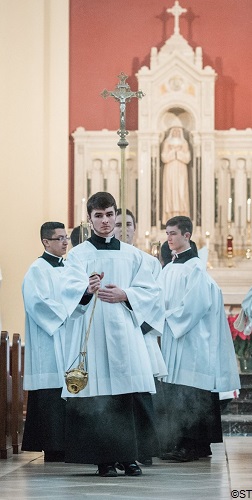
"The Christian Temple is the house of God, the place of prayer, and the gate of heaven. It is the tabernacle of God with men, where He hears the cry of their distress, and pours out the fullness of grace and mercy. It is their paradise upon the earth. Surely ecclesiastics, who approach to God in this His mercy seat, will not by irreverence or contempt commit sin or iniquity in the holy place. In their celebration of the Holy Sacrifice, in the public offices of the Church, their whole conduct and manner will breathe a spirit of piety and devotion. Moreover, it will be impossible for ecclesiastics to enforce on the laity the due and necessary respect for God's house, if they be never seen to exhibit it themselves. How can they ask the laity to fulfill an obligation which they themselves should be the first to observe, and which they are the first to violate?
Above all, the Christian Temple contains in the tabernacle, the Holy of Holies, the living bread which came down from heaven, the great victim and propitiation for sin, the food and nourishment of holy souls. Behold the great reason for the respect and reverence of all - for the fear and awe with which we approach the sanctuary of God. Had we eyes to see, we should behold the angels with their faces veiled in profound adoration before the holy tabernacle, and had we ears to hear we should hear the voice of God crying out: "Locus iste terribilis est." Pavete ad sanctuarium meum."
Ecclesiastical meditations suitable for priests on the mission and students by Ecclesiastical meditations
In Her Purification, Mary teaches priests how to celebrate the Holy Sacrifice of the Mass worthily
by VP
Posted on Wednesday February 01, 2023 at 11:00PM in Meditations

"They carried Him to Jerusalem, to present Him to the Lord."-St. Luke ii. 22.
I. If Mary "carried Jesus to Jerusalem, to present Him to the Lord," Priests, when they celebrate Mass, " carry " Him to the mystical "Jerusalem," that is, to the Church, and there "present" the same Holy Victim to the same " Lord," and for the same ends. But how great is the difference between Mary's preparation and our preparation for this sublime act! She prepared Herself with so great purity, says St Bernard, that there was no need of her purification; She had no real, either legal or carnal stain; and yet, before fulfilling her great office, she waited in the Court of the unclean until the Priest had completed the prescribed rites for her purification, and led her into the Court of the purified (Lev. xii 2).
What a lesson is this for priests, teaching them to prepare themselves for Mass with the greatest possible purity of soul and body; for if Christ, during His mortal life, chose to be presented by a most pure Mother, by whom, says St. Peter Damian, would He be presented, now that He reigns gloriously in Heaven, if not by pure hands !
Moreover, she prepared herself with humility; for she concealed her Divine Maternity and her Virginity, and would not appear to be different from other women. St. Bernard says, that as the Son would be circumcised as a sinner, so she would be purified as unclean.
What ought our humility to be when we approach the Altar, conscious of our unworthiness of so sublime an honor? We ought to remember, as St. Martin says, that no wrinkles, nothing which contaminates mind or body, should affect the priest. Lastly, she prepared herself with immense fervor, knowing what a depth of mystery, of the wisdom and knowledge of God, was comprehended in this act. What, then, should be our fervor when we offer the Holy Sacrifice?
2. The Blessed Virgin, in "presenting Her Son," accurately fulfilled the ceremonial prescribed by the Law. It is worthy of note that St. Luke mentions this fact four times : " according to the law of Moses ... as it is written in the law of the Lord . . . according to the custom of the law . . . after they had performed all things according to the law of the Lord." By these repetitions the Holy Spirit teaches us, that Mary fulfilled these ceremonial precepts with careful accuracy, although neither the letter nor the spirit of the law bound Her to them. Priest too are bound to an exact fulfillment of all the prescribed ceremonies in celebrating Holy Mass. Priests' diligence, says St. Bonaventure, should be great in act, greater in word, greatest of all in intention.
Let us pray to the Blessed Virgin to obtain for our priests a perfect observance of the sacred ceremonies, and an elevation of mind whilst they are celebrating the Divine Mysteries.
3. Mary tasted the purest joy " in presenting her Son to the Lord," not only because she presented a Sacrifice worthy of Almighty God, but also because she saw Him acknowledged by Simeon and Anna, who now obtained from God the fulfillment of their desires with ineffable consolations. And Mary rejoiced in their joy, for it is the property of holy souls to " rejoice with them that rejoice '' (Rom. xii. 15). So, in celebrating Holy Mass, we too should rejoice, that by our means God is glorified, the faithful are nourished, and the whole Church largely benefited. This is the time, says St. Bernard, when we ought to be glad and rejoice. We must not, however, be satisfied with present consolations, but imitate Mary, who ever retained a grateful, thankful remembrance of them, wondering as it were at them. Never should we forget the great grace of being permitted to say Holy Mass, but continually wonder at the infinite condescension of Almighty God. And amidst these consolations, let us make use of the strength we have received in the Holy Sacrifice to prepare ourselves for the tribulations which it may be the will of God we should suffer, and for the temptations with which the Devil may assail us. Even Mary, in the midst of all the consolations she then experienced, heard these words from holy Simeon : " Behold this Child is set for the fall, and for the resurrection of many in Israel, and for a sign which shall be contradicted, and thy own soul a sword shall pierce " (St. Luke ii. 34, 35).
" I will go in to the Altar of God, to God, who giveth joy to my youth." — Ps, xlii. 4.
** O Mary, pray to Thy Son, that He may not be to me for fall, but for resurrection." — St, Luke ii. 34. "
Vigil of All Saints
by VP
Posted on Monday October 31, 2022 at 12:09PM in Meditations
"The souls of the just are in the hand of God, and the torment of malice shall not touch them: in the sight of the unwise they seemed to die, but they are at peace." (Communion Antiphon, Vigil of All Souls)
"Pour forth abundantly upon us of Thy mercy, O Lord our God, and grant us grace to follow in the joy of their holy testifying, all they blessed servants the ever of whose glorious and solemn Commemoration we are keeping. ( Collect)
Pope Pius Sixtus IV in 1484 established November 1, the feast of all Saints, as a holy day of obligation and gave it both a Vigil (known today as "All Hallows' Eve" or "Hallowe'en") and an eight-day period or octave to celebrate the feast. By 1955, however, the octave of All Saints was removed, and the current missal does not have a vigil Mass for the feast." Father Vierling
"The great feasts of All Saints and All Souls, preceded by vigil and fast, bring their annual blessings to us, and make the month of November the most unearthly, unworldly month of all the year to those who dwell, during its too brief thirty days, with the radiant inhabitants of heaven and with purgatory's blessed dead. It is a time for quiet thought, for many memories, for many hopes, and God alone knows many fervent prayers; a time when hearts "through all the faithful past go sorrowing," and, through all the lonely future, look forward to a day when the reapers shall come with rejoicing, bring their sheaves with them, and when God, the loving Father, shall gather His dear children, reunited forever, into an eternal home.
Look upwards and behold them, they who stand there now already, a multitude whom no man can number,assembled triumphant before the great white throne. What do those radiant faces tell you, as they gaze in ecstasy upon the face of Him Who bears continually the glorious scars that proclaim Him King of kings and Lord of lords forever? Over and over again, they say that these saints whose day we celebrate came, like
their Leader, out of a sore conflict, and that they were possessed by a passionate love of the unseen.
"Salt of nations! Twelve foundations!
Twelve apostles - see them all!
Trumps of thunder, and the wonder
Of the Gentiles, holy Paul -
Loving Peter, and still sweeter,
Friend of Jesus, blessed John.
Full of gladness - no more sadness
Clouds the face Christ shines upon!
High procession! great confession!
Hear the loud triumphal tones!
Martyrs bleeding - Stephen leading
With this crown of precious stones.
Warriors glorious and victorious,
Tried companions of the Lord,
Fall before Him and adore Him.
He, the Lamb, is their reward.
It is the old lesson which Venerable Bede teaches, that lesson steeped in the life-blood of the Kind of Martyrs, and which deserves repeating every year, as these festivals return: "Dearly beloved brethren! This day we keep with one great cry of joy, a feast in memory of all God's holy children; His children, Whose presence is a gladness in heaven; His children, prayers are a blessing to earth; His children, whose victories are the crown of Holy Church; His chose, whose testifying is the more glorious in honor, as the agony in which it was given was the sterner in intensity. For, as the dreader grew the battle, so the grander grew the fighters; and the triumph of martyrdom waxed the more incisive by the multiplicity of suffering; and the heavier the torment, the heavier the prize."
What cowards we are, we lesser men who nevertheless have the saints' seven sacraments, the saints' Mother Church, the saints' hope set before us, yet who shiver and shrink at the sound of suffering, and run away from pain! I know not what stuff we are made of, in these mean, pleasure-loving days. Is it not better to suffer now than to suffer hereafter? Pere de Ravignan says that God in His goodness mingles purgatory with every day of our lives, and so we should accept and clasp to our breasts the crosses He offers us. Fenelon declares that it is a blessing to have our purgatory in this world, but that we by our cowardice endure two instead of one. "Our resistance," he says, :"makes earthly trials so ineffectual, that all has to be begun again after death. We should be in this life like souls in purgatory, supple and at peace in God's hand, yielding ourselves up to destruction in the avenging fire of love. Happy those who suffer thus."
Happy? Yes, my God! Teach us this happiness, this deep delight of pain. Teach us two lessons, - to fight, and to suffer, for Thee and under Thy red-cross flag! Blessed who suffer - blessed who mourn - blessed who wounded and bleeding, still face untiring the tireless foe! We are sinners; and we must, here or hereafter, do penance for our sins. We are called to be saints; and like the saints we must war unflinching in the tremendous warfare, if we would win the saints' reward and follow the mighty army into heaven.
"Cut, scourge, purge, burn here," prayed the penitent Augustine, "yea, burn here so as by fire, and spare there!" Yet not only for the cleansing and the penance do we fling ourselves, O God! into the red fire of earth's purgatory but because pain purges out the dross, and brightens the gold, and brings us closer to Thee. Strike and spare not, O God! and, even though we cry out otherwise, heed not, till every fiber of our being is one with Thee!
Sometimes, gazing steadily upward at the Blessed, radiant in their rapture which sin mar no more, a light flashes over the soul for a moment, and dazzles it; and it seems to comprehend, for that moment, that pain is heaven! For what is heaven but union with God/ and odes not he who clings closest to the Sacred Heart find union with God among the thorns, and does he not behold, in that darkness which makes earthly things invisible, the vision of Christ's face?
Cowards that we are, to shrink from pain or from insult; to fear this world's disgrace, or failure as worldly men count failure; when the question is of God's will, God's honor, God's eternal cause! We are soldiers in His army by the ineffaceable character of our Baptism. If we have been cowards, deserters, traitors, a hundred times, then the keener ought to be our soldierly longing to endure and encounter all in order that we may retrieve our honor, and far more, our Lord's honor! But if He has kept us from open treason, who shall tell with what loyal love we ought to follow after Him, down into the very valley of the agony and up the heights of Calvary, upward, with all the saints, to Heaven!"
The Inner Life of the Soul, Short Spiritual Messages for the Ecclesiastical Year by Susan L. Emery, 1903
Book also available at Barnes and Nobles
October 28: Feast of St. Simon and St. Jude (Bishop Challoner)
by VP
Posted on Friday October 28, 2022 at 12:00AM in Meditations
"Consider (...)2ndly, the eminent dignity to which the apostles were raised by our Lord: they were made his disciples, his individual companions, his familiar friends and confidants - yea, his brethren too, John xx. 17; they were made under him the chief priests of the New Testament, the first bishops and pastors of his church, the prime ministers of his kingdom, the stewards and dispensers of all his mysteries; his ambassadors to men; his vicegerents upon earth; the doctors and teachers of the whole world; and next after him, who is the chief corner-stone, the twelve foundations of his church, Eph. ii. 20 - yea, the twelve foundations of the heavenly Jerusalem, Apoc. xxi. 14. Reflect also on the distinguishing graces, and the excellency of power which our Lord conferred upon them, suitable to their great office and callings; such as the power of consecrating and of offering in sacrifice his sacred body and blood; of remitting sins; and of opening or shutting heaven's gates to men; the commission of feeding his flock, and of ruling and directing his church, with the promise of the Holy Ghost to assist them therein; the authority of publishing throughout the whole world his new law, the law of grace; and the covenant of salvation through him, & c.: besides the gifts of tongues, and prophecy, and other eminent graces of the Holy Ghost; and a power of working all kind of miracles, yea, even greater than those of Christ himself, St. John xiv. 12. Christians, bless your Saviour on the festivals of the apostles, for all these great things he has done for them, and through them for his church in general, and in some degree for every one of you in particular. For as they were, under Christ, the fathers and founders of the Christian religion, so from them, and through their ministry, the faith, the word, the sacraments, the graces of Christ, and all spiritual goods and treasures are derived down to your souls by the channel of their successors in the church of Christ."
Source: Meditations for Every Day in the Year, by Bishop Challoner
September 8: Nativity of our Lady: Mary's Sublime Vocation
by VP
Posted on Thursday September 08, 2022 at 12:16AM in Meditations

"Mary was born in order to be the Mother of Jesus. : "Of whom was born Jesus." This is the principle of all her privileges, the summing up of all her praises. (...) It is as the Mother of the Redeemer of mankind that she will be the refuge and advocate of sinners. She is the aurora which precedes and ushers in the morning sun. (...) Certain it is that if men had known the blessings which Mary's nativity drew upon them, there would have been throughout the whole world a repetition of that which occurred among the Jews at their having been preserved from death through the meditation of Ester. "A new light seemed to rise, you, honor, dancing in all peoples...wonderful rejoicing." (Est. viii. 16,17).
You also, O Priests, were born for a sublime destiny! Accomplish it faithfully, and you shall be the cause of an unspeakable joy for heaven and earth. To give Jesus to the world, and with Jesus to give it all blessings, such is your vocation, and such was the vocation of Mary. This is the reason why the holy Virgin has such a warm affection for good priests and lavishes upon them such truly maternal cares.
Source: September 8, the Nativity of the Blessed Virgin p444. Meditations for the Use of the Secular Clergy, from the French of Father Chaignon, S.J. Volume 2. 1907
Good Friday: The Priesthood of Christ on the Cross, when the Victim was Sacrificed
by VP
Posted on Sunday April 03, 2022 at 02:58AM in Meditations

I. The order of its fulfillment.
II. The mode of its fulfillment.
III. Its final accomplishment.
" He said : It is consummated : and bowing His head. He gave up the ghost." — St. John xix. 30.
I. He said: It is consummated. St. Thomas says, that Jesus Christ hung upon the Cross between heaven and earth, in order to shew His quality of Priest and Mediator between God and man ; and St. Augustine says that He then completed that Sacrifice of reconciliation, in which He was one with God, to Whom it was offered, — one with men, for whom it was offered,— and Himself at once both the offerer and the offered. He Himself announced that " all was consummated," for it became Him alone, to Whom were present both past and future, to declare it. All the prophecies, all the figures contained in the sacred Scriptures, were "consummated," as He had already promised : "all things shall be accomplished which were written "(St. Luke xviii. 31); and abundant price had been offered, efficacious means had been merited, to "consummate" all transgression, and to put an end to every sin : "that transgression may be finished, and sin may have an end " (Dan. ix. 24). By "one oblation He perfected for ever them that are sanctified" (Heb. x. 14). He, therefore, being thus "consummated, became to all that obey Him, the cause of eternal salvation" (Heb. v. 9). Let us then meditate on the admirable order with which Jesus fulfilled " the days of His flesh," and let us pray to Him by His most holy death, that, at the hour of our death, we may be found to have "fulfilled the Divine law" (Rom. ii. 27), and to "have finished" well "the course" of our Priesthood (2 Tim. iv. 7).
2. And bowing His head. The manner in which Christ willed to die, was to bow His adorable head, in token of perfect obedience to the command of His Father, to Whom He became " obedient unto death, even to the death of the Cross " (Phil. ii. 8). He proclaimed to the world, that, as He had fulfilled His Father's will through life, so also He rendered Him obedience in His death : "That the world may know that I love the Father, and as the Father hath given Me commandment, so do I " (St. John xiv. 31). Thus was it the fire of love, — that is, the Holy Spirit, the hypostatic Love of the Father and the Son, — "Who immolated the Divine holocaust : " Who by the Holy Ghost offered Himself unspotted to God" (Heb. ix. 14). in bowing His Head, Jesus declared to earth, that His Sacrifice had had the desired effect ; that is to say, " into the face of man," once dead in sin, " was breathed the breath of life, and man became a living soul " (Gen. ii. 7). To the sinner, once an enemy, was given the kiss of reconciliation and of peace; when the Savior turned His Face to him, as though to give him the kiss of peace (says St. Bonaventure). O great High Priest, who can thank Thee for all these inventions of Thy mercy ! When shall I begin to love Thee with the fervor which befits one who is Thy minister, and who is acquainted with these august mysteries ? Bow down Thy head to me, and breathe into me Thy love.
3. He gave up the ghost. The Eternal Word, Who had united His Soul to His Body, and assumed both, alone had power to separate them, and so to fulfill the supreme act of Priesthood (says St. John Damascene). Therefore He " gave up " His " spirit " into the hands of His Father, to shew that He had that power of which He had formerly spoken to His enemies (St John x. 18). Then He immolated the Victim, and offered the Sacrifice decreed from all eternity, promised from the beginning shadowed by innumerable types, predicted by so many prophets, begun in Mary's womb, and continued throughout His whole life. Then was homage and thanksgiving, worthy of the Divine Majesty, rendered to God ; and pardon, and every other grace, obtained for all mankind. Christ died and subjected Himself to the punishment of sin, in order to free us from the fear of death, which held men in slavery all their life ; to teach us to die to sin, as He died to the penalty of sin ; and to fill us with all good things. Let us then, on this day, honor His death, which has been the means of salvation both to our soul and body. Our Savior's single death (says St Augustine) saved us from the double death which was our due. With the same holy Father, let us bless God for having given us so holy a Priest, — "a Victim taken from among ourselves, yet without sin, to cleanse us from our sins ; so that the flesh of our Sacrifice is the Body of our Priest Let us thank our Lord Jesus Christ, Who has loved us so greatly, Who has given Himself for us, as if for each one of us alone (Gal. ii. 20). Let us thank Him that, through the merits of His death. He has engrafted us into His Priesthood, to continue the offering of this same Sacrifice. Let us pray to Him that we may die mystically with Him, in order that we may live in Him in this life, and after the death of our body may dwell with Him for ever.
"Into Thy hands I commend my spirit; Thou hast redeemed me, O Lord, the God of truth." Ps. xxx.6
"O great High Priest, who wast made the death of death and the sting of hell, redeem our soul from the hand of hell." From Ps. XlVIII. 16.
Source: Meditations for the use of the clergy, for every day in the year ..., Volume 1 By Angelo Agostino Scotti (abp. of Thessalonica.)
Prayer for Priests (Fr. Lasance)
My God, I believe in the sublime dignity
of the priesthood-a dignity which St. Denis calls divine; a dignity
which surpasses that of kings and angels, as St. Ambrose says. O My
God! Thy priests are the leaders of Thy people, the guardians of Thy
Church, the light of the world, (Matt. v. 14), the dispensers of the
sacraments, the vicars of Jesus Christ, and His coadjutors in the work
of salvation (1 Cor. III. 9). Grant, then, O Lord, to me and to all the
faithful to have the same respect and submission toward the person,
words, and counsels of Thy ministers as toward Thine own, since Thou
Thyself didst say to them: “He that heareth you Heareth Me, and he that
despiseth you despiseth Me"
I ask of Thee, my God, for all the
priests in the world and specially for those who have done any good to
my soul, by seeking to sanctify it, the grace of loving Thee much and
making Thee to be loved by others, so that by their piety, their
virtues, and the ardor of their zeal they may merit a place with Thy
apostles and most faithful servants.
Divine Spirit! Influence
all their thoughts, words, and deeds; take complete possession of their
minds and hearts, so that they may live in Thee and Thou in them. Jesus,
meek and gentle Lamb of God, let their lives resemble the life Thou
Thyself didst lead upon earth!
Holy Mary, Mother of Jesus, do
thou by thy intercession sanctify the souls of all our priests and
second their efforts in the work of saving souls; shield them, and
defend them as thine own. Pray for them that the peace of God may be
always with them, and that they may attain to the everlasting
blessedness of heaven. Amen.
Blessed Sacrament Prayer Book
A Catholic must believe every truth
by VP
Posted on Monday April 13, 2020 at 09:43PM in Meditations
A Catholic must believe every truth revealed by the Almighty, be it great or small, as God cannot fail either in small things or great. The offense which we do to God by denying even the smallest article of faith, is as great as if we denied an important one, or all of them together; for, is is just as if we said: God has been deceived, or He has deceived us in revealing this article. Whether this is said of great and important articles, or of one that is small, makes but little difference; or if we desire to make a difference, we must say that it is a greater offense to God to ascribe to Him a fault in a small matter than in a great; for, what can be more blasphemous than to maintain that the Almighty has been deceived in a trifling matter, or that He intends to deceive us?
They should ponder on this, who sometimes entertain doubts about an article of faith, or even go so far as to say that in some matters, they agree with non-Catholics, and consider them right. These are no longer Catholics. Their faith is lost; and if they do not repent, as St. Thomas did, they will go to perdition, because they are incredulous. They are disobedient who obey nine of the Commandments but not the tenth. What is the fate of the incredulous? Christ Himself pointed it out when He said: " Who believes not in the Son, will not see life, but the wrath of God will remain with him." (John viii)
Source: Life of the Saints, by Fr. Franz X. Weninger.
A Good Priest
by VP
Posted on Saturday March 28, 2020 at 12:00AM in Meditations
A good priest described by Jesus Christ. By saying to us that He is the good pastor, He declares that none is a good pastor except as he resembles Him. "The good shepherd giveth his life for his sheep." He is ever ready to expose his temporal life to save his people from eternal death.
In the early days of the Church the acceptance of the pastoral charge was a consecration to martyrdom. " I know My sheep, and Mine know Me." Mutual confidence begets mutual affection.
" I give My life for My sheep." It is on Calvary and at the altar that the good priest learns how he ought to love souls.
Source: Meditations for the use of the secular Clergy, Père Pierre Chaignon 1907
