Surrexit Christus spes mea
by VP
Posted on Sunday April 05, 2026 at 12:00AM in Tradition
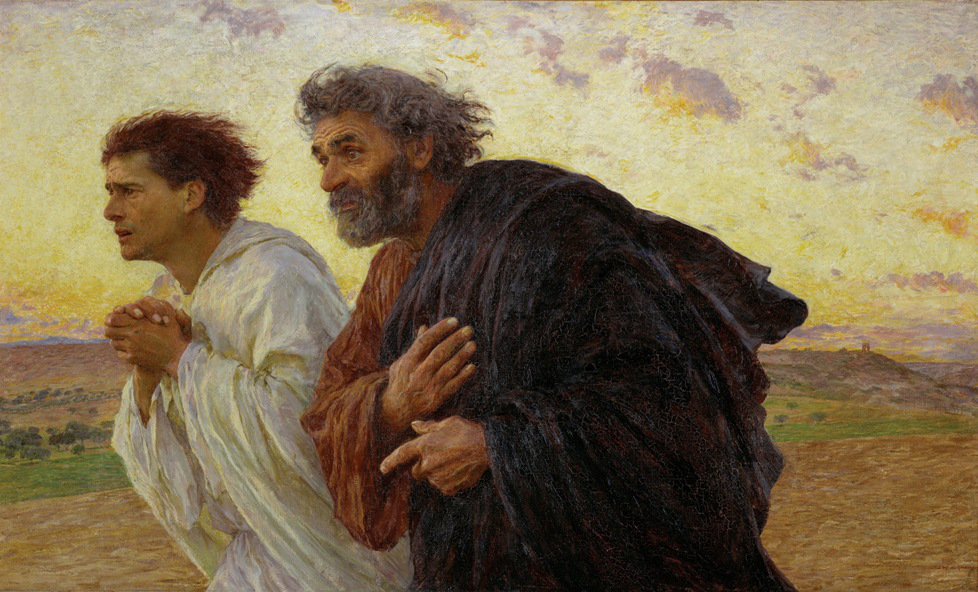
Peter and John Running to the Tomb Eugène Burnand (1850 – 1921)
Christians, to the Paschal victim
offer your thankful praises!
A lamb the sheep redeemeth:
Christ, who only is sinless,
reconcileth sinners to the Father.
Death and life have contended
in that combat stupendous:
the Prince of life, who died,
reigns immortal.
Speak, Mary, declaring
what you saw, wayfaring:
"The tomb of Christ, who is living,
the glory of Jesus' resurrection;
"Bright angels attesting,
the shroud and napkin resting.
"Yea, Christ my hope is arisen;
to Galilee he will go before you."
Christ indeed from death is risen,
our new life obtaining;
have mercy, victor King, ever reigning!
Amen! Alleluia!
Holy Saturday: "He descended into hell, the third day he rose again from the dead.”
by VP
Posted on Saturday April 04, 2026 at 12:00AM in Tradition

James Tissot - Holy Saturday
"The Savior of the world, having expired on the cross, and by His death paid the ransom due to the divine justice for the sins of men, descended into Limbo, to deliver thence those just souls who were waiting for their Redeemer, and were prepared to enter with Him into glory. Inexpressible was the joy of those holy souls at the presence of their Redeemer, who having conquered death and hell, came down in the happy character of a deliverer, and demanded them from their long confinement, to take part in his triumphs. It was the Messias whom they expected; and He being come, they think all the time of their banishment to have been as nothing, beginning now to enjoy Him, whom they had so long desired, and whom no time can ever more take from them. The same will be the happiness of every one that dies well. Whether the evils of life have been great or inconsiderable, long or short, they all disappear at the hour of a happy death, and are lost in eternity.
Our Blessed Redeemer was pleased to be taken down from the cross, and laid in a sepulchre, so to confirm to all generations the truth of His death for us, and of His resurrection from the dead. Pray that by a firm faith of what He has suffered for us, you may plentifully partake of His mercies, and daily increase in that hope and love, which are to bring you to the possession of Him. From His sacred body being laid in the sepulchre, you may learn the mystery which is taught you this day, that you also ought to be buried together with Him; that you are not only to labour that in the likeness of His death the old man may die in you, but that he may be buried also; so that he be altogether hidden from the world, and that nothing may appear in us but the new man, who is renewed in us by his death.
What happy fruit of Christ's passion would it be to us, could we obtain this mercy! We are convinced of the folly of sin, and the vanity of all that pleases for a moment; we are tired of our corruption; but who will deliver us from the body
of this death? None can do this but Jesus. Wherefore apply yourself to Him: sit at His sepulchre, and by His sacred passion beseech Him to have
compassion on you, to help you in the relief of your necessities, and give you the victory which you desire." The Catholic Year by Rev. Fr. John Gother
Maundy Thursday and the Altar of Repose
by VP
Posted on Thursday April 02, 2026 at 12:00AM in Tradition
Institution of the Holy Eucharist and of the Christian Priesthood.
"As in the cenacle there is something more than a repast, so there is also something more than a sacrifice - there is the institution of the new priesthood. Our Savior would not have said to men: "Unless you eat the flesh of the Son of man and drink His Blood, you shall not have life in you," had He not thought of instituting a ministry through which He would renew to the end of time what He had now accomplished in presence of these twelve men. Now these are His words to these men whom He hath chose: "Do this in commemoration of Me." By those words He gives power to them also to change the bread into His Body, and the wine into His Blood, and this sublime power shall be transmitted through Holy ordination in the Church to the end of time. Through the ministry of mortal, sinful men, Jesus will continue to work out the miracle He performed in the cenacle, and while He endows His Church with the only one and immortal sacrifice, He gives us according to His promise, through the bread of heaven the means to abide in Him, and for Him to abide in us." Dom Gueranger Annee Liturgique
The Liturgy of Maundy Thursday is full of memories of the Redemption. It provided formerly for the celebration of three Masses: the first for the reconciliation of public Penitents, the second for the conservation of the Holy Oils, and the third for a special commemoration of the Institution of the Holy Eucharist at the Last Supper. This last Mass is the only one that has been preserved, and at it the Bishop, attended by twelve priests, seven Deacons and seven Subdeacons, blesses the Holy Oils in his Cathedral Church.
- The Reconciliation of Public Penitents: Sinners who had undergone a course of penance were granted on this day "the abundant remission of their sins," "which were washed away in the Blood of Jesus." Dying with Christ, they were "cleansed of all their sins, and clad in the nuptial robe they were admitted once more to the banquet of the Most Holy Supper."
- The Blessing of the Holy Oils: This blessing took place with a view to the baptism and confirmation of the Catechumens during Easter night. The Bishop exorcised the oils, praying God "to instill into it the power of the Holy Ghost," so that " the Divine gifts might descend on those who were about to be anointed."
- The oil of the sick, which is the substance of the Sacrament of Extreme Unction, is the first to be blessed, before the Pater. Formerly this used also to be blessed on other days.
- The Holy Chrism, which is the matter of the Sacrament of Confirmation, is the noblest of the Holy Oils, and the blessing of it takes place with greater pomp after the Clergy have communicated. It is used for the consecration of Bishops, in the rite of Baptism, in the consecration of churches, altars and chalices, and in the baptism or blessing of bells.
- The third Holy oil, which is blessed immediately after, is that of the Catechumens. It is used to anoint the breast and between the shoulders of the person to be baptized, for the blessing of baptismal fonts on Holy Saturday and on Whitsun Eve, at the Ordination of Priests and for the coronation of kings and Queens.
3. Mass for Maundy Thursday: The Church, which, by placing the Mass of the Catechumens in juxtaposition with the Mass of the Faithful, commemorates throughout the year in the Holy Eucharist all the mysteries of the life of Christ, celebrates today in a special manner the institution of that Sacrament and of the Catholic Priesthood (Secret). [The Eucharist and Priesthood are inseparable, for Jesus instituted them both at the Last Supper. After for the first time changing the bread and wine into His Body and Blood. He at once added, addressing only the Apostles present: "Do this for the commemoration of Me." In those words He charged the Apostles and all their successors, Bishops and Priests, to continue the Eucharistic Sacrifice, thus subordinating its perpetuation to the permanence of His priesthood on earth.]
This Mass then realizes eminently the command laid by Jesus on His Priests to renew the Last Supper, at which Christ, at the very moment of His death was being plotted, instituted His immortal presence among us. And the Church, forgetting for the moment her mourning, celebrates the Holy Sacrifice today with holy joy. The Crucifix is covered with a white veil, her Ministers are vested in festal robes, and the Gloria is sung to the ringing of all the bells. And after this Hymn the bells remain silent till Holy Saturday.
Certain abuses which had crept in owing to the Eucharistic banquet
being partaken of after another meal, following the example set by
Christ, having been abolished, st. Paul tells us in the Epistle that the
Mass is a "memorial of the death of Jesus." The Sacrifice of the Altar
is necessary if we are to communicate in the Victim of Calvary and share
in His merits. And the Eucharist, which derives all its virtue from the
Sacrifice of the Cross, makes it universal as regards time and space in
a sense unknown so far. To love the Blessed Sacrament is "to glory in
the Cross of our Lord Jesus Christ" (introit). Christ takes on Himself
to perform the ablutions prescribed by the Jews during the supper
(Gospel), to evidence the purity and charity that God requires of those
who desire to communicate, for, as in the case of Judas (collect),
"Whosoever eats this bread unworthily is guilty for the body and of the
blood of the Lord (Epistle).
After the Mass the altar is stripped in order to show that the Holy
Sacrifice is interrupted and will not be offered up again to God until
Holy Saturday. The Priest therefore has consecrated two hosts, for on
Good Friday the Church refrains from renewing on the altar the Sacrifice
of Calvary." Source: Daily Missal with Vespers for Sundays & Feasts By Dom Gaspar Lefebvre, 1925.

Institution of the Holy Eucharist, ©CAPG
"Jesus having loved His own, who were in the world, He loved them unto the end. This love He expressed in a more particular manner in the institution of the Holy Eucharist on this day. Being now about to depart out of the world, He left us His sacred Body and Blood under the forms of bread and wine; that so, being ascended to His Father, He might not leave us orphans, but still abide with us for the food and nourishment of our souls in their spiritual life, for the support of our banishment, and the comfort of our pilgrimage. He gave Himself to us in this Blessed Sacrament, to be our security in dangers, our strength in temptations, our physician in all distempers, our counsel in difficulties, our encouragement in troubles, and our help in infirmities. In fine, He gave Himself to us, to be all to us that can be necessary for carrying us through the evils of this life, to the possession of that eternal happiness, which He has purchased for us with the price of His Blood.
This was the pure effect of His mercy and love to us: for if we look upon ourselves, what do we see there? Nothing but ingratitude, monstrous self-love, pride, sensuality, stubbornness, and sin. That He should stoop to that humiliating expedient of becoming our food, is the work of His mercy and love to us. It is this love that we are called upon this day to acknowledge and adore: and it must be a reproach to us of insensibility, if we are wanting in this duty.
This is performed in part, by preparing a place for the Blessed Eucharist, which the faithful are accustomed to call the Sepulchre,
where it is deposited after Mass on this day, and surrounded with
lights, flowers, and other ornaments. As far as these are
acknowledgments of our respect and gratitude, they will be acceptable to Him whom we thus honour. But we must pour forth our hearts to God, as
we devoutly visit this sepulchre, in the confession of His power and goodness; we must return Him our love for His love to us: and beseech Him to complete the mercy of this day, by teaching us worthily to praise Him, and sincerely to love Him." Maundy Thursday, The Catholic Year by Rev. Fr. John Gother

The Office of Holy Week, 1870 (Washing of the Feet, Holy Mass, Blessing of the Oils) Daily Missal, Dom Gaspar 1925
"It is not uncommon to hear Maundy Thursday referred to as Holy Thursday. This is a mistake. Holy Thursday is a name belonging absolutely from time immemorial to the Feast of the Ascension. Maundy is a significant name and ought therefore to be jealously guarded. Enough of that element of religion which serves to make it popular has been lost in the course of past centuries.
The word Maundy is derived, through the French maundier, from the Latin mandatum: "Mandatum novum do vobis," (a new commandment I give unto you) John, 13:34. The Mandatum or Maundy was the ceremony of the washing of the feet and almsgiving observed on this day, both of which were performed as a token of that brotherly love which Christ so earnestly inculcated at the last supper.
The ceremony of the washing of the feet was and is part of the liturgy. It was performed by Pope, Bishop, and priest, and kings, nobles and peasants imitated their example. Twelve poor men were selected to be the recipients of the dignitaries' favor.
The Maundy is observed in the ceremonies of the church, and in many religious communities even at the present time.
Visiting the repositories is a custom as popular of old as it is today. It is indeed edifying to Catholic and non-Catholic alike to witness the spontaneous demonstration of devotion to the Blessed Sacrament, and deeper than we are aware of is the impression produced on the multitude of unbelievers around us by this and similar acts of faith." Source: Maine Catholic Historical Magazine, 1914

Altar of Repose, Institute Christ the King, ©DC
" To draw his people more effectually to the holy Eucharist, the Cure d'Ars had endeavoured to communicate to them a taste for all holy things, and his efforts were not in vain. Sunday after Sunday these good people feasted their eyes on beautiful banners and vestments.
("In the minutes of the pastoral visitation held at Ars by the Bishop of Belley, on Monday, June 11, 1838, we read as follows: "After saying Mass and giving confirmation, His Lordship contented himself with giving Benediction of the Blessed Sacrament and reciting the prayers for the departed. He deemed it unnecessary to examine the interior of the church, the chapels, vestments and sacred vessels, because everything is so beautiful and so rich that the beholder is filled with admiration" Msgr. Convert. Le Frere Athanase.)
For a long time the saint himself trained the altar boys, and achieved wonderful results. He carried out with gravity, dignity, and the utmost care all the ceremonies of the rite of Lyons, which at that time was likewise in use in the diocese of Belley. Nor was the behaviors of the altar servers less admirable when, in 1849, Frere Athanase undertook the functions of master of ceremony.
He had so fine a liturgical spirit, and he drilled the children with so much precision and good taste, that Mgr. de Langalerie, during a clergy retreat, held him up as a pattern to the clergy of the diocese. "Do you wish to see a church where all the ceremonies are carried out to the letter? Go to Ars; Frere Athanase is a living and unerring ceremonial. His example will show you what you can achieve yourselves if you will only take the means."
There were days when the people of Ars gave special edification to the pilgrims. On Maundy Thursday, in order to commemorate the institution of the Holy Eucharist, M. Vianney insisted on providing a splendid altar of repose, and his heart rejoiced at sight of the decorations which enhanced the majesty of the tabernacle. The whole of the chancel, which had been considerably enlarged in 1845, was draped with banners. Numerous and tastefully arranged lights transfigured the scene. However, he took every precaution lest these decorations should be a hindrance instead of a help to the interior recollection of the people."
Source: The Cure d'Ars, Abbe TrochuSpy Wednesday: the betrayal of Judas
by VP
Posted on Wednesday April 01, 2026 at 12:00AM in Tradition
The Wednesday of Holy Week is popularly known as Spy Wednesday. On this day Judas played the spy and signed the traitor's contract for thirty pieces of silver. The Maine Catholic Historical Magazine, Volume 2, 1914.

Judas Goes to Find the Jews (Judas va trouver les Juifs) - James Tissot
Sermons de Saint Jean Marie Vianney:
- On the Prayer of a Sinner Who Does Not Wish to Abandon Sin: If Judas—Judas the traitor—instead of giving way to despair, had earnestly prayed to God to forgive his sin, the Lord would have absolved him of his fault. From the French Sermons of the Venerable Jean Marie Vianney, 1883 Vol. 1, 3rd Sunday after the Epiphany, p. 194.
- On Hope: If Judas had thrown himself at the feet of Jesus Christ to beg Him for forgiveness, Jesus Christ would have remitted his sin just as He did for Saint Peter. From the French Sermons of the Venerable Jean Marie Vianney, 1883 Vol. 2, IV Sunday after Pentecost, p. 216 .
- On Absolution: Jesus Christ Himself - God though He was, and Master of Grace - granted forgiveness only to true penitents: He received the Good Thief, whose conversion was sincere, but He rejected the wicked one because of his impenitence. He forgave Saint Peter, whose repentance He knew to be genuine, but He abandoned Judas, whose penitence was false. From the French Sermons of the Venerable Servant of God, Jean-Baptiste-Marie Vianney, 1883 Volume 3, XIII Sunday after Pentecost, p. 90.

Tissot: Judas Leaves the Cenacle

Judas Returns the money, Jacques Tissot
Delay of conversion: "Ah,
my friend! I wish I could lead you to the very brink of despair, so
that—struck by the dreadful state in which you find yourself—you might
at least seize the means that the good Lord still offers you today to
escape it.
-But, you might say, surely there are those who have
converted at the hour of death—the Good Thief, after all, converted at
that very moment.
The Good Thief, my brethren—to begin with, he
had never known God. As soon as he came to know Him, he gave himself
over to Him; and indeed, he is the only example Holy Scripture offers
us, lest we fall utterly into despair in such a moment.
-"But surely there are many others who have converted, even though they lived for a long time in sin."
My
friend, take great care—I believe you are mistaken. You might tell me
that many have repented, but to be *converted*—that is quite another
matter. That is precisely what you will do, and indeed what you have
already done during your illnesses: for you summoned a priest simply
because you were vexed at suffering from your ailment. Well then! For
all your repentance, were you truly converted by it? In all likelihood,
you became only the more hardened.
Alas, my brethren! All this mere
repentance signifies but very little. Saul truly repented, for he
wept over his sins; yet he is damned. Cain truly repented, for he let
out dreadful cries of anguish for having slain his brother;
nevertheless, he is in hell. Judas truly repented, for he went to return
his money, and his sorrow was so great that he went and hanged
himself.
If you now ask where all this repentance led them, I
will tell you... to hell. I will always return to my conclusion: if you
live in sin, and die in it, you will be damned; but I hope that this
will not be the case—that you will not come to such an end."
Source: From the French Sermons du bienheureux Jean-Marie Vianney By Jean-Marie Vianney. IV Sunday of Lent, 1909, p389-390 published By Bishop Etienne Delaroche et Dom Marie Augustin Delaroche.

Tenebrae
by VP
Posted on Wednesday April 01, 2026 at 12:00AM in Tradition

THE TRIANGULAR CANDLESTICK AT THE TENEBRAE.
Question: What is the meaning of the fifteen candles which are extinguished one by one during the chanting of the Psalms at the Matin Office (Tenebrae) during the last three days of Holy Week? The Office of Holy Week (Baltimore edition), which gives the liturgical text, with the rubrics in English, says: "When about to celebrate this part of the office, they place in front of the altar a large triangular candlestick containing several lighted candles, one of which is extinguished after each psalm." De Herdt, I am told, mentions the number of candles as fifteen, but gives no definite explanation of the mystic significance. Is the number essential, or is it merely optional, and expressive of the gradual darkness that came upon the world through sin from which Christ, symbolized by the light at the top which alone remains burning, has delivered us?
Resp. The most prevalent interpretation of the symbolic candlestick commonly called Herse (hersa, hearse, hercia)(1) during the Middle Ages, was that it signified the patriarchs and prophets, whose teaching served the world as a light leading up to Christ. who became the all-absorbing Light illuminating man to the end of time. There are seven lights on each side leading to the apex of the triangle. These fourteen candles were usually of unbleached wax, while the one on top was of white wax. They represent the patriarchal church from Adam to Joseph on one side, and the Mosaic church from Moses to the last of the prophets on the other, for the number seven, according to the Midrash, is the most perfect and representative number. They counted seven Fathers of tribes, the last of whom was to be Moses, their deliverer-Abraham, Isaac, Jacob, Levi, Kahath, Amram, Moses. Seven was the number of revelation (Ps. 96: 13).
Such was the fundamental idea. But since the Patriarchal and Mosaic revelations leading up to Christ might be variously represented by the principal agents of the divine purpose manifesting the coming of the Messiah, so the number of lights which were used to express the expectation of the nations for a Redeemer, and which were to disappear with His coming, varied. Adam, Noe, Abraham, and the succeeding leaders who inaugurated great revivals of the Messianic hope down to Esdras or Judas Maccabæus, might all be represented as lights. Hence there were sometimes as many as twenty-four candles. Feasey, in his Ancient Holy Week Ceremonial, writes: "This Tenebrae candlestick, called Herse or Hersa,' in English Cathedral statutes, is a large triangular candelabrum, or candlestick, or hearse of brass, latten or iron, upon which the tapers used in the Tenebrae office are set, and which is placed on the epistle or south side of the sanctuary and altar. . . . Calfhill says that in England it was called the Judas or Judas Cross.(2)" In some cases the lights were extinguished at once, or at two and three intervals. The six candles on the high altar which are extinguished during the signing of the Benedictus are usually taken to represent the light of Jewish righteousness passing between the birth of our Lord and His death and resurrection.
The upper light is not extinguished, but is hidden behind the altar, while the Miserere is recited in a low tone; after which it is restored to its place at the top of the candlestick, because God did not leave the soul of our Lord in darkness, but raised Him from the dead.
As stated above, the number of candles used in the Tenebrae office appears to have varied very much in the different churches: The Sarum Breviary says twenty-four; at Canterbury and York there were twenty-five; at Nevers there were nine; at Mans twelve; at Paris and Rheims thirteen; at Cambray and St. Quentin twenty-four; at Evreux twenty-five; at Amiens twenty-six; at Coutance forty-four. In some churches the candles corresponded to each psalm and lesson of the office.
--------------------------
1. The word "hearse" (Latin, hercia) is derived through the French herse, from hericius, ericius, ericeus or critius, a harrow, or hedgehog, from its appearance. It was ordinarily used at funerals over the coffin or catafalque.
2. Wordsworth in his Medieval Services in England, says: "One of the candles in the herce for Tenebrae in Holy Week represented the traitor, and is sometimes called the Judas Candle. The antiphon sung at Lauds on Maundy Thursday, when the last light was darkened, was 'He that betrayed Him had given them a token' (Brev. Sar. 783). But what appears a Judace or the Jewes light was the forerunner of these modern dummies and save-alls which are sometimes reprehensively painted to counterfeit the true natural wax." This is the wooden base of the paschal candle blessed on Holy Saturday.
American Ecclesiastical Review, Volume 26, erman Joseph Heuser Catholic University of America Press, 1902
