The New-born Child
by VP
Posted on Friday December 26, 2025 at 12:00AM in Meditations
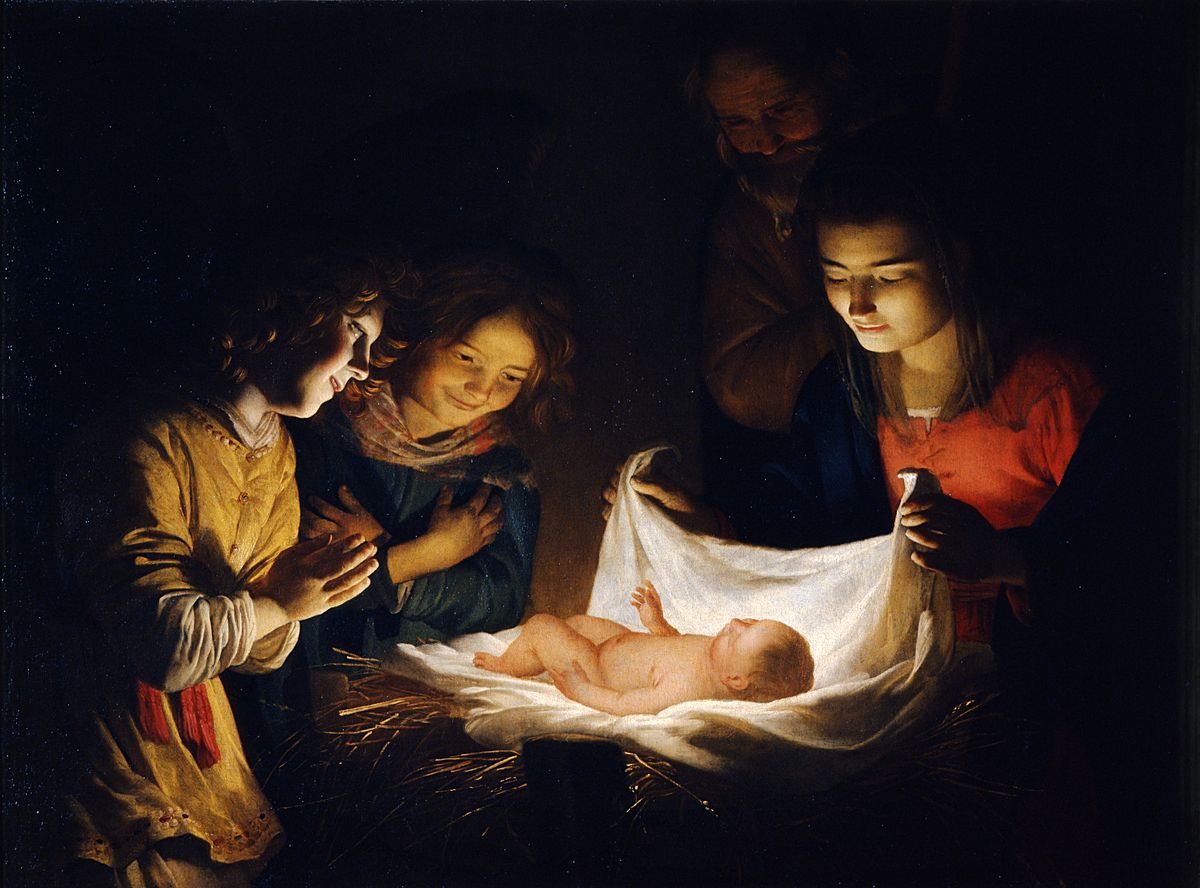

Jean-Baptiste Marie Pierre
(1714–1789) 
"In the cradle before us lies the new-born
Infant wrapped in swaddling-clothes and laid in the manger. Let us
contemplate Him for a few moments and see what lessons He teaches us.
1.
He teaches us the unspeakable force of divine charity. How was it
possible for the Eternal Word, the co-equal Son of God, to leave the
bosom of His Father to clothe Himself with the flesh of sinful man? It
seems an almost extravagant act of love, one unworthy of the dignity of
God. Yet love puts everything aside except the burning desire to promote
the welfare of the loved. The Son of God forgot all else in His divine
compassion for us. How dearly He must love us ! How great should be our
confidence in His love!
2. He teaches us never to judge by
appearances. If we had been told that God had come to dwell on earth,
would not the stable of Bethlehem have been the last place where we
should have sought Him. In how many a humble cottage there may still be
found saints more dear to God than even those who have a world wide
repute for their holiness and virtue !
3. He teaches us the true
dignity of self-abasement. God could not do anything unworthy of
Himself when clad in human flesh. It therefore was no disparagement to
the divine honor that He should thus infinitely condescend. Nay, it
proved that the greatest possible likeness to God is attained by the
most complete humiliation of self. How little I have learned to practice
this lesson ! "
Meditations for Christmas . By Rev. Richard F. Clarke S.J. The Catholic Truth Society, London 1891
The Shepherds, in receiving the Angel’s tidings, were a figure of watchful priests
by VP
Posted on Thursday December 25, 2025 at 12:00AM in Meditations

I. They Were The First To Be Called.
II. They Were The First To Be Enlightened.
III. They Were The First To Be Comforted.
"And there were in the same country, shepherds watching, and
keeping the night-watches over their flock. And behold an Angel of the
Lord stood by them, and the brightness of God shone round about them,
and they feared with a great fear: and the Angel said to them: Fear
not."—St. Luke ii. 8, 9, 10.
1. And behold an Angel of the Lord stood by them.
The shepherds who kept watch over their flocks by night, were a figure
of Priests, who, as St. Ambrose says, in the night time of this present
life sleep not, but watch in order to guard the souls committed to their
care from the assaults of their spiritual enemies; and it was fitting,
as St. Ambrose says further, "that shepherds should be found watching,
and that they should be the first to receive the Heavenly Tidings, that
He, the Good Shepherd, the Pattern of Shepherds, was born." Therefore
all Priests who teach or direct souls, should remember that they
especially are called upon to adore the new-born Child. Venerable Bede
says, "Mystically speaking, they signify the pastors of the flock,
teachers also, and rulers of faithful souls." Let us then be the first
at the manger; let us contemplate this great mystery; let us be the
first to attract the glance of the Divine Child, and let us melt into
tears of tenderness, love, and compunction. He says to us: Come, make
haste, and buy of Me without price, at the expense of only asking, the
wine of strength, and the milk of consolation: "Come, make haste, buy
wine and milk . . . without any price" (Isa. lv. 1). "Come, eat My
Flesh, and drink My Blood; this is your food, this is your drink, and
therefore am I born in Bethlehem," that is, in " the House of Bread."
"Come eat My bread, and drink the wine which I have mingled for you"
(Prov. ix. 5). Come, you who are afflicted with misery, oppressed by the
weight of your ministry. "Come to me all you that labor, and are
burdened, and I will refresh you" (St. Matt. xi. 28). Let us go, then;
"let us go over to Bethlehem," let us imitate the shepherds, who came
with haste, and let us be the first to offer tribute to the new-born
Monarch; for the princes of the people ought to go before the people in
their acts of homage.
2. And the brightness of God shone round about them.
The light which shone round about the shepherds is an image of the
divine light with which worthy ministers of God are invested; and, as
St. Gregory says, the greater their vigilance for the salvation of
souls, the greater will be the light of grace which enlightens them; and
the more solicitous they are for the welfare of their flocks, so much
the more will they merit to understand divine truths better than others.
God, who predestined us to the priesthood, Who enlightened us with His
heavenly light from our earliest years, and gave us a clearer knowledge
of His Son than He gave to the rest of the Faithful: "He hath shined in
our hearts, to give the light of the knowledge of the glory of God, in
the face of Christ Jesus" (2 Cor. iv. 6). When we studied Dogmatic
Theology, we learned the treatise, De Incarnatione, in order that the
sublime teaching of this great mystery might be impressed on our minds;
we have often instructed the ignorant in it, we have confuted
unbelievers, we have defended its truth. One step more remains for us to
take, and it is this; to nourish our minds and hearts with the Faith
and sound doctrine, by imploring the descent of the divine light into
our souls, and so shall we be "good ministers of Christ Jesus" (1 Tim.
iv. 6). Therefore let us hasten to adore the Divine Child; let us study
Him, the pattern of humility, patience, and every virtue; let us say to
Him, with St. Bernard: "The meaner Thou makest Thyself for me, the
dearer Thou art to me." Let Thy grace be made manifest in us, bestow on
us abundance of light, for Thou hast "destroyed death, and brought to
light life and incorruption by the gospel" (2 Tim. i. 10).
3. Fear not. The Angel took away all fear from
the hearts of the shepherds; much more will Jesus Christ take away all
fear from the hearts of His Priests. He says to them now from the
manger, by His infant cries, what, on another occasion, He said in
words: "It is I, fear ye not" (St. Matt. xiv. 27). I am Who am, and you
are My ministers; whom should you fear? I am come, not to give you the
spirit of fear, which was in the Old Law, but the spirit "of power, and
of love, and of sobriety" (2 Tim. i. 7). Preach My Gospel without shame,
without weariness, without diffidence: "be not ashamed of the testimony
of Our Lord . . . but labor with the gospel according to the power of
God" (2 Tim. i. 8). Three times to-day you will offer the mighty
Sacrifice which is the source of all strength, which, as Holy Church
declares, was the support of the martyrs amidst their torments; three
times to-day you will eat My Flesh and drink My Blood, so that in the
strength of that food you may walk, even to "the Mount of God" (3 Kings
xix. 8). And we will answer Him: Jesus, be Thou my strength: come to me,
come to my soul, live in me; or, with St. Ambrose, we may say, For
otherwise what would Thy coming into the world profit me 1
"Say
to my soul, I am thy Salvation."—Ps. xxxiv. 3. "The Lord is my
strength, and my praise, and He is become my salvation." —ha. xii. 2.
Vigil of the Nativity of our Lord
by VP
Posted on Wednesday December 24, 2025 at 12:00AM in Meditations
"THIS day is a preparation for one of the greatest festivals of the year, a festival of infinite mercy and goodness. On the effects of this mercy depends your eternal good: prepare then for it in the best manner you are able; join contrition with your fasting, and a most profound humiliation of spirit. Confess your manifold weakness and unworthiness: He that comes to be your physician will be pleased with the sincere acknowledgment of your infirmities.
This vigil has been kept from the time of the apostles; and in the primitive ages with such exactness, that a neglect of it was reputed criminal.
St. Augustin removed a priest from amongst his clergy, for being wanting in the observance of it, and for breaking his fast. St. Gregory of Tours gives particular instances of God's displeasure against some who had little regard to it. It cannot be questioned that there is great abuse in the disorderly conduct of those who, after assisting at the Holy Sacrifice, hasten from the altar to their entertainments, which are unbecoming at this holy time, and too often profaning it by irreverence and intemperance. Avoid all these abuses: and if necessity obliges you to take any refreshment, let it be with great moderation, without noise or conversation, that your soul may not be disturbed, but be at full liberty to entertain your Lord, and acknowledge all his mercies.
Beg of your Saviour that the mercy of this night may be extended to you, and help you so powerfully in overcoming all the corruption that is yet within you, that having in Him so plentiful a redemption, you may not be lost by any neglect of yours. Appeal to Him under all the infirmities, to which you are subject. Represent to Him all the dangers you meet in the way of salvation.
He comes to be your Saviour; beseech Him then to be a Saviour to you,
and give you all that grace, which He sees necessary for you." The Catholic Year by Fr. John Gother
"He who believes shall be saved: he who believes not shall be condemned."
by VP
Posted on Sunday December 21, 2025 at 02:00AM in Meditations

"My Lord and My God".
Our Lady of Perpetual Help, Rocky Mount NC
"Thomas, now returned to Jerusalem, was the only one who refused to believe so many witnesses. "Except I shall see in His hands the print of the nails," he said, "and put my finger into the place of the nails, and put my hand into His side. I will not believe." Therefore, the eighth days after Easter, the Apostles, and this time Thomas with them, being gathered together in the upper chamber for prayer, and the doors being closed, Jesus stood suddenly in the midst of them, and turning to Thomas, He said, "Put in thy finger hither, and see My hands, and bring hither thy hand, and put it into My side, and be not faithless, but believing." The Apostle, now convinced, fell on his knees, exclaiming, in faith and repentance, "My Lord and my God!" Then, in tones of reproof, Jesus answered him, "Because thou hast see Me, Thomas, thou hast believed: blessed are they that have not seen, and have believed."
This, then, is the last link in the chain of evidence which attests the resurrection of our Lord, and it was, as St. Gregory remarks, for the confirmation of our faith that God permitted such marvelous unbelief. Could those who might refuse to believe the Apostles possibly refuse to accept the testimony of St. Thomas? Therefore Jesus Christ, the Son of God made man, died upon the cross to expiate our sins and truly rose from the dead by His own power; therefore the Christian faith is divine and absolutely certain: therefore the Catholic Church, which brings to us this faith, is the mother of our souls and harbor of salvation.
Let us have more faith than Thomas, let us believe without seeing, the truth affirmed by the Gospel, by the holy Apostles and martyrs; let us believe, love, and adore our risen Lord.
"He who believes shall be saved: he who believes not shall be condemned."
Source: The Light of the Cross in the Twentieth Century, by the Paulist Father Volume 3, 1905
The Golden Rose
by VP
Posted on Sunday December 14, 2025 at 12:00AM in Meditations

"The lights of hope and joy, the shadows of despondency and sorrow are ever flitting over the surface of human life, teaching the heart the solemn lesson of detachment from earth and giving it glimpses of heaven, that city of perpetual brightness whose "light is the Lamb," the uncreated splendor of the Father. We need this succession of light and shade; continual prosperity would make us love the world, and we would forget that the days of our pilgrimage are few and evil, whilst lasting adversity would deaden the elasticity of the heart and drive it to despair. The Church knows the requirements of our nature in this respect and provides for them. The penitential seasons of Advent and Lent are succeeded by the joys of Christmas and the glories of Easter. The sorrows of Holy Week are interrupted by the Gloria of Holy Thursday, and then again the last notes of the Angelic Hymn die away in the wail of the Miserere of Tenebrae and the Improperia of Good Friday.
Advent has its Gaudete Sunday,
when the Church bids her children rejoice in the Lord always, because
He is near, because He is soon to be manifested to the world as the Babe
of Bethlehem; so too on the fourth Sunday of Lent a cry of joy resounds
through the office, Rejoice O! Jerusalem! Rejoice thou barren that
bearest not. The time for the reconciliation of the penitents is
approaching; the children that were dead in sin will come to life and be
restored to the arms of their mother, and in anticipation her heart
beats high with gladness. Then her eye turns to Palestine, ranges the
dark sky that overhangs the scenes of the Passion and rests on the
horizon just reddening with the first faint streaks of light from the
Easter Sun. Sorrow and penance yield for a moment to the exultation of
triumphant love and from her lisp breaks forth an anthem of gladness
Laetare, Laetare, Rejoice, Rejoice."
The Sacramentals of the Holy Catholic Church; Or, Flowers from the Garden of the Liturgy By Rev. William James BARRY, 1858

